Page 76 of 92

Nora Ephron On Parenting: Quotes About Motherhood And Raising Kids

Nora Ephron

Along with legions of fans and friends and family, Nora Ephron leaves behind her two sons: Jacob and Max. In her 2006 essay collection “I Feel Bad About My Neck,” she wrote about the experience of being their mother. The piece was called “Parenting in Three Stages.” Like everything Nora wrote, it was personal, but it was a statement that resonated with all of us. She recounted what it was like to raise children from babies to adulthood, but she also pointed out that the notion of “parenting” as a thing was entirely new. She said:

“Suddenly, one day, there was this thing called parenting. Parenting was serious. Parenting was fierce. Parenting was solemn. Parenting was a participle, like going and doing and crusading and worrying; it was active, it was energetic, it was unrelenting. Parenting meant playing Mozart CDs while you were pregnant, doing without the epidural, and breast-feeding your child until it was old enough to unbutton your blouse.”

If we could republish the whole of the essay here we would, but we can’t and you should go read it. Instead, in honor of a mother who did it all and more, here are several of our favorite quotes, both from that particular piece and from other wise things Nora has said about this thing we all do every day – whether you like calling it “parenting” or not.

If pregnancy were a book, they would cut the last two chapters. The beginning is glorious, especially if you’re lucky enough not to have morning sickness and if, like me, you’ve had small breasts all your life. Suddenly they begin to grow, and you’ve got them, you’ve really got them, breasts, darling breasts, and when you walk down the street they bounce, truly they do, they bounce bounce bounce.

– Nora Ephron, “Heartburn”

We’d say we were so lucky we have this wonderful relationship. … We can fly off to Rome on a moment’s notice. And then one day I was taking Alice’s little girl for the afternoon … and we were in the cab playing “I Spy” … and she looked out the window and she saw this man and this woman with these two little kids. And the man had one of the little kids on his shoulders, and she said, “I spy a family.” And I started to cry … And I went home, and I said, “The thing is, Joe, we never do fly off to Rome on a moment’s notice.”

– Sally Albright, “When Harry Met Sally…”

We have lived through the era when happiness was a warm puppy, and the era when happiness was a dry martini, and now we have come to the era when happiness is “knowing what your uterus looks like.”
– Nora Ephron, “Crazy Salad”
Parenting was not simply about raising a child, it was about transforming a child, force-feeding it like a foie gras goose, altering, modifying, modulating, manipulating, smoothing out, improving.
– Nora Ephron, “I Feel Bad About My Neck”


Think Ahead and Avoid a Meltdown

Clearly, that wasn’t what he wanted to hear. The mother muttered fiercely, “Get up off the floor!” When that didn’t produce a positive response, she turned to coaxing: “Please be a good little boy for Mommy.”

Next came the bribery attempt: “If you mind now, I’ll buy you that video you’ve been wanting.”

Out of desperation came the threats: “Get up now or you can forget about TV and treats for the rest of the week! I’m counting to three, and you’d better be up before that!”

The little boy holle-red, and the mother seemed to stall as if predicting an even more embarrassing tantrum to come. A pregnant silence blanketed the aisle, and then the mother gave in and handed the boy a candy bar.

Parents often find it difficult to follow through and implement disciplinary techniques.

Typically, parents cave in on rules and don’t follow through with consequences. Unfortunately, children quickly learn that acting out can often earn them what they want. That’s not the only problem that arises when parents are too permissive. Failure to follow through with consequences robs children of the opportunity to develop resiliency and the self-confidence to solve problems and handle disappointment.

So what’s a parent to do?

Start with recognizing attention-seeking behavior. We identify those actions by making ourselves aware that when we feel annoyed, our child is displaying attention-seeking behavior.

Children crave attention, so making a big deal out of minor misbehavior will only reinforce that it’s an effective way to get your attention. If parents ignore such behavior, the children soon realize this isn’t going to get the attention they seek, and the behavior will fade away in time.

Begin thinking ahead about your child’s needs by maintaining a child-friendly environment. If you plan to do the weekly shopping — something that is ground zero for misbehavior — prepare some activities that will occupy your child during this outing. Small children can identify the fruits in the produce section by describing the color, shape and size of each object. Older children can help locate items on the shopping list.

Some quality time spent organizing some distractions can turn a high-tension task into a bearable outing for an antsy child — and, in turn, prevent the need for discipline on the parent’s part.

Utilizing choices with children offers them some control over small decisions and will help even a younger child feel that his desires are being taken into account. For example: “Do you want bananas or apples?” “Would you like to check out two books or three?” This approach validates the child’s feelings and will often prevent his need to whine or act out to be heard. Choices are also invaluable in teaching children about making good decisions.

If your 6-year-old insists on wearing a sweatshirt in 98-degree weather, he’ll probably make a different decision next time, and the parents will have the burden of enforcing discipline taken off their shoulders.

Children under the age of 4 are easy to distract when you take their focus off the heated subject at hand. For instance, your toddler refuses to get into the stroller. As a parent you can argue the issue, but how about belting out a few lyrics to “Itsy Bitsy Spider” instead?

Your preschool-aged twins are fighting over a toy. You could just take the toy away from them, but what about giving them some Play-Doh instead? It may seem simple, but for young children, distracting them is better than scolding anytime.

Parents can take control of their children’s environment by setting some rules to ensure that before misbehavior happens and discipline is needed, they have some well-thought-out guidelines to follow.

Step One: Be realistic.

 Parents must first recognize what their child is developmentally capable of understanding before expectations can be established.  For instance, 3-year-olds lack the maturity and the social experience to share well with other children. As a parent, if you insist on sharing regularly, your child will likely rebel, and you will find yourself fighting for cooperation.

Step Two: Know yourself.

 Know your limits. Only set rules that you’re willing to be inflexible on, like no hitting. As parents, we may dream of a world where our children pick up after themselves every day — but if you know you’ll give in when they push back, scrap picking up after themselves as mandatory or amend the rule in such a way that you can manage it. For instance, you might say that picking up after themselves must happen, but you’ll help as needed.

Step Three: Make it official

  Establish a regular family meeting that includes all family members. Use it as an opportunity to establish house rules that everyone can agree upon. Allow everyone — including children — to participate in the procedure.  By allowing children to offer up ideas and help with designing the list and selecting the place to post it, parents are validating their children’s place in the family.

Children who take part in this process are more likely to follow the agreed-upon rules. If they break a rule, parents can direct them back to the agreement they helped create.  

There is no manual to refer to when our children are born. We simply must rely on what we were taught, but we also must be willing to learn as we go. If we, the parents, flounder when our children have a major meltdown, the behavior will continue; but if we plan ahead, we put the odds for good behavior in our favor by being prepared and keeping the environment child-friendly.

Debbie A. Heaton is an author, parent educator, and a master’s level therapist currently employed with The Parent Connection, a member of Arizona’s Children Association Family of Agencies. The Parent Connection utilizes the Adlerian approach to parenting.

Fathers Can Teach Their Children Persistence: Study

FRIDAY, June 15 (HealthDay News) – Children learn persistence from their fathers, according to a new study, and this skill can lead to better performance at school and a reduced risk of criminal behavior.

The study included adolescents aged 11 to 14 in 325 two-parent families; they were followed for several years by researchers from Brigham Young University in Provo, Utah.

About 52 percent of the fathers in the study exhibited above-average levels of authoritative parenting. The children of these fathers were significantly more likely to develop persistence, which led to better outcomes at school and lower levels of delinquency.

The findings were published June 15 in the Journal of Early Adolescence.

“There are relatively few studies that highlight the unique role of fathers,” study co-author Laura Padilla-Walker, a professor in BYU’s School of Family Life, said in a university news release. “This research also helps to establish that traits such as persistence – which can be taught – are key to a child’s life success.”

The researchers emphasized that authoritative parenting is different from authoritarian parenting and has three basic features: children feel warmth and love from their father; children are granted an appropriate level of autonomy; and fathers emphasize accountability and the reasons behind rules.

Although this study included two-parent families, the researchers suggested that single parents may still be able to help teach their children about persistence.

“Fathers should continue to be involved in their children’s lives and engage in high-quality interactions, even if the quantity of those interactions might be lower than is desirable,” Padilla-Walker said.

Fathers Have More Fun

Are parents happier than their childless peers?

For the last five years or so, I’ve answered that question with a resounding “no.” Statistics (not to mention anecdotal evidence) led me to believe that parents tend to be more stressed and less happy.

In some ways, this seems understandable, even obvious. Folks without kids can go to yoga or hang out with friends without having to find a babysitter (or negotiate with a spouse). Childless people don’t panic over stranding their kids at school when a meeting runs late, or lay awake at night worrying about how to keep the kids’ health insurance, or feel overwhelmed by mountains of laundry and plastic toys and permission slips.

But now three new studies throw a wrench in the previous research. The studies, to be published in the journal Psychological Science, find that parents report higher levels of happiness and positive emotion and have more “thoughts about meaning in life.”

Some parents, that is.

Young parents and single parents don’t fare as well: Unmarried parents are unhappier than people without kids, as are parents under 26 years old. (Parents over age 63 don’t differ from their childless peers.)

Then there’s the gender gap. While it’s true that parents on average report greater happiness and satisfaction with their lives than their childless peers, this is actually because fathers are driving the averages up. Mothers don’t show a big uptick in happiness by having kids. It’s really the dads that are happier.

Parenthood, it turns out, is only associated with greater life satisfaction and happiness among fathers.

As a feminist mother, I’d be lying if I said I didn’t feel a tad resentful about this.

Anyone who has looked at the statistics on household division of labor knows that moms typically bear the brunt of the unfun housework that comes with child-rearing, not to mention the logistical backflips of the highly-scheduled childhood.

I’m not saying that men don’t do housework, because they do. And, on average, they are doing more than they have in past generations. But every day, mothers are doing housework and caring for family members for nearly four hours, compared to dads’ three hours.

What’s more, housework in the U.S. is still very gendered: Women do more laundry and dishes and cleaning; men do more yardwork. I know I find gardening on the weekends more fun than battling the dishes in my sink morning, noon and night. So perhaps that extra hour of work, and the different type of work, makes moms less happy than dads.

But my resentment will buy me nothing in the happiness department. Focusing on happiness as a zero-sum game gets us nowhere in our fight for equality.

Here’s why. First, we all presumably have the same goals; namely, to raise happy and healthy kids, and to find happiness ourselves. And a happy father is, generally speaking, a good father. We know that positive emotions make us better parents – when we are feeling good, we are more likely to be better listeners, warmer caregivers and to be more consistent in our discipline.

Second, it is better for our own well-being and the well-being of our children if we are cultivating (and modeling) what Buddhists call mudita rather than cultivating and modeling resentment. Meditation teacher Sharon Salzberg describes mudita as “vicarious joy,” or “the pleasure that comes from delighting in other people’s well-being rather than begrudging it.” Experiencing another person’s happiness vicariously really can bring us great happiness; happiness is very contagious. In fact, happiness generally spreads three degrees, affecting not just our friends, but our friend’s friend’s friend’s.

For example, my own dad is about the happiest father imaginable. He takes my daughters to the dentist, volunteers at their swim meets and takes them out for ice cream once a week. The pride, pleasure and great meaning that he gets from his fathering activities is obvious, contagious and moving. When I watch him with my children, I feel a deep contentment that is hard to come by in other ways.

I’m not suggesting that structural and cultural changes aren’t in order to correct the happiness gender gap among parents, or that it is okay if dads’ happiness comes at the expense of moms’. I am suggesting that this Father’s Day, we should celebrate the fact that fathers tend to be happier than their childless peers, as this bodes well for everyone, not the least of whom are mothers and children.

Maybe your happiness on Father’s Day will come from a moment of reflection, as a dad, about the ways parenting is satisfying. Or, maybe your happiness on Sunday will come vicariously, through the fathers in your life. Either way, Happy Father’s Day.

Fathers: What is it about being a dad brings you the most happiness and life satisfaction?
Mothers and others: How do you derive vicarious joy from watching the happy dads in your life?

© 2012 Christine Carter, Ph.D.

Become a fan of Raising Happiness on Facebook.
Follow Christine Carter on Twitter
Sign up for the Raising Happiness monthly newsletter.

–>


Follow Christine Carter, PhD on Twitter:

www.twitter.com/raisinghappines

Father’s Day Quotes: Best Sayings About Fatherhood

Father’s Day is coming up quickly, but you still have time to craft a perfect card for the dads in your life to cherish (er, stash in a drawer somewhere…) forever. If words aren’t your strong suit, never fear: here are some of the best quotes about fatherhood that are sure to make even the most stoic of fathers crack a smile or shed a tear. Print them, pin them, frame them, or stash notes around the house – whatever you choose, just make sure to let dad know how much you care.

Loading Slideshow...
  • “Having a staring contest with a newborn is one of the weirdest things you will ever do. And it is highly recommended.” -Ross McCammon

  • “Above all, children need our unconditional love, whether they succeed or make mistakes; when life is easy and when life is tough.” -President Obama

  • “Blessed indeed is the man who hears many gentle voices call him father!” -Lydia M. Child

  • “You fathers will understand. You have a little girl. She looks up to you. You’re her oracle. You’re her hero.” -Stanley T. Banks, Father of the Bride

  • “Do I want to be a hero to my son? No. I would like to be a very real human being. That’s hard enough.” -Robert Downey Jr.

  • “A new father quickly learns that his child invariably comes to the bathroom at precisely the times when he’s in there, as if he needed company.” – Bill Cosby

  • “I thought I would be more inspired to have all these new feelings to talk about, but I really just want to hang out with my daughter.” Jay-Z

  • “The reward of child rearing is spending the rest of your life proudly knowing this person you helped guide. Let him be himself.” -Mike Sager

  • “I want my son to wear a helmet 24 hours a day.” -Will Arnett

  • “This is my most important role. If I fail at this, I fail at everything.” -Mark Wahlberg

  • “It is admirable for a man to take his son fishing, but there is a special place in heaven for the father who takes his daughter shopping.”-John Sinor

  • “It is much easier to become a father than to be one.” -Kent Nerburn, Letters to My Son: Reflections on Becoming a Man

  • “Lately all my friends are worried that they’re turning into their fathers. I’m worried that I’m not.” -Dan Zevin

  • “By the time a man realizes that maybe his father was right, he usually has a son who thinks he’s wrong.” -Charles Wadsworth

  • “Few sons are like their fathers – many are worse, few better.” -Homer, The Odyssey

  • “It was times like these when I thought my father, who hated guns and had never been to any wars, was the bravest man who ever lived. ”-Harper Lee, To Kill a Mockingbird

  • “Father! – To God himself we cannot give a holier name.” -William Wordsworth


Father’s Day Quotes


1 of 18


The Secret Meaning of Loving Feelings

The Secret Meaning of Loving Feelings

June 3, 2012 by Mark Brady

Decades ago the Righteous Brothers pined forlornly about the sorry state of affairs that come calling when you’ve lost that lovin’ feeling, especially after you’ve had a love, a love you don’t find every day. What the Righteous Brothers never really offered listeners though, is a hypothesis about where that lovin’ feeling actually went … and how we might investigate ways to bring it back. Me and my brain are here at this late date to offer one possible explanation … and a plan of action.

Essentially, every time I’ve lost that lovin’ feeling it became buried under one or more of the Dirty Dozen Defense Mechanisms. Those mechanisms invariably fired up limbic structures in my brain, structures like the amygdala, hippocampus and hypothalamus. Once triggered, the parts that make up the HPA axis (Hypothalamic-Pituitary-Adrenal Axis) began secreting stress hormones into my blood stream. Those hormones produce the exact opposite feelings that oxytocin and endorphins produce, leaving me sad and forlorn and singing along with Don and Phil, the Everly Brothers … Bye-Bye Love.

Feeling love means I’m running soft, safe, undefended, expansive energy, as opposed to loss or fear, which most often show up as hard, constrictive, defensive, protective energy attempting to safeguard my body and brain. One of the reasons I can so often unconditionally love babies and pets is that they rarely trigger defensive reactions in me. On the other hand, one big life challenge is to be able to continue running, soft, safe, undefended expansive energy in the face of someone I’ve become disenchanted with, or around someone who has become disenchanted with me. But I can tell you from personal experience, that while it’s not necessarily easy, it’s not impossible.

Given this state of affairs, it’s useful for me to think of emotional reactions as early warning signals surfacing from down below the neck and also from the depths of the right brain primarily (in actuality, thoughts and feelings are probably widely distributed across many neurophysiological nodal points). Emotions are early warning signals because almost all of the (only) 40 conscious pieces of the 11 million data bits we take in at any moment are often apprehended by the Bully Interpreter brain. And the Interpreter is constantly distorting things conservatively, i.e. negatively and apprehensively.

Why I Write Listening Books

David Augsburger, a professor of pastoral care at Fuller Theological Seminary and the author of Caring Enough to Confront, has noticed that “being listened to is so close to being loved, that most people don’t know the difference.” It’s also a great way to combat my Bully Interpreter’s distortions. Turns out I’ve never lost that loving feeling in response to someone earnestly and undistractedly attempting to hear and deeply understand me. So, I think David’s right. One partial reason is that being listened to helps us discharge the increased levels of neurotoxic glucocorticoids that Big Emotion often generates in the wake of a grand HPA axis activation. We begin to feel less fear. Which means we generate fewer stress response neurotoxins. Which means our brains are freed up to process more energy and information as a result of make increasing connections (even with our heart, perhaps).

But also, deep listening, much like love, is radically seditious. It goes toe to toe with our culture of distraction

. It promotes the cultivation of radicalness and rebellion, fearlessness and defenselessness. Both listening and love live to go beyond themselves. Not only does our safety lie in fearless defenselessness, but therein also lies a pathway back to Rumi’s field out beyond rightdoing and wrongdoing. It’s in that field that we can each begin to breathe out and tell tender truths that permit Defense Mechanisms to dissolve. When we are able to do this successfully, we come back face to face with Rumi’s other great awareness: love is the default condition, the primary, subtle, driving creative energy of the universe. It’s the energy that grows flowers and trees and baby’s brains and children’s hearts.

Learning to listen skillfully is however, a VERY difficult practice. There’s rarely a day that goes by that I don’t find Bully Interpreter trying to convince me and others about the rightness and righteousness of what it believes. And not only is it adamant in its beliefs, it’s often inflexible in its ability to consider alternative possibilities. Not a great way to invoke and sustain loving feelings, unfortunately.  

The Benefits of Reclaiming Love

Using listening skills as a contemplative spiritual practice invariably seems to work to soften mental and physical structures inside me. Tensions I’m holding in body, mind and brain begin to ease, allowing the Bully Interpreter to relax. With such release I often find myself opening to the possibility of increasingly creative responses. As Neil Gaiman offers in this inspiring commencement address given recently to the graduating class at The University of the Arts in Philadelphia, listening practice begins to foment not only a deep desire to “make good art,” but a conviction that I really can. And in my experience much of the good art in the world springs from … love. People who love who they are and what they do rarely lose that lovin’ feeling.

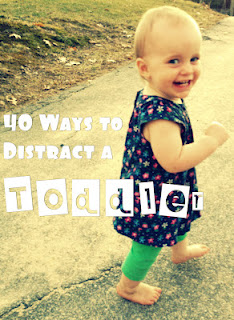
40 Ways to Distract a Toddler

1. Rice/bean bins. All you need is a bin, some rice or beans, and some scoops or cups. (I use an under-the-bed storage tub because I actually store mine under a bed, and because that way it’s long enough for multiple children to use at once.) These require close supervision for really young children, so I set mine up right next to the table I’m working at so the young kids are always in sight. And may I mention that I strongly prefer beans to rice? You see, beans vacuum and sweep up easily while rice just gets blown every which way.

2. Water bins/tables. These require a nice day and a deck…smile… but are great. Again, fill up a tub with water and provide scoops, bowls, and a few fun trinkets (some that float and some that sink) and let kids play ‘til their heart’s content. Add a few drops of food coloring for extra fun! Accept before you begin that each child who plays will require a full wardrobe change. I actually use this one a lot while I’m making dinner- the kids are going into the bath at that point anyway, right? Please use your best judgement when allowing young children to engage in water play and ensure close supervision at all times.

3. Paint with water books. Yes, they still exist and yes, they are still a great way to get some exploration going with less than half the mess of the full-fledged version.

4. Puzzles. Use the manufactured variety or try making your own by cutting up pictures your child (or a sibling) has drawn.

5. Special Play Boxes. The idea is that you only take these special boxes of toys out when you are homeschooling another child. These are special treats. Change them up every few weeks or so depending upon your younger child’s interests. Here, my youngest daughter is playing with matchbox cars as I work with her brother.

6. Stickers. On paper, on clothes, on favorite chairs…

7. Number Wheels. Print a color wheel and ask kids to place the corresponding clothes pin on the wheel. For details, check out Money Saving Mom’s post here. If your child isn’t ready for numbers yet, try putting colors onto the wheel and colored dots on the clothes pins for kids to match. If your child is really young, try just giving them clothes pins with a variety of things/materials to attach them to.

8. Legos and blocks. These are great all by themselves, but can also be used in conjunction with props like dolls, cars, shoeboxes and paper towel rolls. What can kids make with them?

9. Tweezers and pom poms. Provide some multi-colored craft pom poms and ask kids to sort by size or color. If the child is still very young, take away the tweezers and give them a yogurt container with a small hole cut in the top to stuff pom poms through. When they are done, open the container and start again.

10. Toddler sewing basket. For instructions on how to assemble one of these babies, go here, to Childhood 101.

11. Pipe cleaners in containers. This is a variation of the pom pom suggestion: cut several small holes in a yogurt or coffee container and ask the child to stick pipe cleaners into them. For added challenge, color hole-reinforcers (like you use in three-hole-punched documents) and ask the child to match the pipe cleaner color to the hole reinforcer color.

12. Magazine scavenger hunts. Really young kids can just rip up the pages, but slightly older toddlers can search through pages to find items you ask for, like pictures of smiles, flowers, a Mommy, etc.

13. Alphabet or picture tracing sheets. This is as easy as laminating an alphabet practice sheet and providing dry erase markers. All done? Wipe and start again.

14. Egg cartons filled with plastic colored eggs. Fill these eggs with little trinkets that will make noise in the eggs. This is enough for young kids. For slightly older kids you can ask them what they hear in the eggs, then have them open the eggs on their own to see if they were correct. (Be careful of very small items for very young children.)

15. Play-Doh filled balloons. You never know what a child is going to create with these, but the sensory experience is the major boon. For details, go here.

16. Pool Noodle Stringing. Cut up pool noodles and provide yarn for little kids to string together.

17. Magnetic Magazine Face-Making. Cut out eyes, ears, mouths, noses, etc. from magazines, laminate, and adhere to magnets. Then, provide your toddler with a magnetic surface to rearrange faces. For details from The Iowa Farmer’s Wife, go here.

18. Lacing boards. These can be made with leftover cereal boxes, or can be purchased. You punch several holes along the outline of a shape, and ask your toddler to weave shoestring in and out of the holes. Don’t expect perfection unless you are giving instructions- just let them do it on their own.

19. Felt Face-Making. Same idea as above, but you use felt to create facial features and let little hands assemble the faces as they will. This idea can be adjusted to fit any theme you’re working on in your homeschool with just a little forethought. Cupcakes, ice cream cones, firetrucks, fish… the list goes on and on. Just create one large, major shape and provide lots of smaller shapes to adorn the large one.

20. Soda bottle filled with glitter, oil, and water. Grab a two-liter and fill it with these ingredients for fun. Roll them, shake them and put them into containers. Remember to glue the cap on before you give this to your child!

21. Button Snake. Tie or sew a button onto a piece of ribbon and provide felt scraps to thread onto the “snake.” For details, go here.

22. Clothesline Play. String up a pretend clothesline and provide a few socks, some felt clothes cut-outs, a few scarves, etc. plus a few clothespins and let younger kids have fun hanging up the wash.

23. Bathtub painting. Let a squirmy toddler paint in the bathtub with tempra or other washable paint. Just strip them down and let them go to town, then use the shower head to rinse it all (including what’s on their bodies) down the drain. Use your best judgement when it comes to supervising your child in the water (which you will need to use when you’re cleaning up the masterpiece).

Image from No One Has More Fun Than The Adams’

24. Ziplock bag painting. Fill a bag with paint and tape it up to a glass surface. For details, go here.

25. Giving babydolls a bath. This isn’t so gender-specific as you may think. You might be surprised at how many boys enjoy a small tub of water, plastic baby doll, towels and soap. This is another activity which may require a full wardrobe change, but is well-worth the effort.

26. Stamping. Ink pad, paper and a variety of stamps. Check out my tutorial on how to make foam stickers into stamps here.

27. Color scavenger hunt. Give your child a paper bag with a color scribbled on the front, or a colored bag, and ask them to run around the house until they find items of that color to put in the bag. You should also *ahem* set some limits as to what can, and cannot, go in the bag.

(Image from Home Learning From Birth)

28. Bottles and cap matching. Take a bunch of used bottles (washed, of course) and let children match the caps to the bottles. Added bonus? This is a self-correcting activity, so when they get to the end and all the caps don’t match, they know they’ve made a mistake and can go back to find it. Want details? Click here.

29. Rubberband/shoebox guitars. These are fun to play, and fun to make. Just a couple of shoeboxes with rubber bands around them create music (but not too loud) and lots of opportunity for exploration.

30. Give them “work.” Give your younger child the same worksheet you give your older child and see what they do with it! The more authentic and identical the worksheet, the better.

31. Pudding/Yogurt fingerpainting. This is another activity which necessitates prompt bathing (boy, I have a lot of those), but gives you peace of mind while you work with another student that your child won’t be ingesting paint. Tools like spoons and paintbrushes only add to the fun.

32. Cutting practice. While themed printables are fun, you don’t need anything that fancy. Just draw some wiggly lines across a page and ask your older toddler to cut the marks you’ve made.

33. PlayDoh prints. My kids will play with Play Doh for hours anyway, but they’re especially intrigued by anything that makes a print in the soft dough (think Legos, sporks, beaded necklaces, cookie cutters and little truck wheels).

34. Sorting. Colored pasta, old keys, nuts and bolts. You name it, kids can sort it.

35. Balloons. They don’t even need helium- just blow them up and provide a pool noodle for hitting, or tie bunches of them up with a bunch of ribbon and let your kids try to keep them in the air. Try giving kids a straw and having them blow their balloons around the room.

(Please note: use your best judgement when using balloons around young children as popped balloons pose a serious choking hazard.)

36. Water transfer. This can be done with pipettes and small bowls of water, or with small pitchers. The key here is small amounts of water. Colored water is extra exciting.

37. Chalk. It’s versatile- if you have a chalkboard that’s great, but chalk can be used on black construction paper, on driveways and sidewalks if you’re outside, on rocks, on felt…

38. Masking tape obstacle course. You can tailor this to meet your child’s needs- put down a straight line and ask your child to walk/hop/skip along it. Create squares they must use to jump between, even adhere tape to the walls in a hallway and tell your child to try to go below the lines you’ve put up.

39. Pattern Blocks. The idea is to use a set of blocks and ask your child to create the same patterns with the blocks that appear on a form. This can be done by tracing blocks you already have, or by purchasing a set like this one.

40. Give up. Really. When all else fails: skip school for the time being and give your babies the attention they need. I’ve seldom regretted calling it quits on a tough school day to give us all a chance to regroup, but I have often regretted not doing so. Realize that you aren’t a superhuman and there is nothing so important that should make you ignore a young child who wants and needs you.

Some teens aren’t liking Facebook as much as older users

Is Facebook losing its likability among teens?

Teens who belong to the first truly mobile generation — their most common form of communication is text messaging — are increasingly gravitating to services made for their smartphones and tablets like mobile social network Path. Photo-sharing apps are also very popular, especially Instagram. Above, Mary Lee, 13, of suburban Cleveland says she spends more time on the computer now than in the past.
(Tony Dejak, Associated Press / July 14, 2008)

Ron Huxley Reacts: The main reason I got on FB was to keep up with what my children are doing? Answer this question: What social network is your child hanging out online? Should mom and dad’s follow them to find out what they are posting? Where do you, the parent, like to hand out socially?