Page 45 of 92

Stepparenting can be tough. Stepparents frequently report feeling confused about their role, displaced from their spouse when the stepchild is around, helpless to change the situation, and guilty because they know that God is expecting them to love their stepchildren, even though they sometimes don’t.
Finding an effective stepparent role is a challenge—you must persevere to find success. Here are some practical tips for the journey.
Relationship Building Tips for Stepparents
Play! Having fun is a great way to connect.
Track with them. Know what activities a child is engaged in and enter that world. Take them to practice, ask about an activity, and take interest in their interests.
Share your talents, skills, and hobbies.
Communicate your commitment. Let the child know you value and want a relationship with them.Share the Lord and your walk. Shared spirituality can facilitate connection and a sense of family identity, but don’t be preachy. Instead share with humility your faith journey so they will experience you as a safe person.
The cardinal rule for stepparent-stepchild relationships is this: Let the children set the pace for their relationship with you. For example, if your stepchildren are open to physical affection from you, don’t leave them disappointed. If they remain aloof and cautious, respect their boundaries. As time brings you together, slowly increase your personal involvement and affections.
It’s important that stepparents not consider themselves failures if they do not form deep emotional bonds with every child.
The length of time required to move into this role depends on multiple factors, most of which are beyond the stepparent’s control. Enjoy the relationship you have now and trust that investments made over time will increase affection and respect.
Do’s and Don’s for Stepparents
Early on biological parents must pass power to stepparents so that children understand that stepparents are not acting on their own authority
Parents and stepparents negotiate rulestogether behind closed doors and seek unity in leading the family. The biological parent then communicates the rules to the children with the stepparent’s support.
Stepfamilies, where both parents bring children to the stepfamily, still negotiate rules together, but each takes the lead role with their own children.
Over time as emotional bonds with stepchildren deepen, stepparents can become more authoritative and shows of affection can become more common.
Don’t be harsh or punish in a way inconsistent with the biological parent. This tends to polarize parents and create marital discord.
Do focus on relationship building with each child. This is your long-term strength as a parent-figure.
Source: Youversion.com
Anger Tools for Families
Anger Tools for Families
by Ron Huxley
Anger is one of the most commonly reported problems in families today. It surfaces in a variety of forms, including domestic violence, child abuse, marital conflicts, sibling rivalry, and generational tensions. Why do we direct our anger at people we know and love? Part of the answer is hidden in the dynamics of the family itself. Other answers come from the hectic pace of contemporary family life and our own thinking.
A family is a complex emotional system where every member affects other members. Unless a person takes drastic measures to emotionally cut themselves off from the family or physically moves away; they cannot escape the power of the family over their behavior. It is this complexity and the fact that so much of family dynamics are outside of member’s conscious awareness, that makes change difficult. Consequently, members feel helpless to change anger in the family.
Anger takes place in the family in three ways: It is inherent in family temperament; it carries over from other stressful systems (such as work); it serves a specific function in the family.
Temper, Temper! A temperament is defined “as a persons customary manner of emotional response (Roget’s II, The New Thesaurus).” Everyone knows someone they would describe as having a “temper.” One member or more of the family can be moody, intense, reactive, and dislike change. These people could be said to have a feisty or difficult temperament. They have inherited a biology that reacts in a different manner to stressful life events. Temperament is not something that family members can completely change, but it is something that can be modified or adapted to.
Parents who understand this realize that they have not failed their children. They simply have a child with a different temperament. It also answers the question, for many parents, why they seem to have more discomfort relating to one child over another. The more dissimilar the temperament, between parent and child, the more difficult it is to understand and interact together. On the other hand, family members with similar temperaments may “rub” each other the wrong way. Two members with “tempers” will engage in more frequent arguments and power-struggles than would two members with flexible temperaments.
Displaced Anger. Another way that anger affects families is through displacement of anger from one system (i.e., work) to another system (i.e., home). Parents who had a rough day at work don’t automatically shed their frustrations on the way home. They can bring it home and react to other family members in a hostile and abusive manner. One answer why family members direct their anger at people they know and love is that it is safer to vent with people they know will not abandon them. The boss may fire someone for venting at them or another employee. A teacher may give a student a bad report for acting out at school. But family members usually stick by you, even if you get angry. Unfortunately, chronic venting at loved one’s will result in negative consequences. It breaks down members’ ability to feel safe and trust one another.
Anger is Power. Anger has specific social functions that signal us when there is a need that is unfulfilled or a problem that needs solving. The earliest example of this, in families, is seen in the newborn. When the baby is hungry, hurt, or wet, it cries. If responses to its needs are not immediate, it can become angry. The baby will shake and scream until that need is met.
Anger can be used to control other family members. The most common example of this is a small child throwing a “temper” tantrum. The purpose of the tantrum is to get mom or dad to comply with their wants. Older children and adults also throw tantrums. They use it to get children to comply or spouses to listen or siblings to leave them alone. While anger may be one way to gain control, in the short-term, it always back-fires, destroying relationships, in the long-term.
Anger Toolbox. Families do not have to continue to be victims of their own or other’s anger. They can use some simple tools to manage anger:
The first tool to managing anger is to take personal responsibility for it. Even if a member’s anger is due to temperament or an overbearing boss, take responsibility for your reaction and what you do with that anger. The destructive root of family anger is blame. The blame game only has losers, no winners.
The second tool is to find safe and healthy ways to vent your anger. Give yourself more time to get home so that you are not so upset from the day at work or school. Or ask family members for a few moments alone when you do get home so that you can detox yourself for the day’s stress. Find alternative outlets for the pressure that builds up through the day. Exercise, sports, and physical activities are good choices. Additionally, meditation, relaxation training, and healthy diets will ensure a much more powerful buffer to stress.
Thirdly, be aware of how you talk to yourself. If you find yourself reacting to a situation differently than other family members, you may be causing your own problems. What we say to ourselves about situations and other family members influences our emotions. Get help from a qualified therapist to work on changing how you view difficult problems in your life.
And lastly, increase your social support network. The more people you have to turn to in a time of crisis, the more resourceful you will feel. Some of these people may not be your family members. That’s all right. They are safe places to deal with anger so that time at home, with other members, is spent enjoying one another.
References:
Ellis, Albert Anger: How to Live With and Without it. New York: Carol Publishing Group. 1992.
Huxley, Ronald Love & Limits: Achieving a Balance in Parenting. San Diego: Singular Publishing Group, Inc. 1998.
McKay, M., Rogers, P.D. & McKay, J. When Anger Hurts: Quieting the Storm Within. Oakland: New Harbinger. 1989.
Robins, Shani & Navaco, Raymond W. “Systems Conceptualization and Treatment of Anger.” Journal of Clinical Psychology. (1999). Vol. 55, No. 3, p. 325.

The 5 Freedoms For Happier Relationships
By Virginia Satir
1. TO SEE AND HEAR
What is here,
Instead of what should be,
Was, or will be.
2. TO SAY
What one feels and thinks
Instead of what one should.
3. TO FEEL
What one feels,
Instead of what one ought.
4. TO ASK
For what one wants,
Instead of always waiting
For permission.
5. TO TAKE RISKS
In one’s own behalf,
Instead of choosing to be
Only “secure”
And not rocking the boat.
How often are each of these five freedoms present in your life?
1Never 2 Present 3 Infrequently Present 4 Often Present 5 Always Present
#1 – To See and Hear
1
2
3
4
#2 – To Say
1
2
3
4
#3 – To Feel
1
2
3
4
#4 – To Ask
1
2
3
4
#5 – To Take Risks
1
2
3
4
5 Steps to Managing Big Emotions
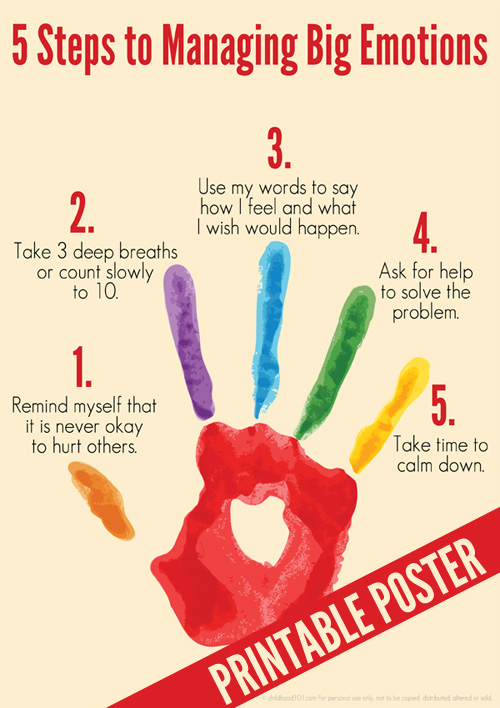
5 Steps to Managing Big Emotions
Source: http://childhood101.com/2015/03/helping-children-manage-big-emotions/

Dream Parenting: Winning the Battle
You don’t have to win every battle with your child. You don’t have to be a perfect parent. Some days are going to be sweet one’s, with lots of cuddling, peaceful interactions and other days are going to be more chaotic and bumpy. It is important that parents learn how to ride these ups and downs and now that they are still headed in the right direction. if today was a bad day, than you get to have another day. Make tomorrow different. If tomorrow is bad too, look forward to the day after than and so on…
You were there to write the first chapter of your child’s life and you get to help write the next one until the day they start writing their own chapters. You are never totally powerless and no mistake cannot be forgiven and un-reconciled. It make take a while but time really is on your side and it can heal the most grievous hurts. Use this to your parenting advantage.
Action Parenting Tool: Don’t focus on today’s problem. Visualize how you want tomorrow to look and start working toward it. Be OK with small adjustments until you achieve the family you dreamed about.

April is Child Abuse Prevention Month
April is National Child Abuse Prevention Month, a time to recognize that we each play a part in promoting the social and emotional well-being of children and families in our communities. Learn more on the National Child Abuse Prevention Month website.
https://www.childwelfare.gov/topics/preventing/preventionmonth/
Encourage your mayor or governor to issue a National Child Abuse Prevention Month proclamation. They can use the 2014 National Child Abuse Prevention Month Proclamation as a model.https://www.childwelfare.gov/topics/preventing/preventionmonth/about/proclamations/
Want to raise awareness about the importance of child abuse prevention? Add a National Child Abuse Prevention widget to your agency’s website.
https://www.childwelfare.gov/topics/preventing/preventionmonth/widgets/
Have you downloaded the 2015 Resource Guide: Making Meaningful Connections? Available on Child Welfare Information Gateway, the guide supports service providers in their work with parents, caregivers, and their children to strengthen families and prevent child abuse and neglect. Learn more here: https://www.childwelfare.gov/topics/preventing/preventionmonth/resource-guide/
Download the National Child Abuse Prevention Month activity calendars to learn how you can promote child well-being throughout the month of April. The calendar is available in English and Spanish on the Child Welfare Information Gateway website.
https://www.childwelfare.gov/topics/preventing/preventionmonth/resource-guide/activity-calendar/
Watch real-life stories from prevention programs across the nation. Visit the National Child Abuse Prevention video gallery, and share with your friends, family, coworkers, and community.
https://www.childwelfare.gov/topics/preventing/preventionmonth/video-gallery/
 Ron Huxley LMFT