Page 11 of 92

Helping Children Focus in School After Trauma…

When children experience trauma, it can be difficult to focus and stay engaged in the classroom. Fortunately, many social-emotional learning activities can help children develop the skills they need to stay focused and engaged in the classroom. Here are 10 ways children can use social-emotional learning activities to help them focus in the classroom after experiencing trauma.

1. Positive Self-Talk: Positive self-talk can be a powerful tool for helping children to stay focused and engaged in the classroom. Encourage your child to practice positive self-talk by repeating mantras and affirmations to themselves throughout the day. This will help them to stay positive and motivated, even when facing challenging tasks.

2. Mindfulness: Mindfulness activities can help children to stay in the present moment and pay attention to what is happening in the classroom. Encourage your child to practice mindfulness activities like deep breathing and body scans to help them stay focused and engaged.

3. Visualization: Visualization activities can help children to create positive images in their minds, which can help them stay focused and engaged in the classroom. Encourage your child to practice visualization activities, such as imagining a peaceful place or positive future, to help them stay on task.

4. Social Skills: Social skills can help children stay engaged in the classroom and positively interact with their peers. Encourage your child to practice social skills, such as active listening, problem-solving, and conflict resolution.

5. Emotional Regulation: Emotional regulation activities can help children to manage their emotions and stay focused in the classroom. Encourage your child to practice emotional regulation activities like deep breathing, progressive muscle relaxation, and positive self-talk.

6. Self-Awareness: Self-awareness activities can help children to understand their emotions, thoughts, and behaviors. Encourage your child to practice self-awareness activities such as journaling, reflecting on their experiences, and talking to a trusted adult.

7. Goal Setting: Goal-setting activities can help children to stay focused and motivated in the classroom. Encourage your child to set short-term goals that are achievable and to create a plan for how to reach those goals.

8. Problem-Solving: Problem-solving activities can help children to think flexibly and stay focused in the classroom. Encourage your child to practice problem-solving activities, such as brainstorming, making lists, and breaking down tasks into smaller steps.

9. Self-Care: Self-care activities can help children to stay focused and engaged in the classroom. Encourage your child to practice self-care activities such as getting enough sleep, eating healthy meals, and engaging in physical activity.

10. Connecting With Others: Connecting with others can help children to stay focused and engaged in the classroom. Encourage your child to connect with peers by talking to them, listening to their stories, and engaging in conversations.

Ron Huxley can help your and your child focus and learn after dealing with stress and trauma. Ron Huxley is a licensed therapist specializing in anxiety and trauma. Contact him today!

Why Choose Co-Parenting Counseling?

Co-parenting counseling can offer several benefits, including:

  1. Improved communication: Co-parenting counseling can help parents develop effective communication skills to handle conflicts and negotiate parenting decisions.
  2. Better understanding: Counseling can provide a safe space for parents to understand each other’s perspectives and feelings.
  3. Better relationships: Co-parenting counseling can help improve the relationship between parents, leading to a more positive and supportive co-parenting experience.
  4. Increased empathy: Counseling can help parents see things from their child’s perspective and increase empathy towards their co-parent.
  5. Improved well-being: By improving the co-parenting relationship, co-parenting counseling can reduce stress and improve well-being for both parents and children.
  6. Better outcomes for children: Children of co-parents who participate in counseling tend to have better outcomes, including improved mental health, academic performance, and behavior.

Co-parenting counseling typically involves a trained therapist who meets with both co-parents to discuss and address their challenges in co-parenting. The counselor may use techniques and strategies, such as active listening, empathy building, conflict resolution, and problem-solving, to help co-parents improve their communication and relationship.

During the sessions, the counselor may encourage the co-parents to discuss their concerns and goals, work through conflicts, and develop a more positive and effective co-parenting plan. The counselor may also provide guidance on how to manage common co-parenting issues, such as disagreements on discipline or schedule, and help co-parents develop a parenting plan that works for their family.

The number of sessions required for co-parenting counseling can vary, depending on the specific needs of each co-parenting relationship. Co-parenting counseling aims to help co-parents learn to work together as a team and provide a supportive environment for their children.

Let’s schedule a time to work together!

5 Misconceptions of Trauma-Informed Care

When it comes to trauma-informed care, there are a lot of misconceptions that can prevent people from getting the help they need. Trauma-informed care is a way of providing care that recognizes trauma’s impact and helps reduce the trauma’s effects. Unfortunately, some common misconceptions can result in people getting the needed help.

Misconception #1: Trauma-Informed Care Is Only for People with Severe Mental Illness

One of the most common misconceptions about trauma-informed care is that it is only for people with severe mental illness. This is not true. Trauma-informed care is for anyone who has experienced trauma, regardless of the severity of their mental illness. We all go through trauma; call it a Big T trauma or a Little T trauma. Trauma affects every group of people in society. Call it a silent wound that goes unspoken due to shame or fear if you want. It is still a growing reality in our world, even if undetected.

Misconception #2: Trauma-Informed Care Is Too Expensive

Another misconception about trauma-informed care is that it is too expensive. While there can be a cost, there is no substitute for the price you can pay for not understanding trauma-sensitive principles. Trauma-informed care can enhance client outcomes, prevent relapses, open cooperation and communication, and create more health and happiness for traumatized individuals.

Misconception #3: Trauma-Informed Care Is Only for Survivors of Abuse

Another misconception about trauma-informed care is that it is only for abuse survivors. While trauma-informed care can be beneficial for survivors of abuse, it can also be helpful for anyone who has experienced trauma, regardless of the source. Trauma-informed care can help reduce the effects of trauma, including natural disasters, accidents, and other life-altering events.

Misconception #4: Trauma-Informed Care Is Only for Adults

A fourth misconception about trauma-informed care is that it is only for adults. While trauma-informed care can be especially beneficial for adults, it can also be helpful for children. Trauma-informed care can help children process and cope with the trauma they have experienced, which can help them lead healthier and more fulfilling lives.

Misconception #5: Trauma-Informed Care Is Only for Those Who Are “Professionals”

Finally, there is the misconception that trauma-informed care is only for “Professionals.” You don’t have to be a clinician, doctor, social worker, or lawyer to benefit from Trauma-informed care. Everyone needs to understand the principles and practices of trauma because trauma happens in every area of life. There might be some areas of trauma that individuals don’t need to know in great detail, but recognizing the signs, responding compassionately, and avoiding retraumatizing others are crucial for anyone who lives with or works with a traumatized child or adult.

Ron Huxley can provide you with trauma-informed therapy or training. Let Ron work with your entire organization to get everyone on the same page and create Trauma-Informed Champions at every level of your school, nonprofit, church, or business. Contact Ron today at rehuxley@gmail.com.

Updates on In-Person Sessions and Telehealth

Please note that I only conduct in-person sessions on Wednesdays and Thursdays. Telehealth is available Monday through Thursday as an alternative.

Telehealth can include phone, FaceTime, or Secure Video, depending on your preference or what provides the best connection for our sessions.

In-person sessions are located at 6621 Bay Laurel Pl, Avila, Ca. 93424 in Suite A, Building 4.

Anxiety should be our primary focus for the New Year

Anxiety is a common and often debilitating mental health condition that affects millions of people around the world. It is characterized by feelings of worry, unease, and fear and can manifest in a variety of physical symptoms such as increased heart rate, difficulty breathing, and muscle tension. While anxiety is something that many experiences at some point in their lives, it can become a chronic problem that interferes with daily functioning and overall well-being.

Given the significant impact of anxiety on individuals and society, we must make it a priority to address this issue in the coming year. In this blog post, we will explore why anxiety should be our primary focus in 2023 and what we can do to support those struggling with this condition.

One of the main reasons anxiety should be a focus in 2023 is that it is highly prevalent. According to the World Health Organization (WHO), anxiety disorders are among the most common mental health conditions globally, affecting an estimated 264 million people. One in every 13 people is likely to experience anxiety at some point.

Anxiety can have a major impact on a person’s quality of life. It can interfere with work, relationships, and daily activities and lead to other mental health issues, such as depression. Anxiety can also have physical consequences, such as an increased risk of heart disease and other health problems.

Another reason anxiety should be a focus in 2023 is that it is often overlooked or misunderstood. Despite its prevalence, anxiety is often stigmatized and not taken as seriously as other mental health conditions. This can make it difficult for people to seek help or even recognize that they have a problem.

There is also a lack of awareness about the various forms of anxiety and the different ways it can manifest. For example, generalized anxiety disorder (GAD) is characterized by excessive and persistent worry about various topics, while social anxiety disorder is marked by extreme fear of social situations. Understanding the different types of anxiety can help us better identify and support those struggling with this condition.

So what can we do to make anxiety a focus in 2023 and support those dealing with this condition? Here are a few suggestions:

  • Increase awareness and understanding of anxiety: One of the first steps to addressing anxiety is to increase awareness and understanding of the condition. This can involve educating the public about the different forms of anxiety, the signs and symptoms, and the available treatments. It can also involve debunking myths and stereotypes about anxiety and promoting a more compassionate and understanding approach to struggling people.
  • Expand access to treatment: Another important step is ensuring that those struggling with anxiety have access to effective treatment. This can involve making therapy and medications more readily available and affordable and increasing the number of trained mental health professionals. It can also involve supporting alternative treatments such as mindfulness and meditation, which can be effective for some people.
  • Create supportive environments: We can also create more supportive environments for those with anxiety. This can involve providing accommodations in the workplace, such as flexible scheduling or the option to work from home. It can also involve creating safe and supportive spaces in schools, universities, and other community settings.
  • Promote self-care: Finally, it is important to encourage self-care and stress management techniques to help individuals better manage their anxiety. This can involve educating people about healthy habits such as exercise, sleep, and nutrition, as well as techniques such as relaxation and mindfulness.

In conclusion, Anxiety is a growing problem for children and adults. It can be an invisible illness overlooked by society, leading to fear and anxiety in those suffering from it. The good news is that anxiety can be managed, and we can work together to bring change so that more people can recover from it.

Let Ron Huxley help you deal with anxiety by scheduling a session today!

New Year Reflections (vs. Resolutions)

This year, I am working on short reflections, taking an inner path of peace and wellness instead of the traditional new year resolutions. I hope you enjoy them…

It’s Normal

It is normal to feel abnormal from time to time. Fear and uncertainty are certainties in worlds that are broken and fragmented. What is needed isn’t more glue and duct tape but more compassion and softness for ourselves. Try the softer path versus the hard, logical road and see if your journey discovers new growth in the rocks and gravel you overlooked before.

Action Step: Reflect on your inner path. How rocky has it been? Where does it feel broken? What would the softer path look like for you? What will you find that you overlooked?

Take a Breath

Inspiration doesn’t always require perspiration,
I am not against it; I have shed my share of it.
Inspiration is “in spirit,” breathing hope in and
releasing hopelessness. Pausing to feel the true
self and letting go false. Allow new ideas to
happen, without striving, with just the breath.
Take another until there are several, like
pearls on a string, shimmering in the light.

Action Step: Practice breathing more and stop trying to find inspiration and creativity. Let it find you…Don’t let the wait time increase your anxiety; start striving again. Take another breath and breath in the spirit, in-spire-nation.

OVER IT

Drinking is just the symptom of the bigger
problem, the iceberg under the surface
no one wants to consider. The yelling is just a
sign. Overeating is just the frosty
tip, the overspending, the overthinking,
the over-everything, and excesses to mask
the pain. Let’s start with a few ice cubes,
drink a glass of chilled water, and talk about
the stuff long buried. Aren’t we finally OVER IT?

Action Step: Assess how ready you are to be OVER It, whatever it is…What’s your first step for inner healing? Can you read a book, listen to a podcast, or talk to a therapist? Get out your journal, brush off the dust and start writing.

STOP Anxiety and Unwanted Emotions in Four Simple Steps

Dialectical behavioral therapy (DBT) is a therapeutic approach that has been used to treat a variety of mental health issues, including anxiety. It focuses on helping individuals learn how to regulate their emotions and build healthier relationships. One of the core concepts of DBT is the “stop technique”, which is a tool that can be used to help reduce anxiety.

What is the DBT stop technique?

The DBT stop technique is a way to help individuals recognize and manage their emotions in a healthy way. It is based on the idea that when we experience strong emotions, it can be difficult to think clearly and make rational decisions. The stop technique encourages individuals to pause and take a moment to recognize their feelings and to make a conscious effort to shift their focus to something else.

The stop technique is broken down into four steps:

  1. Stop: This is the first step in the technique and it involves taking a moment to recognize your emotions and to pause. You can do this by saying the word “stop” to yourself or by taking a few deep breaths.
  2. Take a step back: The second step is to take a step back and to observe the situation from a distance. This can help to provide perspective and to give you a better understanding of the situation.
  3. Observe: The third step is to observe your thoughts and feelings without judgement. This can help to provide clarity and to give you a better understanding of yourself and the situation.
  4. Proceed: The fourth step is to proceed with a plan of action. This could involve talking to someone about your feelings, writing down your thoughts, or engaging in a calming activity.

How can the DBT stop technique help with anxiety?

The DBT stop technique can be a helpful tool for individuals who are struggling with anxiety. It can help to provide a sense of control and to give individuals a sense of clarity. It can also help to reduce feelings of overwhelm by allowing individuals to take a step back and to observe their emotions without judgement.

The stop technique can also help to reduce the intensity of anxiety-related symptoms, such as racing thoughts, increased heart rate, and difficulty concentrating. By recognizing and acknowledging your feelings, you can take control of the situation and focus on calming yourself down.

Using the DBT stop technique effectively

Using the DBT stop technique effectively requires practice and dedication. It can be helpful to talk to a therapist about your experience with the technique and to practice it in a safe, comfortable environment. It is also important to be patient with yourself and to remember that it takes time to develop new skills.

It is also important to remember that the stop technique is not a “cure-all” for anxiety. It is a tool that can be used to help manage anxiety in the moment, but it is not a replacement for other forms of therapy or treatment.

Ron Huxley can help you stop anxiety and any other unwanted emotions. Let’s schedule an appointment for you today!

Reflection and Journaling for the New Year

Reflections and journaling are powerful tools that can help us better understand ourselves and our lives. They can provide a sense of clarity, direction, and purpose, and can even lead to personal growth and transformation.

What is reflection?

Reflection is the process of thinking deeply about something, considering different perspectives, and learning from past experiences. It involves evaluating and analyzing events, actions, and feelings, and considering their significance and impact.

Reflection can take many forms, including self-reflection, where we reflect on our own thoughts, feelings, and behaviors; and external reflection, where we reflect on the experiences and perspectives of others. Reflection can also be formal or informal, depending on the context and the purpose of the reflection.

Why is reflection important?

Reflection is an essential part of the learning process, as it helps us make sense of our experiences and understand how they relate to our goals and values. It can also help us identify patterns and trends in our behavior and thought processes, and identify areas for improvement or growth.

Reflection can also provide a sense of perspective and clarity, and help us better understand ourselves and the world around us. It can be a way to process and make sense of difficult experiences, and can even help us find meaning and purpose in our lives.

How do we reflect?

There are many different ways to reflect, and what works best for you will depend on your personal style and preferences. Some common methods of reflection include:

• Writing in a journal: This can be a great way to capture your thoughts and feelings on paper, and can be especially helpful for processing and making sense of difficult experiences.

• Talking to someone: Sharing your thoughts and feelings with a trusted friend, family member, or therapist can be a helpful way to reflect on your experiences and gain insight.

• Meditating or practicing mindfulness: These practices can help you focus your attention on the present moment and reflect on your thoughts and feelings without judgment.

• Engaging in creative activities: Creative activities like drawing, painting, or writing poetry can be a way to express and explore your thoughts and feelings in a different way.

• Doing something physical: Engaging in physical activities like exercise or yoga can be a way to reflect on your thoughts and feelings while also taking care of your physical well-being.

Why is journaling important?

Journaling is a form of reflection that involves writing down your thoughts and feelings on a regular basis. It can be a powerful tool for personal growth and development, and has a number of benefits, including:

• Providing a sense of clarity and perspective: Writing down your thoughts and feelings can help you better understand and make sense of them. It can also provide a sense of perspective and help you see things in a new light.

• Enhancing self-awareness: Journaling can help you become more self-aware by providing a space to reflect on your thoughts, feelings, and behaviors. This can help you identify patterns and trends, and better understand your strengths and areas for growth.

• Promoting emotional well-being: Journaling can be a way to process and express difficult emotions, and can even help reduce feelings of stress and anxiety.

• Setting goals and tracking progress: Journaling can be a way to set goals and track your progress towards achieving them. It can also help you reflect on what is and isn’t working, and make any necessary adjustments.

Journaling is a simple but powerful tool that can help improve your mental well-being and overall quality of life. It involves writing down your thoughts and feelings on a regular basis, and can provide a sense of clarity, perspective, and self-awareness. It can also be a way to process and express difficult emotions, set goals, and track progress.

If you’re new to journaling, or are looking for ways to make it a more meaningful and beneficial practice, here are some tips to get started:

1. Find a comfortable and private space to journal

It’s important to have a dedicated space where you can journal without distractions or interruptions. This can be a physical space, like a quiet room or cozy corner, or it can be a virtual space, like a private journaling app or document. Make sure you have everything you need, like a pen and paper or a laptop, and create a comfortable and inviting atmosphere.

2. Choose a journaling method that works for you

There are many different ways to journal, and what works best for you will depend on your personal style and preferences. Some options include:

• Pen and paper: This is a traditional and simple way to journal, and can be especially helpful for those who enjoy the physical act of writing.

• Digital journaling: There are many apps and online platforms available that allow you to journal electronically. This can be a convenient option if you’re always on the go or prefer typing to writing.

• Creative journaling: If you’re more creative and artistic, you might enjoy using your journal as a canvas for drawing, painting, or collaging.

• Prompted journaling: If you’re struggling to know what to write about, you might find it helpful to use prompts or questions to get started. There are many online resources and journals available that provide prompts for different topics and themes.

3. Set a regular journaling schedule

To get the most out of journaling, it’s important to make it a regular practice. Choose a time of day that works best for you, and try to set aside at least 15-20 minutes for journaling. You might find it helpful to journal at the same time each day, or to schedule specific times for different types of journaling (e.g., morning pages, gratitude journaling).

4. Write freely and without judgment

One of the key benefits of journaling is that it provides a safe and private space to explore your thoughts and feelings. It’s important to remember that your journal is for you, and that you don’t have to worry about grammar, spelling, or structure. Just write freely and let your thoughts and feelings flow.

5. Be honest and authentic

Journaling is an opportunity to be honest and authentic with yourself, so don’t hold back. Write about what’s really on your mind, even if it’s difficult or uncomfortable. You might be surprised at the insights and revelations that come from this process.

6. Reflect on and learn from your journaling

Journaling is a form of reflection, so it’s important to take some time to review and analyze your writing. Look for patterns and trends in your thoughts and feelings, and consider how they relate to your goals and values. Use your journaling as a way to learn about yourself and identify areas for growth and improvement.

7. Consider sharing your journal with someone you trust

Sharing your journal with a trusted friend, family member, or therapist can be a powerful way to gain additional insights and support. It’s important to choose someone who is supportive and non-judgmental, and to only share what you feel comfortable sharing.
Emotional Regulation Tools for Stressed-Out People

Emotional regulation is the ability to manage and respond to our emotions in a healthy and productive way. It’s a crucial skill to have, especially for those who struggle with stress and anxiety. When we’re overwhelmed by negative emotions, it can be difficult to think clearly and make good decisions. However, with some practice and effort, we can learn to regulate our emotions and feel more in control of our lives.

Here are some strategies for improving emotional regulation in times of stress and anxiety:

1. Practice mindfulness: Mindfulness is the practice of bringing your attention to the present moment, without judgment. It can help you become more aware of your thoughts and emotions, and allow you to respond to them in a more thoughtful way. Try setting aside a few minutes each day to sit quietly and focus on your breath, or try a guided mindfulness meditation.

2. Use deep breathing: Deep breathing is a simple but effective way to calm the body and mind. When we’re stressed or anxious, our breath tends to become shallow and rapid. By slowing down and deepening our breath, we can help activate the body’s natural relaxation response. Try taking a few slow, deep breaths whenever you’re feeling overwhelmed.

3. Engage in physical activity: Exercise can be a great way to reduce stress and improve emotional regulation. It releases endorphins, which are chemicals that improve mood and reduce feelings of stress. Plus, getting your body moving can be a great distraction from negative thoughts and emotions.

4. Practice gratitude: Focusing on the things we’re grateful for can help shift our perspective and improve our mood. Try keeping a gratitude journal where you write down three things you’re grateful for each day. Or, share your gratitude with a friend or family member.

5. Seek support: It’s important to remember that you don’t have to face stress and anxiety alone. Talk to a trusted friend or family member about how you’re feeling, or consider seeking support from a mental health professional.

6. Use positive self-talk: Our thoughts have a powerful impact on our emotions. When we’re struggling with stress and anxiety, it’s common to have negative thoughts about ourselves or the situation. By practicing positive self-talk, we can reframe these negative thoughts and improve our emotional well-being. For example, instead of telling yourself “I can’t handle this,” try saying “I’m doing the best I can and I will get through this.”

7. Take breaks: It’s important to give yourself time to relax and recharge. Make sure to schedule breaks into your day and take time to do things you enjoy. This could be something as simple as going for a walk or reading a book.

8. Use relaxation techniques: There are a variety of relaxation techniques that can be helpful for managing stress and anxiety. These might include progressive muscle relaxation, visualization, or guided imagery. Experiment with different techniques to see what works best for you.

9. Set boundaries: It’s important to set boundaries and make sure you’re not taking on more than you can handle. Learn to say no to things that don’t align with your values or that are overwhelming for you.

10. Seek professional help: If you’re struggling to manage your stress and anxiety on your own, it may be helpful to seek the support of a mental health professional. They can provide you with tools and strategies to help you cope with difficult emotions and improve your overall well-being.

Emotional regulation is a skill that can be developed with practice. It’s not always easy, but it’s worth the effort. By using the strategies outlined above, you can learn to manage your emotions in a healthy and productive way, even in times of stress and anxiety.

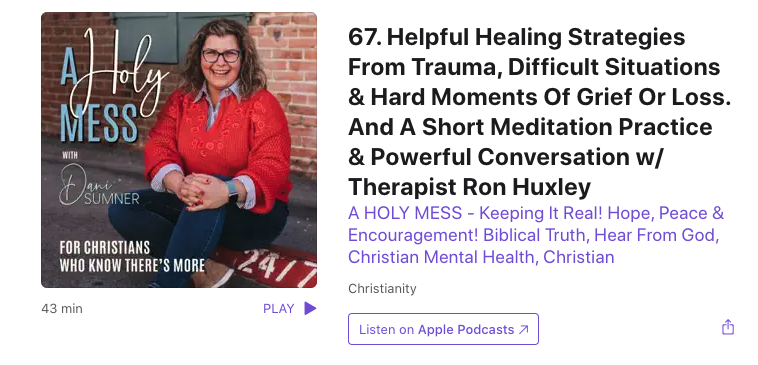
Helpful Healing Strategies from Trauma, Difficult Situations & Hard Moments of Grief or Loss (a Holy Mess Podcast)

I am so excited to guess again on the Holy Mess Podcast (see the link below). The show creator, Dani Sumner, has the #1 Christian Mental Health podcast on Spotify. This episode talks about healing from a body, mind, and spirit perspective. At the end of the podcast, I will lead you through a short meditation on how to “resource” safety from each perspective. You don’t want to mess with this podcast: Click here now!