The Pillars of Resilience in Trauma-Informed Care: Insights from SAMHSA’s Guidance


In Trauma-Informed Care (TIC), resilience is an essential factor that enables professionals to provide effective and compassionate support to individuals affected by trauma. In its guidance for a trauma-informed approach, the Substance Abuse and Mental Health Services Administration (SAMHSA) has identified key elements of resilience. By understanding and incorporating these elements, TIC workers can improve their ability to handle difficult situations while also maintaining their own well-being.

  1. Being self-aware is crucial to building resilience. As a TIC worker, it’s essential to have a deep understanding of your personal triggers, emotions, and stress responses. This knowledge enables you to respond appropriately and prevent any negative impact on your interactions with trauma survivors. With self-awareness, you can identify when you require additional support or resources to maintain your well-being.
  2. Taking care of oneself is crucial to maintaining physical, emotional, and mental well-being. This is especially important for TIC workers, who need to prioritize their own self-care in order to effectively support others. Engaging in healthy activities like exercise, eating well, getting enough sleep, and relaxation techniques can help build emotional resilience and prevent burnout. It is important to remember that taking time for oneself is not selfish, but rather a necessary step towards maintaining personal well-being and professional longevity.
  3. Establishing Relationships: Fostering Supportive Connections and Building a Robust Social Network. Having stable and supportive relationships is vital for developing resilience. TIC personnel gain advantages from nurturing relationships with coworkers, mentors, managers, and other experts in their area. These connections offer opportunities for collaboration, debriefing, and peer support, fostering a sense of belonging and reducing feelings of loneliness. Constructing a powerful social network grants TIC professionals a support system that can aid them in navigating difficult situations, providing insights and guidance when required.
  4. As a key element of resilience in TIC, flexibility plays a crucial role in supporting trauma survivors. TIC workers must be able to adapt to various challenges and respond effectively. This involves embracing change, considering different perspectives, and finding innovative solutions. By remaining flexible, TIC workers can better support individuals throughout their recovery journey and address the changing needs of trauma survivors.
  5. Practicing present-moment awareness and self-reflection is what mindfulness is all about. It is an incredibly useful tool for building resilience, especially for TIC workers. By staying fully engaged and attuned to the needs of trauma survivors, mindfulness enables them to listen and respond with empathy and compassion. Additionally, self-reflection is crucial as it helps TIC workers examine their thoughts, emotions, and responses, fostering personal growth and enhancing their ability to provide trauma-informed care.


Building resilience is paramount for Trauma-Informed Care workers in their mission to support individuals affected by trauma. SAMHSA’s guidance outlines critical elements of resilience, including self-awareness, self-care, connections, flexibility, and mindfulness. By incorporating these elements into their practice, TIC workers can enhance their ability to navigate challenging situations, maintain their well-being, and provide compassionate support to trauma survivors. Remember, resilience is an ongoing journey, and investing in these critical elements will contribute to personal growth and professional effectiveness of Trauma-Informed Care.
Restoring Peaceful Sleep: Nurturing Your Spirit with Trauma-Informed Care

Sleep is vital to our overall well-being, affecting our physical, mental, and emotional health. For individuals who have experienced trauma, achieving restful sleep can be particularly challenging. Understanding the impact of trauma on sleep patterns and adopting trauma-informed care practices can help create a safe and healing environment for promoting peaceful sleep. In this article, we will explore the importance of trauma-informed care and provide insights from experts to support your journey toward restorative sleep.

Understanding the Impact of Trauma on Sleep:

Experiencing trauma can severely impact our sleep patterns. Trauma survivors often struggle with insomnia, nightmares, hypervigilance, and anxiety – all of which can negatively impact their physical health and make it difficult for them to recover and find emotional stability.

Applying Trauma-Informed Care:

Trauma-informed care is an approach that recognizes the prevalence of trauma and seeks to provide support and understanding to those who have experienced it. By incorporating trauma-informed practices into our sleep routines, we can create an environment that fosters healing and promotes restful sleep.

  1. Safety and Trust:

Creating a safe sleep environment is essential for individuals healing from trauma. “Safety is the most important thing that trauma-informed care provides. If people don’t feel safe, they can’t heal.” (Harris, 2014) Ensure your bedroom is a sanctuary, free from potential triggers or disruptions. Utilize calming elements like soothing sounds or comforting scents to create an atmosphere of safety and tranquility.

  1. Establishing Predictability:

Consistency and predictability in our sleep routines can be grounding and reassuring. “Predictability and structure help survivors feel safer, allowing them to relax and be open to healing.” (Hopper, 2010) Set regular sleep and wake times to establish a sense of stability. Engage in relaxing activities before bed, such as reading a book or taking a warm bath, to signal to your body and mind that it’s time to unwind.

  1. Mind-Body Connection:

Trauma can disrupt the connection between our minds and bodies. Rebuilding this connection is crucial for promoting restful sleep. “Engaging in mindfulness practices can help individuals reconnect with their bodies, bringing awareness and relaxation to the present moment.” (Nakazawa, 2020) Explore techniques like deep breathing exercises, progressive muscle relaxation, or meditation to help ground yourself and promote a sense of calm before sleep.

  1. Cultivating Self-Compassion:

Self-compassion is a powerful tool for healing from trauma and promoting restful sleep. “Self-compassion involves treating yourself with the same kindness, care, and understanding you would offer to a loved one.” (Germer, 2009) Practice self-care rituals like journaling, practicing gratitude, or engaging in hobbies that bring you joy. Embrace the idea that you deserve healing and peaceful sleep.

  1. Seeking Support:

Reaching out for support is an essential aspect of trauma-informed care. “Connecting with others who understand and support you is an important part of the healing process.” (Herman, 1997) Consider joining support groups or seeking therapy with professionals experienced in trauma-informed care. Engaging with others who have similar experiences can provide validation, empathy, and guidance on your healing journey.

By embracing trauma-informed care practices, you can create a nurturing environment that promotes restful sleep and facilitates healing from trauma. It’s crucial to prioritize safety, establish predictability, foster mind-body connection, cultivate self-compassion, and seek support from others. Keep in mind that healing takes time, but with the help of trauma-informed care principles, you can restore peaceful sleep and reclaim your well-being.

Sources:

  • “Trauma-Informed Care: How Neuroscience Influences Practice” by Patricia A. Harris (2014).
  • “Trauma and Recovery: The Aftermath of Violence–from Domestic Abuse to Political Terror” by Judith Herman

Had any assumptions shattered lately?

The last two years have been one of daily uncertainty and fear, but a crisis is also a great revealer of the myths and idols we hold. It “knocks us off our thrones” and breaks our “assumptive worlds.” Our assumptions are the beliefs we hold about who we are and the world we live in…at times, like these, they don’t hold up. In fact, they can shatter into thousands of meaningless thoughts.

In social psychology, shattered assumptions theory proposes that traumatic events can change how victims and survivors view themselves and the world. We all have three inherent assumptions including “overall benevolence, the meaningfulness of the world, and self-worth.” They are the bedrock of our conceptual system, and as such, they are the ones we are least aware of and least likely to challenge. We become confident in our beliefs and use them to plan and act in daily living. If nothing challenges them they allow our lives to move along smoothly.

Sadly, traumatic life events shatter core assumptions, and coping with them requires a new effort to construct more realistic and viable assumptions. We have to rebuild our belief systems to fit the new world we live in.

Core Beliefs:

The world is benevolent

The world is meaningful

The self is worthy

This can be painful for people of faith who end up questioning their faith. When our assumptive worlds shatter, it causes believers to questions the goodness of God. They might “assume” that God is silent or uncaring. The promises they believed must be wrong since things didn’t work out the way they “believed.” Trying to reconcile a good God to their adverse life situations may turn some to question themselves, wondering if they ever heard God speak into their lives or if some sin or trauma from the past has made them unworthy of mercy.

I mean, if God never changes, then the problem must be ourselves, right? Christians believe that when they become followers they are “new creations.” New creations have to have renewed minds to find new beliefs about God’s goodness and nature in their lives. Renewal is exactly what we need when our assumptions become shattered. Neurologists called this neuroplasticity.

Neuroplasticity is the brain’s ability to restructure itself through training and practice, thereby creating new neuropathways in the human nervous system. Neuroplasticity, renewed minds, and rebuilt belief systems are about personal growth that is sometimes only possible after trauma.

The reason that believers feel peace after giving their lives to follow the Christian faith is that new neuropathways are being created. Transformation or growth is occurring. From a more secular viewpoint, life has a way of creating maturity in our thinking. The trick is how to not become bitter and negative afterwords.

There is a favorite verse of mine that goes: “Do not worry about anything, but in everything by prayer and supplication with thanksgiving let your requests be made known to God. And the peace of God, which surpasses all understanding, will guard your hearts and your minds in Christ Jesus.  –Philippians 4:6-7 (NRSV)” Prayer and meditation increase brain neuroplasticity and makes renewal possible. Allowing our minds to let go of distractions and slow down helps us focus on what we control and let go of what we cannot. In Alcoholics Anonymous, this is the path to serenity.

After a shattering event, people are able to discover strength they didn’t know that had in them. They also find new purposes and seek out deeper connections than before. Faith also grows in people after difficulty. They start to see deeper meaning and value in their life. This is called Post-Traumatic Growth in contrast to Post-Traumatic Stress Disorder.

Would you like assistance recovering from a shattering event or trauma? Need new tools for your organization or group? Contact Ron Huxley today!

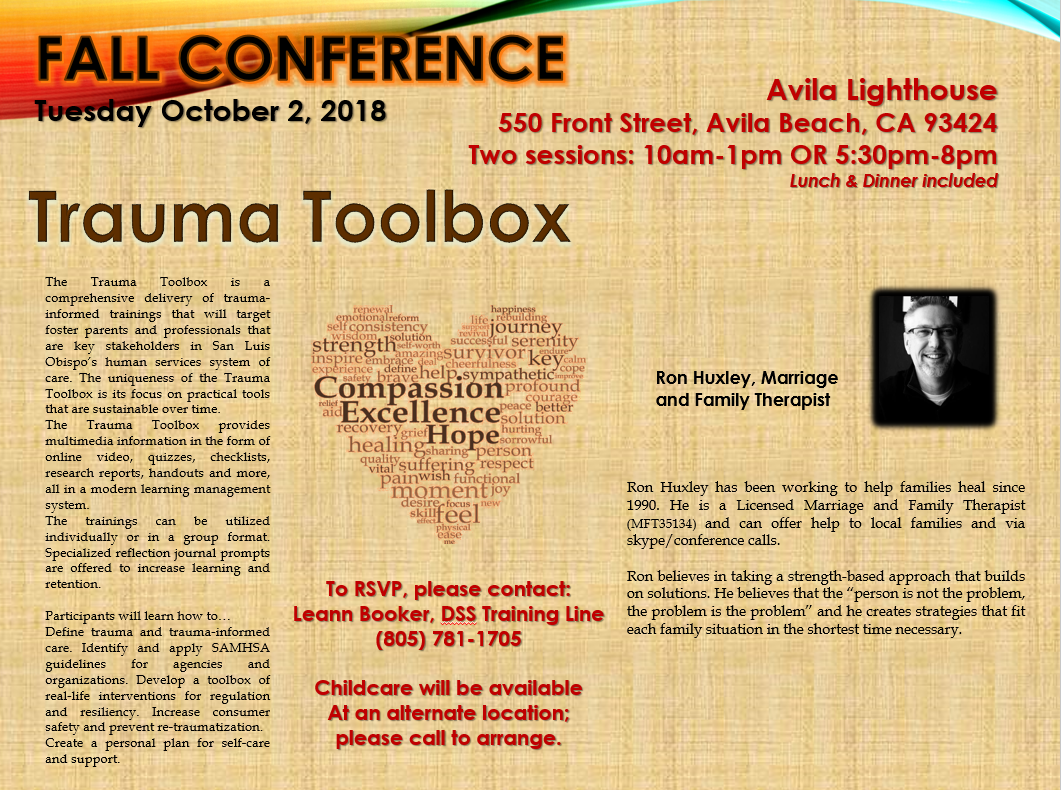
Trauma Toolbox Fall Conference

Join me as the speaker for San Luis Obispo, California’s Fall Conference. I will be featuring my online trauma-informed care training: The Trauma Toolbox. 

This conference is free for parents and professionals who want to know more about this project and learn practical tools for healing trauma.

Be sure to RSVP at the DSS Training Line at 805-781-1705. Childcare will be available at an alternative location. Please call to arrange.

image001