Page 3 of 4
Just Like Me…
In a recent training on Trauma-Informed Care, I led the group through a mindfulness exercise that explored the nature of suffering. The goal was to bring a higher level of compassion for others in emotional pain.
Suffering refers to the state of undergoing pain, distress, or hardship. We know, in our heads, that everyone goes through difficult times but in our hearts, we neglect to connect with others, in their pain. This is because we are in pain too!
Professionals, who work with hurt people, are double-agents. They provide trauma-informed care and services to others AND they have experienced trauma too. We can be triggered by others pain and this will result in a distancing of emotions in order to keep ourselves safe. We sometimes call this a “professional distance” or “objectivity.” It might help us feel safer but it will also disconnect us from the heart of what we are trying to do in serving others. How to maintain this balance is the subject for another discussion. In the meantime, try this mindfulness exercise called “Just Like Me…” Examine how you feel before and after reading through it. Use it weekly or as often as you need to reconnect you with others who have experienced trauma and loss.
“Think of someone you like or dislike that you want to expect positive feelings and forgive. It help to think of that person who is similar to you. Take deep breaths and repeat after me…
This person has a body and a mind, just like me.
This person has feelings, emotions, and thoughts, just like me.
This person has in his or her life, experienced physical and emotional pain and suffering, just like me.
This person has at some point been sad, disappointed, angry, or hurt, just like me. This person has felt unworthy or inadequate, just like me.
This person worries and is frightened sometimes, just like me.
This person has longed for friendship, just like me.
This person is learning about life, just like me.
This person wants to be caring and kind to others, just like me.
This person wants to be content with what life has given, just like me.
This person wishes to be free from pain and suffering, just like me.
This person wishes to be safe and healthy, just like me.
This person wishes to be happy, just like me.
This person wishes to be loved, just like me.
Now, allow some wishes for well-being to arise:
I wish that this person have the strength, resources, and social support to navigate the difficulties in life with ease.
I wish that this person be free from pain and suffering.
I wish that this person be peaceful and happy.
I wish that this person be loved.
Because this person is a fellow human being, just like me.”
Need a therapist or trainer on healing from the hurt of trauma? Contact Ron Huxley today at rehuxley@gmail.com.
Take an online course on Trauma-Informed Care dealing with Trauma, Anxiety, Parenting, and more at http://FamilyHealerSchool.com
H.U.R.T. = Healing “Un’s” and Releasing Trauma
A key element of the healing strategies for individuals who have experienced trauma is to “ReWriting Our Narratives.” These are the stories that we believe about ourselves as a result of the negative, hurt-full things in our life. But these stories are not all true even if they feel so, so, true. They are also not the end of the story. We can be the authors of our own lives and choose the plot lines of your future story.
Children and Trauma
Children are “ego-centric”. These means that they believe the world revolves around them. Therefore, when bad things happen, they believe it is their fault. This is due to an immature nervous system and executive functioning skills that are supposed to help them see things rationally. They are not rational creatures. Consequently, if something bad happens traumatized children believe that they are bad! This is a false narrative based on painful/shameful memories.
This is a hallmark of trauma-informed care that is revolutionizing the programs and services across the nation. We are learning to shift our paradigms from asking “what is wrong with a person?” to “what happened to a person?” This allows us to concentrate on the story. But this must go deeper. We have to ask the healing questions: “where does it hurt?”
We can use the acronym for HURT to help us explore our stories:
H.U.R.T. = Healing Un’s and Releasing Trauma
HURT children carry around a lot of Un’s (a prefix meaning “not”): Unworthy, unwanted, unloved, unsafe, unstable, unkind, untrustworthy, etc”.
What UN’s do you or your child believe?
1.
2.
We could also ask ourselves this question. What UN’s do I believe about myself. Everyone goes through some level of trauma. The challenges and hassles of everyday life can be quite severe. Many caregivers suffer compassion fatigue or vicarious trauma as a result of working/living with a traumatized child.
Fortunately, healing is possible for children and adults. We can look at where the HURT is and find strategies that change our life stories with positive, resilient endings!
Get more help from Ron Huxley by scheduling a session today or taking one of an online Trauma-Informed training at http://FamilyHealerSchool.com
Healing the Special Needs Child
Many foster and adoptive parents have children with special needs who require specialized care and skills. According to Wikipedia, the term special needs “is a term used in clinical diagnostic and functional development to describe individuals who require assistance for disabilities that may be medical, mental, or psychological.”
In the United States, more than 150,000 children with special needs are waiting for permanent homes. Traditionally, children with special needs have been considered harder to place for adoption than other children, but experience has shown that many children with special needs can be placed successfully with families who want them.
This can put more of a strain on families than they realize. Just loving a child really hard is not enough to manage the requirements of a special needs child. It takes special knowledge and a support system from other parents of special needs children and professionals who “get it!”
Being unprepared is one of the reasons foster and adoptive families disrupt. Disruption is a term that refers to the ending of a foster placement prior to the finalization of an adoption. The rate of disruption has traditionally been10-20% nationally. Post-Adoption services and education can decrease this rate dramatically!
Perhaps the most challenging special needs issue, for parents and professionals, is Fetal Alcohol Spectrum Disorder (FASD). This is defined as a “continuum of permanent birth defects caused by maternal consumption of alcohol during pregnancy. It refers to a group of conditions that can occur in a person whose mother drank alcohol during pregnancy. Problems may include an abnormal appearance, short height, low body weight, small head size, poor coordination, low intelligence, behavior problems, and problems with hearing or seeing.” (Wikipedia)

In addition to the physical symptoms of FASD, there are several corresponding mental health problems, such as attentional deficits, clinical depression, anxiety, or other mental illness. As you can imagine, many of the problems show up in the child’s school experience. Suspensions or expulsion from school occurs in 90% of children in the united states. For teenagers, this can result in dropping of out of school, experienced by 60% of the subjects (age 12 and older).
Other problems, such as legal issues, can occur for FASD children. Being charged or convicted of a crime is experienced by 60% of the children ages 12 and older. (Wikipedia)
One of the ways to help children with special needs heal is to work on executive functioning skills. Executive Functioning: “are a set of cognitive processes – including attentional control, inhibitory control, working memory, and cognitive flexibility, as well as reasoning, problem-solving and planning – that are necessary for the cognitive control of behavior: selecting and successfully monitoring behaviors that facilitate the attainment of chosen goals.”
Elevating executive functioning skills will help children with special needs make better choices, control their behavior and manage their thoughts and emotions. The simplest way to elevate them is through play.

It’s been said that play is the “beginning of knowledge.” The play is a child’s natural language and how they interact with the world and learn new skills and the shortest route to helping special needs children.
Babies and young children can benefit from games of peekaboo, pat-a-cake, hiding games, simple songs, and music, copying games, and fingerplays. Example of young child games include Eensy Weensy Spider, Where is Thumbkin, Open, Shut Them. Repetition and allowance for failure is key to helping children’s brain develop normally.
School-age children benefit from reading books, music, and movement, simple imitation games like follow the leader, conversations, manipulation of objects like blocks and Legos. Allow children to set the course of play allowing them to start and stop the rhythm of play.
It would seem that play with special needs children is the same as with any other child and it is…except that the intention and purpose of the play are to build brain skills that need reinforcement. The ability to stay focus and tolerate interactions need to be increased over time. If a child can only sit and play for 5 minutes, we want to increase that time to 6 minutes, then 7, etc. Start where the child is and allow them to increase tolerance and focus.
Take into consideration that each time the nervous system starts and then stops, it learns how to persist past impulses and distractions. Each time it achieves a difficult goal, it discovers the pleasure of success and wants to repeat this experience. This provides an internal locus of control that doesn’t require an adult to always supervise the play.
Play also develops social skills, an area that can be drastically missing in children with special needs. As children get older, teamwork becomes more important and necessary both at home and school. Children become more active and like to engage in dance, sports, playing catch, and various competition games. Competition can become a way to alienate others as special needs children have tantrums/meltdowns when they don’t win. This is due to a need to compensate for low self-esteem feeling like a failure at tasks and games.
Let the play be about the process and not the end result. Be happy for others who when and concentrating on celebrating team efforts will enhance executive functioning and overall relational success.
Is this still exhausting work? Yes! But the effort will be worth it in the long run. Use storytelling and imaginary play to make the connections that are missing in social/emotional development. Role-playing and creative art can also be a powerful tool for parents and professionals. Red Light/Green Light, Simon Says, clapping rhythms, guessing games, I Spy, and Brain Teasers are also useful brain tools.
Teenagers with special needs can benefit from practicing real-time daytimers, calendars, whiteboards, mind mapping and more to develop organizational, goal setting, planning, and monitoring and studying skills.
None of these activities should be done in isolation from caring, patient adults. Attachment and brain researchers operate under the maxim that “brains that fire together, wire together.” Just giving a toy to a child or tell them to do a task will not enhance the prefrontal cortex of the brain, where executive functioning is centered. Optimal development occurs when do people interact. Adults can guide the conversation and play to specifically target the individualized needs of the child. The child’s ability to push passed frustrations and manage moods will need the adult to help them through it.

Finally, children of all ages can benefit from the mental organization power of mindfulness. Executive functioning is more than academic ability. This might be the focus on many of the adults in the child’s life but life smarts are important aspects of book smarts.
According to Jon Kabat-Zinn, the founder of Mindfulness-Based Stress Reduction (MBSR), “Mindfulness is the awareness that arises through paying attention, on purpose, in the present moment, non-judgmentally.” Learning to be mindful of one’s thoughts, emotions, and bodily sensations calm the nervous system so thinking skills can increase. Teaching children the importance of experiencing their breath, mindful eating, yoga, and how to ground themselves are crucial skills at all ages.
Get more powerful tools for managing special needs and trauma for your organization with Trauma-Informed Training by contacting Ron Huxley now…click here!
The “R’s” of Trauma-Informed Care

Trauma affects all levels of society, including the home, school, religious institutions, social service organizations, public and private business, the arts and all areas of culture. A major movement has been occurring, throughout the nation, to change our perspective on trauma-informed approaches. The goal of this movement is to increase sensitivity in client care and prevent re-traumatization.
In order to meet this goal, the Substance Abuse and Mental Health Services Administration has created 4 R’s to guide the individual practitioner and society. These R’s include:
1. Realizing the widespread impact of trauma and understand the potential paths of recovery.
2. Recognize the signs and symptoms of trauma in clients, families, staff, and others involved in the system.
3. Respond by fully integrating knowledge about trauma into policies, procedures, and practices.
4. and seeks actively to Resist Re-traumatization.
This guidance has resulted in paradoxical shifts that promote Resiliency and Regulation to promote positive Recovery. These “R’s” are essential to the practice of social work and mental health.
As the ideas and practices spread through society, we have to explore lesser recognized R’s of trauma-informed care, including Respect and Relationship. These two R’s are elements of success in creating a trauma-informed (cultural of) care.
There is a Zen saying:
If there is light in the soul,
There is beauty in the person,
If there is beauty in the person,
There will be harmony in the house,
If there is harmony in the house,
There will be order in the nation,
If there is order in the nation,
There will be peace in the world.
Respect starts with the individual – has to start with the individual – and then slowly moves through-out society. It starts with the parent in the home, the social worker in the field, the rabbi in the synagogue, the teacher in the physical education program, the supervisor in the organization. This light sparks from respecting oneself and then it then gets paid forward to others around them. It brings gratitude for beauty in the person and harmony in the “house”. It sustains families and transforms organizations and the world.
Respect is defined as the admiration of someone’s ability, qualities or achievements. It creates an atmosphere that promotes safety for the trauma survivor.
“Trauma, by definition, is unbearable and intolerable … Nobody wants to remember trauma. In that regard society is no different from the victims themselves. We all want to live in a world that is safe, manageable, and predictable, and victims remind us that this is not always the case. In order to understand trauma, we have to overcome our natural reluctance to confront that reality and cultivate the courage to listen to the testimonies of survivors.”
- Recruiting, hiring, and retaining trauma-informed staff.
- Training behavioral health service providers on the principles of, and evidence-based and emerging best practices relevant to, TIC.
- Developing and promoting a set of counselor competencies specific to TIC.
- Delineating the responsibilities of counselors and addressing ethical considerations specifically relevant to promoting TIC.
- Providing trauma-informed clinical supervision.
- Committing to prevention and treatment of secondary trauma of behavioral health professionals within the organization.
All of this must be held in the context of a Relationship. The relationship is the healing factor behind it all. Without relationship, there is no family, no organization, no church, no society. In the science of resiliency, the relationship is how we tip the scale from negative to positive outcomes. One healing relationship in a chaos of trauma can provide enough emotional strength for a child or adult to survive.
Reflect on the “R’s” of Trauma-Informed Care:
1. How has your organization utilized the 4 R’s of Recognize, Realize, Respond, and Resist Retraumatization?
2. What can you do to start or improve on any efforts already done using these 4 R’s?
3. Can you define the concepts of Regulation, Resiliency, and Recovery? Write these definitions on an index card and consider them each time you interact with a co-worker, friend, or client.
4. How have the ideas of Respect and Relationship impacted you personally and/or how have you used these two powerful R’s to move others to more positive outcomes?
~> Need training or consultation on how to implement Trauma-Informed Care into your church, school, or business? Let Ron Huxley help you train your staff or community. Email him today at rehuxley@gmail.com or call 805-709-2023.
Manage Compassion Fatique with Self-Care Strategies
Watch more trauma-informed videos now at http://TraumaToolbox.com
Grounding Exercises
Grounding exercises are short, simple techniques that focus attention and distract from intense emotions.
They often involve focusing on environmental stimuli or pleasant, calming topics or objects.
They can usually be done with minimal equipment, such as a pen and paper, or nothing at all except one’s thoughts and imaginations.
Therefore they are versatile exercises that can be performed anywhere.
Grounding exercises quiet down extreme emotions and help survivors of trauma shift to a more rational form of thinking.
People with trauma will, from time to time, experience high stress or emotional overload.
This is true for people with acute trauma, complex trauma, even traumatic grief.
The goal is not to eradicate feelings of intense anxiety, sadness, or anger. Instead, learning how to respond to those emotions, in the moment, is key to our healing.
In the video above you will learn 5 powerful Grounding Exercises:
Item Listing
The 54321 Game
Task Visualization
The Method of Loci
The 5 Senses Technique
It’s always best to have multiple grounding techniques in your toolbox.
What works best for one stressful situation (a trauma flashback, for example) might not work best in another (such as prior to a job interview).
A technique that you use frequently may become less effective over time. It is best to use a variety of techniques to avoid becoming acclimated to them.
Some grounding exercises may not be a good fit for your temperament.
For example, some people find the Ice Cream Technique frustrating because they get stuck and can’t remember any additional flavor examples.
Other people find the 54321 Game unhelpful because it can draw attention toward unpleasant feelings or sights in their environment.
For each technique, there are modifications to help expand their usefulness. But some techniques might just not be for you.
Get more tools for your Trauma Toolbox at http://www.TraumaToolbox.com/
Looking for a speaker on Trauma-Informed care for your next workshop, conference, or event? Contact Ron Huxley for more information at rehuxley@gmail.com
Faith-In-Motion Seminars: “Healing The Family Constellation”
Join me as I kick off 2018 with a new series of Faith-In-Motion Seminars. Sponsored by the San Luis Obispo County Department of Social Services, Grace Central Coast, and Cuesta College, this seminar scheduled on January 22, from 9 am to 12 noon, will be on “Healing the Family Constellation.”
I will be talking about the healing power of the family from a faith-based, trauma-informed approach. In addition, we will have a panel that represents the adoption constellation. They will share their diverse stories and answer some practical, real-life questions.
In this month’s seminar, we will discover the pro’s and con’s of open adoption, the various levels of relationship between adoptive parents, children, bio family members, extended family, and professionals. You will collect powerful trauma tools to heal the damaging effects of toxic stress and trauma. And, of course, there will be a time for questions and answers.
There is NO FEE to attend this seminar. Training hours are available. I hope to see you there.
The Anxiety Balance: Acceptance and Change
Anxiety vs. Fear
A lot of people confuse anxiety with fear. We use the words interchangeably without much thought about the difference. Understanding the definitions will help us find the anxiety balance between acceptance and change.
Imagine you are on a rollercoaster and as you start up the hill you are starting to get tense and gripping the rail in front of you in anticipation of the drop that will come on the other side. This is anxiety. As you make the sudden plunge downward you are screaming in joyful terror and feel out of control. This is fear.
Anxiety can be described as the “fear of the fear.” The experience of fear resides in your imagination about an event in the future. It could be a real event or it could be false. Fear is the experience of terror in the present as events are actually occurring. This is important because, in anxiety, the future has not happened yet. We are anticipating a stressful event and creating our own physiological symptoms, sweating, tension, heart palpitations, in our minds. The actual events, however, justified they appear to be, have not taken place. Knowing this would suggest that we can control what we think and imagine to manage anxiety.
This presents us with a key strategy used by Marsha Linehan, Ph.D. in her program called Dialectical Behavior Therapy. Dialectical simply means “tension” between two equally valid concepts such as acceptance and change.
Acceptance & Change
While it appears that acceptance and change are opposing forces, they are actually compliments of one another in the process of managing our emotional states. Applying them together facilitates a greater sense of mastery in our lives.
For example, if we are scheduled to give a public presentation and feeling anxious about it, we simply accept that we have these feelings while also recognizing that we only have to speak for a few minutes and then it will be over. You also know there are supportive people in the audience who would never humiliate you and in fact, you are very well prepared.
You might worry about your health and while you accept that you may find out bad news and get a poor diagnosis, you also know that modern medicine has a lot of treatments, medications, and know that you trust.
This paradox creates space for skill building. If presentations are part of your work and can’t avoid doing them, you can build skills like getting a coach, go to Toastmasters, read books or watch Youtube videos to increase your confidence and abilities. If the idea of asking someone out on a date terrifies you, you can just hang out with your peers, go on group dates, find a matchmaker to help you find your true love. If you are worried about your health, because your family has bad genes, you can get a trainer, talk to doctors, develop a new eating routine, and so on. The more you build skills, the less anxious you feel about some bad event occurring in your future.
Get more information on this topic and how to build mind-full-ness into your life to balance anxiety by taking the complete “Freedom From Anxiety” program >> Click here!
The 4 Kinds of Memory and How Trauma Affects Each…
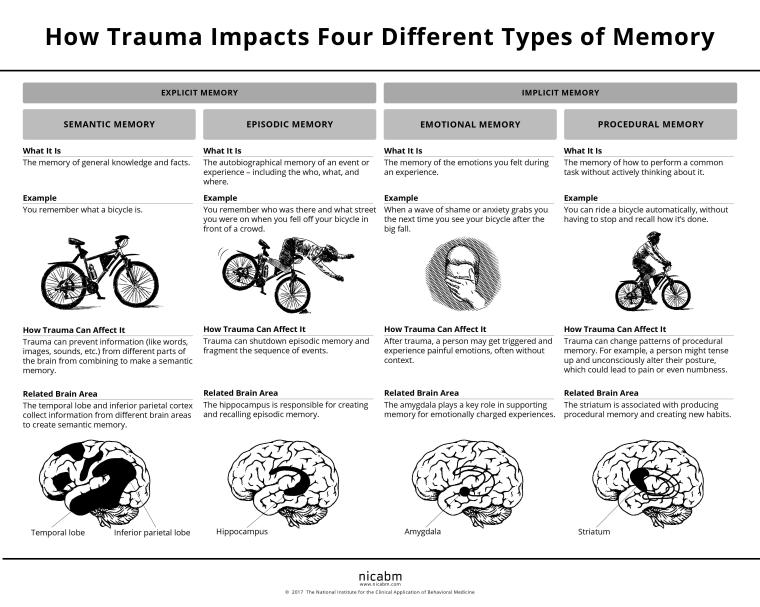
Download this infographic here!
Source: http://www.nicabm.com/trauma-how-trauma-can-impact-4-types-of-memory-infographic/
 Ron Huxley LMFT