Digital Parenting is a Big Problem for Parents in 2023

It’s 2023, and parenting is changing just like everything else at a pace parents struggle to cope with. Technology has changed the way we communicate, the way we learn, and even the way we parent. It’s no surprise that digital parenting will be one of the biggest problems.

First, parents are trying to cope with their children’s virtual learning. With the increasing number of online classes and virtual schooling options, parents are trying to figure out how to make virtual learning work for their kids. They’re looking for ways to create a productive home learning environment, manage their kids’ online classes, and stay connected with their kids’ teachers and classmates.

Second, “digital parenting” is a growing struggle for parents in 2023. As technology becomes increasingly integrated into our lives, parents are trying to figure out how to monitor their kids’ online activities while still allowing them freedom. Parents need clarification about setting boundaries, teaching responsible screen use, and monitoring children’s digital activities. They’re attempting to protect children from cyberbullying and online predators.

Parents have differing views about how to manage their children’s screen time. With so many devices and platforms available, tracking how much time kids spend on screens can be tricky. Parents are looking for strategies to manage screen time and create a healthy balance of online and offline activities for their kids. Part of the problem is that parents need to become more familiar with the digital world, as are their children. Children can run circles around parents on operating computers and manipulating monitoring software.

It is essential that parents set some boundaries and rules, even if they are not perfect. Focus on the types of content your child can access, the amount of time they can spend online, and the people they can interact with. These boundaries should be age-appropriate and consider your child’s maturity level.

Parents will have to model responsible use of technology. Sit with children, ask questions, be open about how to use the internet safely and securely, protect themselves, and be wary of potential risks. Don’t shy away from difficult conversations about cyberbullying and online predators.

Even if you can’t control or out-think your child when it comes to technology, stay active in monitoring what your child is doing online. If warranted, search internet browser history, follow their social media accounts, and even look through children’s posts/messages.

Discuss limits with children to get their input on what they think is appropriate. Parents can make the final decisions, but getting children to take some ownership of the limits they recommend will increase cooperation. Let children teach you about social media and internet use.

Here is a list of the best websites parents can use to better understand how to manage digital parenting and technology.

  1. Common Sense Media: Common Sense Media is an invaluable resource for digital parenting. They offer various resources, from age-appropriate media recommendations to online safety tools. They also provide guidance on talking to kids about online safety and setting up parental controls.
  2. National PTA: The National Parent Teacher Association (PTA) is an excellent resource for parents looking to better understand how to manage digital parenting and technology. The PTA offers a variety of resources, including tips on how to set up a family media plan, how to talk to kids about online safety, and how to recognize signs of cyberbullying.
  3. Connect Safely: Connect Safely is a nonprofit organization providing parents with safety tips and guidance on managing digital parenting and technology. They offer a wealth of resources, including a parent guide to social media, a guide to online gaming, and advice on creating a family media plan.
  4. Parent Zone: Parent Zone is a website dedicated to helping parents and carers understand and manage digital parenting and technology. They offer a range of resources, from advice on setting up parental controls to tips on talking to kids about online safety.
  5. Net Aware: Net Aware is a website run by the UK’s National Society for the Prevention of Cruelty to Children (NSPCC). It provides parents with reviews and advice on social media platforms, apps, and games, as well as tips on how to keep children safe online.
  6. Media Smarts: Media Smarts is a Canadian organization that provides parents with resources to manage digital parenting and technology. They offer a range of resources, including tips on how to talk to kids about online safety, spot and respond to cyberbullying, and set up parental controls.
  7. Microsoft Family Safety: Microsoft Family Safety is a free app that helps parents manage their family’s digital experience. The app provides parents with tools to set limits on screen time, content, and insights into their children’s online activities.
  8. Be Internet Awesome: Be Internet Awesome is a program from Google that teaches kids digital safety and citizenship. The program includes activities, games, and resources to help kids understand online security and make intelligent decisions.

Protecting Teens from the (Potential) Dangers of Social Media

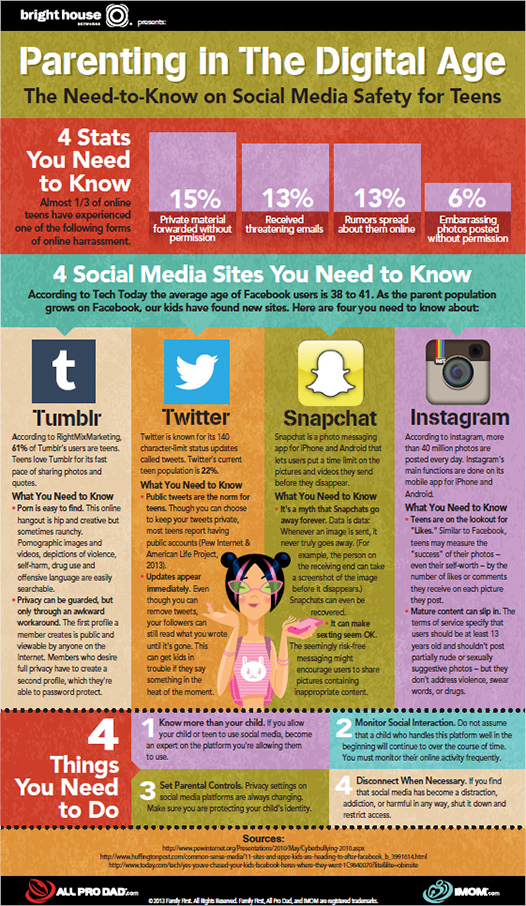
Social media has become an integral part of our everyday lives. Parents use it, just like their children. However, on average, teenagers are the ones who spend the most time on Facebook, Instagram, Snapchat, Twitter, and similar platforms. These platforms confuse and frighten parents!

Do you know what social media platforms your teen is using?

According to the report, Common Sense Media, teens spend about 9 hours on entertainment media, including social media, games, and TV, every day. 

This means that teenagers spent more time with media and technology than with parents, school work, or physical activities. 

Parents probably ask themselves: “Will my child become addicted to video games? Will this ruin their ability to think for themselves? What happens if my child is cyberbullied or becomes one? Could an online predator harm my child? Will continual screen use diminish their ability to know how to socialize normally?”

As a Child and Family Therapist, I believe parents are right to ask these questions. The issue is how to get to the answers!

Our current world makes getting answers challenging. Before the pandemic, many parents banned social media, screen use, and cell phone ownership from children, including their teenagers. After the pandemic, many children were isolated from peers without any possible way to connect. Parents had no choice but to let their children go online to stem the growing anxiety and depression their children were experiencing from the isolation. During the pandemic, children were doing school online, but many parents discovered they were “multitasking” and playing games online or talking to friends via social media while participating in school. Being online, for school or social connection, is now a regular part of our lives. It isn’t going away anytime soon.

Why are we concerned? Studies show that social media and online video games reduce our effectiveness in understanding human emotion and create a barrier to communicating deeply. There is no substitute for face-to-face interaction. The more teens spend online, the more shallow their communication and empathy skills could be. The teen years is a crucial time for skills that will sustain them in adulthood and the right mix requires real face-to-face interaction along with screen time.

Mirror neurons underlie emotional empathy

Our brains use “mirror neurons” to understand others’ perspectives and emotions through an inner imitation of other people’s actions. These special neurons reproduce emotions and actions in ourselves. This can be outside of our awareness and contributes to “gut reactions” and inform us on knowing right from wrong. It is the key to developing empathy and compassion as our neurons mirror the pain witnessed in other people. When they feel it we feel it too.

Perhaps this is why cyberbullying has become such a problem with preteens and teenagers? Maybe they cannot feel the pain and suffering of the peers they are tormenting. Without that feedback loop, they lose the natural conscience we need in social situations. Mirror neurons are also a prime component of learning, and this might account for the massive drop in school grades and homework performance. There is more to learning than facts and information. The joy of learning and the social connections that physical schools provide are a necessary part of a teens social emotional growth.

Of course, not all teens are engaged in cyberbullying or looking at inappropriate content. Many really just want to have fun and connect with peers. Teens can learn valuable things online. Additionally, many teens have found groups that support and encourage them through unique challenges in life situations, like mental health or artistic/cultural pursuits. This can’t always be found in our local community. Balance is needed and parents may need to help teens find the good and minimize the bad.

Here are some tips to help you learn more about your teen’s social media interactions and help them if necessary:

Give yourself permission, as the parent, to ask your child about concerns they have or problems they have experienced. Maybe your teen never tells you anything because you never ask, or perhaps you ask in an anxious and condemning way. Don’t assume wrongdoing but don’t be in denial either. 

If your teen gives you some pushback, don’t get offended when asked about social media use. These are normal human defenses. Just reassure them that you don’t believe they are doing something wrong but that you are curious and want to know more about social media and how it all works. Be curious and open-minded.

Get on social media yourself and learn how it works. Don’t depend on your teen to tell you everything or tell the right things. You can discover it yourself. I recommend parents friend or link to your child on various social media platforms – even though if they might think it weird. If they know you are online too and can see their content, they might think twice before posting something inappropriate. Sometimes being POTS (parent over the shoulder) has its benefits.

Parenting teens on social media might feel like the old adage: “If you can’t beat them, join them,” and that is exactly what this is…You can’t beat them, so you better join them in the online world!

If you have concerns about what your child is doing or they actively resist you finding out what they are posting or doing or who their friends are, that could be a red flag to pay attention to. Don’t go all “hair on fire” on them. Just note your concern and firmly investigate further. Don’t let a their resistance deter you. Ask questions of them, their friends, their friend’s parents, and look at their media on their devices when they sit them down. Yeah, they will get annoyed. They will live. 

I tell parents, who have real concerns about their children’s social media use, insist on having all passwords, account names and even stalk them online! Sounds harsh? It is better to have an irritated teen than an exploited one or one in deep trouble with the school or law. Even the most innocent child can get caught up in things way beyond their developmental capacity to deal with…I have seen it happen many times over. Many teens have hidden accounts, back up phone in case you take theirs, borrow their friends phone, etc.

You can take a social media fast for the entire family

You are allowed to remove all devices if needed. They may have been gifts to your child, but that gift was intended to be used correctly and safely. As a side note, many teens who lose their devices start finding more outside entertainment or real world social interactions to engage in…they frequently come out of their rooms and talk to parents. Wow, so strange, but true.

Because of this fact, take a “social media fast” for the whole family from time to time. Ban all social media and screen use for a day or a weekend. Provide lots of fun alternatives and food. Food is always helpful! Once you get past the grumbling, the home atmosphere might become more positive. 

Don’t focus so much on controlling the child as managing the media. Shaming and condemning don’t get positive results, and children can seek revenge. Be respectful but firm, loving but insistent. Tell them you are removing the devices because THEY are causing too many problems or distractions. You just want to help the ENTIRE family find a better focus and social interaction, not just the teenager, right?

Make discussions about the world and its problem a regular thing. Teenagers want and need support, and they don’t have adult wisdom and experience to manage life’s difficulties. You have to open the space to have these conversations. It may be awkward at first, but making them a normal car-ride conversation or over an after-school snack can open your child up to share their fears, anxiety, and needs. 

Parents of teens cannot effectively use control to manage them. You have to use influence if you want to have a lasting effect. Your goal for this developmental stage is to train them for adulthood. It’s only a few years away. If you tell them what to do all the time versus helping them with the best solution and sometimes experience the negative consequences of life, they won’t be ready. 

Parenting a teen is like when your child learned to walk. You couldn’t catch them every time but had to let them stumble and fall on occasions. You protected them against any serious threats (sharp objects, going into the street), but you cautiously walked alongside, encouraging and cheering on their successful steps until walking was natural. You can do this for social media and screen use too. Walk alongside them. Protect but don’t smother them. Steer them in the right direction and remove them from obvious dangerous situations. Bring a balance of off-screen activities to the family. And in the end, they will protect themselves, and be better human beings.