Page 7 of 11

It’s Almost Here! It was an honor to be able to contribute to this publication on helping grandparents raising grandchildren or aunts and uncles raising nieces and nephews or older siblings raising younger brothers and sisters or any kinship care situation. Reserve your copy today!

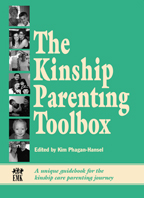
The Kinship Parenting Toolbox
A unique guidebook for the kinship care parenting journey

Edited by Kim Phagan Hansel
With 7.1 million grandchildren living with their grandparents and 4.7 million children living with “other relatives,” according to the 2010 census, almost 12 million children in America today are being raised in kinship care. Of course, this group of kinship providers comes with unique needs and challenges that they face. And the outcome for millions of children depend on the resources and support these families can access. This book helps build resources for these families, in the hopes that children’s lives will be profoundly, positively impacted.

Containing articles from more than 70 contributors touched in a variety of ways by kinship care – grandparents raising grandchildren, children raised by relatives, social workers, therapists, kinship support organizations and others, this book will be a much need resource for those working with and parenting relative’s children.

Chapters include:
The Unexpected Role
Getting Organized
Your Legal Toolbox
Your Financial Toolbox
Our Changing Family
Guilt, Shame, & Love
Perspective of the Child
Finding Support
Parenting Children from Tough Starts
Understanding Attachment
Behavior and Discipline
Working with Schools
The Teen Years
Tying Up Loose Ends
Resources

Get more info: http://www.emkpress.com/kinshiptoolbox.html

A New Organization and a New Focus: Enabling Children and Families to Succeed

by Adam Pertman

Source: http://www.huffingtonpost.com/adam-pertman/a-new-organization-and-a-new-focus_b_6543152.html

Finding safe, permanent homes for children in foster care – usually through adoption when they cannot return to their families of origin – has become a federal mandate and a national priority during the past few decades. That’s obviously a very good thing, but there’s a too-little-discussed downside to this positive trend: Far too little attention is being paid to serving children after placement to ensure that they can grow up successfully in their new families and so that their parents can successfully raise them to adulthood.

Notice the use of the word “successfully” twice in the last paragraph. It’s the key. It’s also the founding principle of a new organization I’m proud to lead, the National Center on Adoption and Permanency (NCAP). Our mission is to move policy and practice in the U.S. beyond their current concentration on child placement to a model in which enabling families of all kinds to succeed – through education, training and support services – becomes the bottom-line objective.

Along with fellow NCAP team members, I’ll be writing more about our organization and its goals in subsequent commentaries. For now, please check out our website and know we are already at work around the country. Furthermore, I’m delighted to announce that we’re entering into an exciting new partnership designed to significantly enhance our efforts; it is with the American Institutes for Research, one of the world’s largest behavioral and social science research and evaluation organizations. In addition, we are partnering with the Chronicle for Social Change, which like NCAP is dedicated to improving the lives of children, youth and families. 

Because of the traumatic experiences most children in foster care have endured, a substantial proportion of them have ongoing adjustment issues, some of which can intensify as they age. And many if not most girls and boys being adopted from institutions in other countries today have had comparable experiences that pose risks for their healthy development. 

Preparing and supporting adoptive and guardianship families before and after placement not only helps to preserve and stabilize at-risk situations, but also offers children and families the best opportunity for success. Furthermore, such adoptions not only benefit children, but also result in reduced financial and social costs to child welfare systems, governments and communities. 

A continuum of Adoption Support and Preservation (ASAP) services is needed to address the informational, therapeutic and other needs of these children and their families. The overall body of adoption-related research is clear on this count: Those who receive such services show more positive results, and those with unmet service needs are linked with poorer outcomes.

(Next June, the first national conference in over a decade to focus on ASAP – which many in the child welfare community believe is the most important issue facing their field – will take place in Nashville, TN. NCAP is among the many sponsors; learn more about the event here.) 

Our nation has made a concerted effort to move children into adoption and other forms of permanency because, from research and experience, we understand their value for girls and boys who cannot remain in their original homes, a value rooted in the belief that all of them – of every age – need and deserve nurturing families to promote optimal development and emotional security throughout their lives. Indeed, while child welfare systems in many states are still experiencing a variety of problems, it’s also the case that a combination of federal funding and other resources has made a significant difference – that is, they have contributed to a huge increase in the number of children moving from insecurity into permanency over the last few decades, from about 211,000 in FY 1988-1997 (an average of 21,000 annually) to 524,496 in the 10-year period ending in FY2012 (over 52,000 annually).

Furthermore, an analysis conducted by the Donaldson Adoption Institute indicates that, as a nation, we have made some progress in developing ASAP services, particularly in 17 states rated as having “substantial” programs. At least 13 states, however, have almost no specialized ASAP programs, and even the most developed of them often serve only a segment of children with significant needs. For example, many of the specialized therapeutic services have limits in duration or frequency or serve only children with special needs adopted from foster care in their own states, and some serve only those at imminent risk of placement outside their homes. 

To enable families to succeed, ASAP services must become an integral, essential part of adoption. Just as the complex process of treating an ongoing health issue requires continuing care, as well as specialists who understand the complications that can arise and how to best address them, the adoption of a child with complex special needs requires specific services and trained professionals to address the challenges that arise over time. 

When families struggle to address the consequences of children’s early adversity, they should be able to receive – as a matter of course integral to the adoption process, and not as an “add-on” that can be subtracted – services that meet their needs and sustain them. Adoptive families, professionals, state and federal governments, and we as a society share an obligation to provide the necessary supports to truly achieve permanency, safety and well-being for the girls and boys whom we remove from their original homes. 

Given the profound changes that have taken place in the field today, especially the reality that most adoptions in the U.S. are of children from foster care with some level of special needs, permanency for them should focus on more than just sustaining their original families when possible or finding new ones when necessary. We must also provide the resources and supports that will allow them to – here’s that word again – succeed.

Get more information at http://www.nationalcenteronadoptionandpermanency.net

Parenting Without Tears, Fears or “Rears”

by Ron Huxley, LMFT

Do you know Rudolph Driekurs? If you have ever taken a parenting class or read a parenting book you might. He was a child psychiatrist and parenting educator that wrote several books on how to change challenging behavior problems. What was unique about Dr. Driekurs is that he did it without punishment or rewards! He believed that behavior is driven by the need for social connection and feeling inadequate or not “fitting in” is what fueled a child’s misbehaviors. He concentrated on what he described as the 4 goals of misbehavior. 

Here is a list of some of Rudolph Driekurs most important parenting tools and ideas: 

Mutual respect based on the assumption of equality, is the inalienable right of all human beings. Parents who show respect for the child–while winning his respect for them–teach the child to respect himself and others. Equality in this sense is treating each person with respect and integrity, no matter what their age. This also leaves room for parents to be in charge and to set some non-negotiable rules and limits, but to do so in a respectful manner.

Encouragement implies faith in and respect for the child as he is. A child misbehaves usually when he is discouraged and believes he cannot succeed by useful means. 

Feelings of “security” are highly subjective and not necessarily related to the actual situation. Real security cannot be found from the outside; it is only possible to achieve it through the experience and feeling of having overcome difficulties. 

Punishment is outdated. A child soon considers that punishment gives him the right to punish in turn, and the retaliation of children is usually more effective than the punishment inflicted by the parents. Children often retaliate by not eating, fighting, neglecting schoolwork, or otherwise misbehaving in ways that are the most disturbing to parents. 

Natural and logical consequences are techniques, which allow the child to experience the actual result of his own behavior. 

  • Natural consequences are the direct result of the child’s behavior. 
  • Logical consequences are established by the parents, and are a direct and logical–not arbitrarily imposed – consequence of the transgression. 
  • Natural consequences are usually effective. However, when they are not effective or consequences are too far in the future, use logical consequences. 
  • Logical consequences can only be applied if there is no power contest; otherwise they degenerate into punitive retaliation. 

Acting instead of talking is more effective in conflict situations. Talking provides an opportunity for arguments in which the child can defeat the parent. If the parent maintains a calm, patient attitude, he can, through quiet action, accomplish positive results. 

Withdrawal as an effective counteraction: Withdrawal or planned ignoring (leaving the child and walking into another room) is most effective when the child demands undue attention or tries to involve you in a power contest. Often doing nothing effects wonderful results. 

Withdrawal from the provocation but not from the child. Don’t talk in moments of conflict. Give attention and recognition when children behave well, but not when they demand it with disturbing behavior. The less attention the child gets when he disturbs, the more he needs when he is cooperative. You may feel that anger helps get rid of your own tensions, but it does not teach the child what you think he should learn. Keep your emotions out of the situation.

Don’t interfere in children’s arguments. By allowing children to resolve their own conflicts they learn to get along better. Many arguments are provoked to get the parent involved, and by separating the children or acting as judge we fall for their provocation, thereby stimulating them to fight more. However, if children are hurting each other, your intervention is necessary.

Fighting requires cooperation. We tend to consider cooperation as inherent in a positive relationship only. When children fight they are also cooperating in a mutual endeavor. Often the younger, weaker child provokes a fight so the parents will act against the older child. When two children fight, they are both participating and are equally responsible. 

Take time for training and teaching the child essential skills and habits. Don’t attempt to train a child in a moment of conflict or in company. The parent who “does not have time” for such training will have to spend more time correcting an untrained child. 

Never do for a child what he can do for himself. A dependent child is a demanding child. Children become irresponsible only when we fail to give them opportunities to take on responsibility. 

Overprotection pushes a child down. Parents may feel they are giving when they act for a child; actually they are taking away the child’s right to learn and develop. Parents have an unrecognized prejudice against children; they assume children are incapable of acting responsibly. When parents begin to have faith that their children can behave in a responsible way, while allowing them to do so, the children will assume their own responsibilities. 

Over-responsible parents often produce irresponsible children. Parents who take on the responsibility of the child by reminding or doing for him, encourage the child to be irresponsible. Parents must learn to “mind their own business” and let the child learn from the logical consequences of his own behavior. 

Distinguish between positive and negative attention if you want to influence children’s behavior. Feeling unable to gain positive attention, and regarding indifference as intolerable, children resort to activities, which get them negative attention. Negative attention is the evidence that they have succeeded in accomplishing their goal. 

Understand the child’s goal. Every action of a child has a purpose. His basic aim is to have significance and his place in the group. A well-adjusted child has found his way toward social acceptance by cooperating with the requirements of the group and by making his own useful contribution to it. The misbehaving child is still trying, in a mistaken way, to feel important in his own world. For examples a young child who has never been allowed to dress himself (because “the parent is in a hurry”), who has not been allowed to help in the house (“you’re not big enough to set the table”), may lack the feeling that he is a useful, contributing member of the family, and might feel important only when arousing a parent’s anger and annoyance with misbehavior. 

The four goals of misbehavior. The child is usually unaware of his goals. His behavior, though illogical to others, is consistent with his own interpretation of his place in the family group. 

  • Attention-getting: he wants attention and service. We respond by feeling annoyed and that we need to remind and coax him. 
  • Power: he wants to be the boss. We respond by feeling provoked and get into a power contest with him–“you can’t get away with this!" 
  • Revenge: he wants to hurt us. We respond by feeling deeply hurt–"I’ll get even!" 
  • Display of inadequacy: he wants to be left alone, with no demands made upon him. We respond by feeling despair–"I don’t know what to do!" 
  • If your first impulse is to react in one of these four ways, you can be fairly sure you have discovered the goal of the child’s misbehavior. 

A child who wants to be powerful generally has a parent who also seeks power. One person cannot fight alone; when a parent learns to do nothing (by withdrawing, for example) during a power contest, the parent dissipates the child’s power and can begin to establish a healthier relationship with him. The use of power teaches children only that strong people get what they want. 

No habit is maintained if it loses its purpose, its benefits. Children tend to develop "bad” habits when they derive the benefit of negative attention. If crying or tantrums gets children what they want, they will continue to use those “bad” habits. If they don’t work, they quit using them.

Minimize mistakes. Making mistakes is human. We must have the courage to be imperfect. The child is also imperfect. Don’t make too much fuss and don’t worry about his mistakes. Build on the positive, not on the negative. 

A family meeting gives every member of the family a chance to express himself freely in all matters of both difficulty and pleasure pertaining to the family. The emphasis should be on “What we can do about the situation.” Meet regularly at the same time each week. Rotate the leader. Keep minutes. Have an equal vote for each member. Only bring those concerns to the family meeting, which are negotiable. Require a consensus, rather than a majority vote on each decision. Some family rules are non-negotiable. Perhaps explanations or reinforcement of a rule would be appropriate.

Have fun together and thereby help to develop a relationship based on enjoyment, mutual respect, love and affection, mutual confidence and trust, and a feeling of belonging. Instead of talking to nag, scold, preach, and correct, utilize talking to maintain a friendly relationship. Speak to your child with the same respect and consideration that you would express to a good friend.

Parenting and Pain

Parenting & Pain

By Ron Huxley, LMFT

It is hard to be on top of our parenting game when you are in a lot of emotional pain. This is especially challenging if the origin of this pain comes from the children that we are trying to parent. It might be simplistic to say but the pain is “painful.” It hurts! It shuts us down and drives a wall between us and others so we can’t be hurt anymore. We want to retreat to nurse our wounds before risking more in relationships. Unfortunately, the everyday tasks of life have to be completed and our children continue to need us. As a compromise to this situation, we become robotic in our actions. We are hyper-functional but we are hypo-relational. We get stuff done but we are just going through the motions and have no emotions to share. We are too raw!

If you are in this place, make a resolution to find some help through good friends, therapists, doctors, etc. There are a lot of support groups and parenting educations classes in your community. Be determined not to repeat past problems. Find new ideas and new support to achieve new, less painful interactions with your family. Second, be OK with being in a place of pain but don’t let it define you. You feel bad but YOU are not bad. Hurtful feelings are normal responses to hurtful actions they are not meant to be permanent. You will have better days again but don’t allow shame to pull you deeper into that dark place of despair. Set some boundaries, find some help and get mad a shame. It is not your friend!

A recent article by Scientific American reviews desperate attempts to change unruly teen behavior around. One of the toughest challenges is to reach an adolescent who is angry, defiant and acting out in destructive ways. Confrontational strategies and harsh punishment, the article explains, has only short-term benefits. No studies prove lasting results from this type of “scared straight” intervention. So what does work? The article ends with this summarization: 

results show that merely imposing harsh discipline on young offenders or frightening them is unlikely to help them refrain from problematic behavior. Instead teens must learn enduring tools—including better social skills, ways to communicate with parents and peers, and anger management techniques—that help them avoid future aggression. Several effective interventions do just that, including cognitive-behavior therapy, a method intended to change maladaptive thinking patterns and behaviors, and multisystemic therapy, in which parents, schools and communities develop programs to reinforce positive behaviors. Another well-supported method, aimed at improving behavior in at-risk children younger than eight years, is parent-child interaction therapy. Parents are coached by therapists in real time to respond to a child’s behavior in ways that strengthen the parent-child bond and provide incentives for cooperation [see “Behave!” by Ingrid Wickelgren; Scientific American Mind, March/April 2014].”

What can you do to strengthen your bond with your child? How can you reach his or her heart, locked behind a wall of pain and anger? Don’t expect overnight miracles. Turning your defiant teen around will require consistency and continual micro-shifts of change in you and your child. You will probably blow it on days and be exhausted from the effort on others. This is a marathon, not a sprint. Focus on who the child will be and not on who they have been or what they are doing. Consequences are natural and necessary. Boundaries are even more important! Just don’t equate your love with positive behavior. Nothing your child does should make you love him or her any less and nothing can make you love them more. Love just is…

Anger Management: “Jump!”

by Ron Huxley, LMFT

Four frogs were sitting on a log and one decides to
jump. How many frogs are left? Still four. Deciding to jump does not
mean that the frog actually did jump. Managing our anger is often the
same. We decide to make a change in our attitudes and behaviors but
we never “get off the log.” The difference between the person who
succeeds in managing anger in their life and the one who doesn’t is
commitment. One must be committed to change if it is to become a
reality. There are no easy alternatives. Stopping the destructive
path of anger is hard work and takes courage and discipline. 

Today, write out a statement of commitment to
changing the role of anger in your life. Make it strong and make it
clear. It can be as long as you like but there can not be any
ambiguities in your language. No “maybes.” No “trying.” Just “doing.”
Oh, you will mess up and you will fall a few times but you have to go
back to your statement and do it again. How many times? As many times
as it takes until anger is your slave and not the other way around.

Dear ANGER Diary

by Ron Huxley, LMFT

Have you ever kept a diary? Maybe as a child you did. I still do although I am not as diligent with it as I used to be. Using a diary is a simple way to manage your anger. Anger triggers and solutions are very predictable. Unfortunately, we miss the clues to both of these anger management tips and continue to repeat the negative process of outburst and tantrums.

Every day for two weeks, write in a diary using this four step anger management process:

1. List what made you angry.
2. List how angry it made you feel on a scale from 1 to 10, one being cool and calm and 10 being a major rage.
3. Put a plus sign (+) down if you handled it well and a minus sign (-) if you didn’t.
4. Write what you will try next time this situation presents itself.

After two weeks are over go back and see what you have learned. You will be surprised by how much info you gathered in a short time and how much insight and change you have accomplished.

Get more help on anger management by Ron at http://inner-healing.tumblr.com/anger

Dream Parenting Project: I Choose You

All families have disagreements and fights. It is easy to get into polar opposition toward one another and the result can be feelings of hurt and loss. How do you build a dream family when these painful elements exist? You make a choice! You choose one another despite the hurts. Of course, you work to change that negative atmosphere and you must have boundaries and even consequences for certain behaviors but you still make a choice to connect. Take a moment today to tell a family member: “I choose you.” If it is not safe to say it aloud, at least, say it to yourself when you are thinking about that person and how they wronged you. Again, set good boundaries and make positive, safe behavioral choices but make a choice to connect by taking your will to task and declaring: “I choose you." 

FREE Ebook: 101 Parenting Tools: Building the Family of Your Dreams

Ron Huxley wants to invite you to a special event or offer: 

Click here to enjoy a free copy of Ron’s ebook: “101 Parenting Tools: Building the Family of Your Dreams”

(via Amazon.com: 101 Parenting Tools: Building the Family of Your Dreams eBook: Ronald Huxley: Kindle Store)
Tired of time-out? Yelling and counting to three no working for you? Parents can have a whole toolbox of parenting ideas with this power packed ebook.Parents need the right tools for the job. Get 101 Parenting Tools from family therapist Ron Huxley and his popular ParentingToolbox.com website. This 53 page ebook gives an A-Z guide on how manage the toughest parenting problems. In addition, each tool lists the age of the child and parenting style (balance of love and limits) it is best suited for…get it and start taking back control of your home today!

(via Amazon.com: 101 Parenting Tools: Building the Family of Your Dreams eBook: Ronald Huxley: Kindle Store)

Tired of time-out? Yelling and counting to three no working for you? Parents can have a whole toolbox of parenting ideas with this power packed ebook.

Parents need the right tools for the job. Get 101 Parenting Tools from family therapist Ron Huxley and his popular ParentingToolbox.com website. This 53 page ebook gives an A-Z guide on how manage the toughest parenting problems. In addition, each tool lists the age of the child and parenting style (balance of love and limits) it is best suited for…get it and start taking back control of your home today!