Page 6 of 7

New evidence shows that certain types of praise can actually backfire, making kids less successful and giving them low self-esteem.

One recent report explains the results of two experiments that compare the results of “person praise” (praise for personal qualities) and “process praise” (praise for behavior). Overall, person praise (“You are so smart!”) predisposed children to feel ashamed following failure, since they attributed the failure to their own self – some intrinsic quality. Process praise (“You worked really hard!”), on the other hand, did not have this effect, as children attributed failure to a factor that they can control – some extrinsic quality.

A similar study reveals the results of three experiments that tested the effects of inflated praise. Overall, inflated praise sent the message that kids need to continue to meet unreasonably high standards. Inflated praise decreased challenge-seeking behavior in children with low self-esteem, causing them to miss out on learning experiences. However, in children with high self-esteem, inflated praise had the opposite effect. It inspired these kids to continue to set high expectations for themselves.
Generic person-centered praise implies that a child has a specific quality, such as intelligence, aptitude, or other talent, that is responsible for his or her achievements. Non-generic process-centered praise implies that a child’s achievements are performance-based. Person praise has been found to increase the attention that kids pay to errors – their own and others. Such attention is caused by the belief that an error threatens the possession of a positive trait. Further, after an error or failure, children who received person praise displayed less task persistence, less task enjoyment, and worse task performance.

In general, inflated and/or person-centered praise undermines motivation in children with low self-esteem. However, when sincere process-centered praise is heaped upon children, it encourages performance that is attributed to controllable causes, promotes autonomy, and establishes attainable standards and expectations.

We all think our children are great, and so we should. But, as parents we must also be mindful of setting our kids up for failure with inappropriate praise. Praising hard work seems to be a much better motivator than praising intrinsic qualities that the child has no control over.
Achievement is the result of performance and behavior, not always inherent traits, and children should be motivated to love learning, engage in new experiences, and even risk failure to achieve goals. Praise should help children flourish, instead of becoming an obstacle to success.

via Punishing with Praise | Brain Blogger)

It’s time to rebuild your family life…2014

image

Click here to get the right tools for the job…of parenting! 

Time Out? Spanking? Yelling? The more popular parenting tools but usually ineffective.

Get 101 Parenting Tools from family therapist Ron Huxley and his popular ParentingToolbox.com website. This 53 page ebook gives an A-Z guide on how manage the toughest parenting problems. In addition, each tool lists the age of the child and parenting style (balance of love and limits) it is best suited for…get it and start taking back control of your home today!

diyparent:

Grieving All The Way: 12 Ways to Cope with Grief during the 12 Days of Christmas.

by Ron Huxley, LMFT

“Grieving boys,
Grieving girls,
Grieving in the home.
Oh what terrible pain it is 
when you lose someone you love.”

(Loosely sung to the tune of Jingle Bells).

This song is not meant to be disrespectful. It is meant to demonstrate how disrespectful society can be to children who are grieving the loss of a loved one. Christmas, according to our stories, is supposed to be a magical time of the year. Children, who have lost someone they love to death or divorce, shouldn’t have the wintertime blues, should they? They should be dreaming of a white Christmas, not having their dreams shattered, right? The true story of Christmas is that many children are grieving the loss of loved ones during this season, causing Christmas morning to turn into Christmas mourning. Parents can help their children by giving them twelve gifts, for the twelve days of Christmas, to help them cope during this painful time:

Gift # 1: Educate yourself about grief. Parents can unwittingly pass on their anxieties and fears to their children. Even the best actors will give themselves away. Children are tuned into adult’s nonverbal signals. Trying to hide painful feelings or awkward emotions will only increase children’s anxieties. They will assume they are “bad” or “responsible” for the absence of the loved one. Instead of hiding your emotions, learn about the stages of grief by reading books on the subject, attending support groups for families of loss, or working with a qualified family therapist. The better you care for yourself, the better you can care for your child.

Gift # 2: Let children teach you about grief. Children respond to loss in different ways. No way is the right way. Let children teach you how they think, feel, and respond to the loss. Walk along side the child in his or her personal journey. Notice the path and scenery as well as the direction you are headed. If children are taking a destructive route (suicide or self-harm) steer them in a different direction. Don’t wait till you are stepping over the edge. Be on the look out early in the journey for upcoming dangers. Talk to qualified educators and therapists about the warning signs of suicide, chronic depression, unrealistic fears, and other self-destructive behaviors if you are concerned.

Gift # 3: Wrap your child in relationship. Just as you would wrap a Christmas present in beautiful wrapping, with string and ribbons, you can wrap your child in relationship. Healing comes in connection with healthy people. It doesn’t make up for the loss, but it does provide children with a safe environment to heal. This requires that parents spend quality time with children and permit free expression of thoughts and feelings about the loss. If a child doesn’t want to spend time with a parent or healthy adult, give him or her some space but remain available to them. Occasionally ask them how they are feeling about the loss and stay involved, physically and emotionally. 

Gift # 4: Talk openly and honestly about the loss. Many cultures avoid the topic of grief. Because the person is gone, we want the painful feelings to be gone too. But this isn’t how grief works. Grief has its own time and space to do the work of healing in children’s lives. Children need to be able to talk openly and honestly about the loss. They may have questions that can’t be answered easily. Don’t avoid them. If you don’t know the answer to the question, be honest and say so. Never tell children silly stories or lies, by saying, “Grandpa went away on a trip.” 

Gift # 5: Don’t wait for the big talk. Use little, everyday experiences to talk to children about loss. If you find a bird has died in your yard or the gold fish dies in the fish tank, use that time to talk about your child’s thoughts and feelings around their loss. When your child’s friends move away and go to another school, talk about how that feels in relation to mom and dad’s divorce. Treat loss as a “serious curiosity.” Children are naturally curious and talking about your thoughts, feelings, and ideas about loss can be an equally natural experience.

Gift # 6: Respect children’s responses, however negative they may be. Some of children’s responses to loss might be unpleasant (grumpy, rude, oppositional), unattractive (poor hygiene, messy room, poor grades) or even frightening (inconsolable crying, insomnia, and refusal to eat). Take the necessary steps to respond to their responses. Don’t judge them or shame them. Respect their responses as one of many ways to cope with a difficult, overwhelming situation. Of course, not all responses are constructive. Stop destructive ones, but do it in a sensitive manner. In addition, children should not be allowed to set their own limits by avoiding responsibilities and rules. Continue to set limits while being flexible and understanding.

Gift # 7: Expect and understand that your child may have bodily reactions to loss. When children’s hearts hurt, so do their bodies. They may experience some somatic problems, such as, stomach aches or headaches. This can be perfectly normal and if not due to a physical problem, will go away with time and support. Always check these bodily reactions out with a physician to be sure. If conditions persist, and have not physical cause, consult with a child or family therapist.

Gift # 8: If someone has died, allow the child to attend the funeral. Although children are young they need to participate in a ceremony designed to say goodbye to a loved one and find some emotional closure. Although you should never force a child to go to a funeral, don’t exclude them either. Let them set the pace for each part of the ceremony. At each step of the way, ask them if they wish to participate. They may be comfortable attending a service but not viewing an open casket. Respect their wishes. Have someone who can take them home or wait outside with them if you wish to continue and they do not. 

Gift # 9: If the lose does not involve a death or a funeral, create a ceremony to perform with the child. Rituals, traditions, and ceremonies are important physical markers of our emotional territory. They create a solid boundary for starting and stopping an activity or relationship. In the case of a divorce, no ceremony exists for a child to gain closure. Make a special dinner and eat it in memory of the person who has left. Find rituals to mark the goings and coming of children from mom’s house to dad’s house. During the Christmas holiday, find special ways to celebrate that are uniquely different from the past, such as, caroling, doing volunteer work, baking breads, hanging a special ornament, reciting the advent message, etc.

Gift # 10: Give children permission to feel relief without it being interpreted as a lack of love. In some circumstances the loss of a loved one may bring relief. For example, a family member may have suffered from a chronic illness that produced great physically pain for the victim as well as emotional pain for the family. A divorce may result in the reduction of abuse (verbal, emotional, or physical) that occurred in the home prior to one parent leaving. Children may interpret this relief as a lack of love for the loved one. Explain the differences and give them permission to feel relief that the pain has stopped, not their love.

Gift # 11: Focus on the spiritual. Use times of loss as motivations to learn more about your religious beliefs and culture. Great comfort can be found in this neglected aspect of us. Turn to your religious and cultural leaders for support. Read age appropriate materials, with your child, on religious and cultural thoughts. Attend religious and cultural functions. Don’t worry that you won’t have all the spiritual answers to loss. That really isn’t the point. Although you will find some answers, the greatest benefit is recapturing or nurturing your spiritual self. 

Gift # 12: Prepare for hard work. Grieving is complicated. Fortunately, it is also natural. If you trust the process, the work will not be as hard as if you resist it. If you or your child have not been comfortable expressing your feelings, in the past, grieving may be harder. But it will not be impossible. In fact, grieving is inevitable. Let it do its work in you, to heal you and your child, so that you and your child can do the work of grieving. And in so doing, have a merrier Christmas!

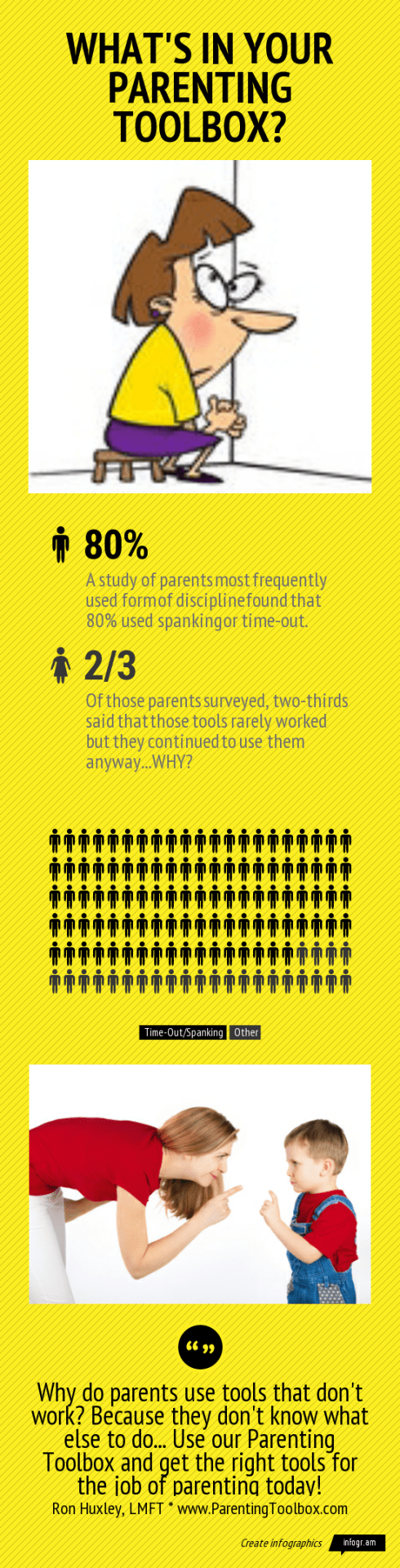
What is in your Parenting Toolbox? A study on the most widely used parenting tool revealed that most parents use time-out or spanking to discipline their children. When asked how effective their primary tool was only 1/3 stated that it worked consistently for them. That left 66.9% that felt it didn’t work. Why use a tool that doesn’t work? Because parents don’t know what else to do…

This is the mission and goal of the Ron Huxley’s Parenting Toolbox: To give parents the right tools to do the job of parenting.

What works for you? Share with us by clicking the comment button or go to Facebook at http://www.facebook.com/parentingtoolbox

or share with us on twitter at http://www.twitter.com/ronhuxley

Take your parenting measurements…

image

Does your child have so many problems that you don’t know where to start? Are you so frustrated that you can’t see or think straight? Do you feel helpless about how to make changes in your relationship with your child? Perhaps the first place to start is with a few measurements. When behaviorists study people’s behavior, they start with a baseline.

Baselines:

A baseline is a tool that is used to measure the frequency and duration of someone’s specific behavior. It can be used to measure the frequency and duration of both desirable and undesirable behavior. This dual measurement can tell parents what they want to increase and what they want to decrease, all without a lot of screaming, hair pulling, or medication!

Step 1: Measure without interventions.

The first step in determining a baseline is to measure a child’s behavior when no intervention or tool is being used with the child. This way parents can get an accurate estimation of the child’s behavior. Baselines will allow a parent to measure the effectiveness of a particular parenting tool they are using. If a parent discovers that a tool is not getting the desirable results (i.e., the misbehavior continues at the same level as before or is much worse), then the parent knows to abandon this approach and try another. Parents then find a different tool to use that gets them better results. Sound easy? Actually it isn’t but with a little practice parents can use baselines to objectively and rationally approach a behavior problem and change it.

Step 2: Basic materials and picking a behavior.

The next step is to gather a few basic materials: a piece of graph paper, pencil, and daily calendar. Write across the top of the graph paper the behavior you wish to increase or decrease. For example, you might write: “I want to increase the number of times that Tommy takes his bath on time” or “I want to decrease the number of times that Mary hits her little brother.” Picking the behavior may not be as easy at it sounds. Pick one behavior to focus on and don’t get confused with other problems at home. Be very specific about what you want to increase or decrease. Don’t write: “I want Tommy to behave.” That is too general and vague. You will never achieve that anyway, so why frustrate you and Tommy. If a behavior is extremely troublesome and/or dangerous, that is a good place to start.

To get a baseline, simply count how many times a day that particular behavior is occurring for one week. Average it on a per day basis by taking your weekly total and divide it by seven (days of the week). That will be your baseline.

Let’s say that you want Tommy to take his bath, on time, every day. At this time, Tommy only takes his bath one time per week. One is your baseline. Anything you use to increase this frequency will be considered effective. Anything that does not or reduces it to zero is not effective. After you have picked the behavior, use the bottom of the paper to list the days of the week from the calendar (Sunday, Monday… Saturday). Along the left side of the paper you will write a range of numbers, starting from the bottom and going up. The range could be from zero to ten, if the behavior you are targeting is a low frequency problem or zero to hundred, if it is a high frequency problem. I would suggest sticking with a low frequency problem. It will make the process simpler and easier to monitor.

Step 3: Pick a tool (intervention).

Now comes the fun part: Picking the tool. What will you use to increase or decrease your child’s behavior? You could do what you have always done, like Time-Out or Removing Privileges. You could read up on a couple of books, ask a wise friend or teacher, or search the Internet or download Ron Huxley’s 101 Parenting Tools ebook.

Regardless of where you go for your tools, choose only one! Use the tool of choice for a period of one week and faithfully measure how many times a day that behavior occurs with the application of the tool. Be sure that all caregivers (moms, dads, relatives, day care staff, etc.) use the same tool or you will not get a good measurement. In fact, if dad is doing one thing and mom another, you could be sabotaging each other’s efforts. Get everyone on the bandwagon and cooperating. Chart the number of times the behavior occurs (its frequency per day) and the time that it occurred. In order to see if change has occurred, parents must check to see if there is any difference between the baseline number, before any intervention was made, and the number of occurrences after an intervention is made. This final number should come close to your target number.

Let’s take another look at Tommy and his bath time. Mom and dad decided to take away Tommy’s television privileges if he did not get in the bath on time each day. They did this by simply stating the consequence ten minutes before bath time to give him time to prepare. If Tommy did not get in the bath on time (they gave him a five minute window of opportunity either way) they stated that there would be no television privileges the next morning and stuck to their decision. After a couple of days, Tommy realized that mom and dad were serious about this bath time business and decided to cooperate. He was able to get in the bath, on time, three times in one week, as a result of mom and dad’s new interventions. This was a definite increase from the baseline and considered successful by everyone. Don’t worry if the change doesn’t occur immediately. Children will test their parents to see if they really mean what they say. Consistency is one of the biggest killers of behavioral control in the home. One to two weeks may be needed to witness any real results. If the behavior is still not changing after that period of time, find a new tool. Its just a tool and not a magic wand, to wave over your child’s behavior and make it magically go away. 

What if one parent is willing to cooperate but the other is not?

This makes our task harder but not impossible. Simple measure during a time that you are able to control, say, during the daytime when dad is at work. Obviously, you must pick a target behavior that occurs during that time period and find a tool that you can administer alone. Children will adapt to the different parenting styles of their parents, even if they are exact opposites. Reward all positive, behavioral changes. This will help to maintain the behavior over a long period of time. Don’t resort to bribes, such as sweets, money, or toys. This will backfire on you. Use social praise, like: “Great job” or “I really appreciated how you did that.” This is usually sufficient for children. Any negative behavior should be ignored, as much as possible.

How long should you use the baseline tool?

Use the tool for as long as you need. Once you are getting positive results from your new tool, you can go on to targeting a new behavior or put the chart away until it is needed again. Behavior tools, like the baseline, have some limitations. Very smart children see your strategy and try to go around it or do as they are asked, during the specific time it is asked, and then immediately misbehave right after. For example, Tommy may get into the bath on time so that he can watch his favorite television programs, but right after the bath, he may become rude and obnoxious to his little sister. This is a weakness in the tool, not you. Ignore the weakness for now. All you are concerned with is increasing getting into the bath on time. Later you will address, with the baseline tool, the rude behavior. The value of this parenting tool is in its ability to get a baseline measure of a child’s behavior and to test the validity of the parenting tools your are using. It allows you to cope with feelings of frustration and target behavior objectively and without negative attention to the child. This allows the parent and the child to concentrate on more enjoyable activities together.

There are a lot of very good parenting techniques available to parents in the form of parenting books, videos and classes. I have written and taught them myself. What you don’t often hear about is how to “do" parenting when the rubber hits the road. How do you get through the daily grind of life and keep a cheerful face and engage your child (or for some us multiple children)? My best parenting advice is this: Be silly. I know, parenting should be serious, shouldn’t it? The truth is that it is serious way too often.

Silliness is a useful way to lighten up the mood in the home and to engage bored or irritable children. Over the years I have used variations on the silly theme with mostly good effect. Here’s a few to try on and see how they fit for you:

Change the game rules Parents can get exhausted playing the same old game of “Go Fish" or “Sorry.“ Anything done hundreds of times can be hum drum. Spice it up by changing the game rules. Use a pirate voice when playing a card game. “Argh, give me your fours!” Narrate the characters in the book you read at bedtime every night. Act it out instead of reading it. This weekend I played my niece, nephews and grandson Ping Pong Poetry. Every time you hit the ball you have to rhyme a word: Ping, sing, ring, thing, king, etc. It resulted in several belly laughs.

Tell a joke This is perhaps the simplest silly strategy. Have a long car ride? Tell a few Knock-Knock jokes. OK, you might have to do a Google search first to come up with a few but it will be worth the research! I have one I told me kids over and over again. They groaned every time I would start to tell it but I could tell by their smiles they loved the “tradition" of it as well. Want to hear it? “How do you make a hanky (handkerchief) dance? Put a little boogie in it.“ Made you laugh? I know it is a little irreverent but isn’t that the point here?

Make up a song Need to get your kids to focus and march in a file through a store without touching everything? Come up with a marching song and sing it (quietly) as you go down the aisles. Preschool teachers do this all the time to get kids to clean up their mess and move to a new classroom activity. Use it at home too.

Food can be fun Got a picky eater? Dinner time always turns into a fight? Use the food to create some fun. Put coloring food into the milk. Make a game out of how slowly you can eat. Wiggle your nose at others around the table and see who can catch who doing it. Eat in courses, switch seats for each one or use your opposite eating hand to do it. Make faces out of the foot as you place it on the plate. We often use special pancake forms on the griddle to make dinosaur shapes. A lot of food is package in shapes of animals or other character. I enjoy biting their heads off. Sorry, but I do. Have a crunching contest – keeps kids focused and eating mom!

Wear funny slippers My sister-in-law came over for the weekend and wore fluffy pink slippers most of the weekend. She was comfortable and the kids loved making fun of her. Keep a full house of people energized and in good humor. Alternate this strategy by wearing bright clothing, mix patterns or act cool in your shades. I am sure you have a few silly tricks up your sleeve.

Share them with us by leaving a comment or Facebook post or Tweet us! Let’s pool our silliness ideas together and use it to increase cooperation, enjoy each other more, and decrease stress levels.

Reposted from Parenting Toolbox April 2011.

Parenting Games: 3 Ways to Build More Cooperation

Sometimes parenting just seems like a game…that you can never win.

The other team has more energy, more time, and more players. To help parents improve the odds, we’ve come up with some new “game plans" that might even the score. 

Follow the Leader is a parenting tool that can be used in two ways:

 As a game; and as a “redirection" tool. When using this tool as a game, parents can invite their children to play “follow the leader.“ This game is fun on family trips or vacations. Families with more than one child can have each child take turns leading the family hike or singing a song. The leader has the power to choose which forest path to take or which song to sing. Each child (and parent) gets the opportunity to be the leader, thereby encouraging equality and fairness. When used as a “redirection” tool controlling children can be direct their need to take charge of a particular task, such as getting the family together for dinner or organizing a wood gathering party for the campfire. This is a great game to replace power-struggling.

Freeze Play is a parenting tool variation of the old stand-by: Time-Out

Time-out is usually conducted by isolating or excluding a child from the rest of the family or classroom. In this traditional form children are sent to their room, a chair in the kitchen, outside the classroom door, or left facing a wall. Time-Out has a number of disadvantages, the primary one being that it involves the use of punishment that may seem harsh to some parents and children. Some children may become out-of-control or physically destructive when put in isolation or exclusion time-out. Fortunately, parents can use a different form of time-out, that behaviorists call “nonexclusionary time-out.“

Nonexclusionary time-out, like isolation and exclusionary time-out, eliminates reinforces (interaction with others). It accomplishes this by freezing the moment of interaction with the child for a very brief, but poignant amount of time. For example, if a child starts whining when told they must wait for dinner to eat, the parent can firmly but evenly, say, “freeze!” The parent then avoids eye contact (i.e., attention during the discipline) for a few seconds and the child is prohibited from communicating during this time. Afterwards the parent can nonchalantly carry on the task at hand or use Time-In or educational parenting tool. Be careful not to place too much emphasis on talking about the misbehavior afterwards as it might inadvertently reinforce the child to misbehave again for the attention it gains.

It might be necessary for the parent to tell the child what is going to happen during “freeze play" and the expectation that there will be no communication/eye contact during that time, so that the child knows why the parent is “acting this way.“ In addition, the old rule of thumb for time-out, one minute for every year of life, can be used in Freeze Play by substituting seconds for minutes (e.g., one frozen second for every year of life.) 

Huddling is a parenting tool shorten version of a family meeting without all the fuss or preparation time.

Huddling is a quick, informal, type of family meeting that any number of family members can have together and can occur at any time or place. Football players do this before every play to make sure the team knows what the plan is and to make clear everyone’s job. Family members can stop whatever they are doing to have a quick, little meeting about a specific problem or task. Parents can play the captain by telling the family to “huddle together.” Put arms around one another for support or just gather together in a circle, face in. Talk about the problem or task and assign jobs or ask for quick input. Decide on a plan of action and say “let’ go!“ Parents can use this tool at the zoo to decide what they are going to go see first, at the restaurant to decide what everyone wants to eat, and at home to decide what toys need to be gathered up before going to the park. While these “game plans” don’t guarantee a winning season, they can coach parents on new ways to improve their performance and their satisfaction in parenting.

OK, let’s play!


Share your thoughts on these three power parenting tools by leaving a comment here or on our Facebook page at http://www.facebook.com/parentingtoolbox


You can get more quick tips to change your family dynamics and have the family you dreamed about by contacting Ron now! Click here for more information.

Do you know your child’s Love Language?

To love and be loved is the most basic of all human needs. People will go to extremes to get this need met. It forms the basis of the world’s religions. Society has capitalized on it commercially through the marketing of Hallmark cards, chocolate candy and diamond rings. Whatever its form or expression, getting the love you need and sharing it with others is a life-long process.

 One of the best books on the subject, for me, was the book “The Five Love Languages”by Dr. Gary Chapman. In a very practical manner he listed the five love languages as:

1. Words of Affirmation

2. Receiving Gifts

3. Quality Time

4. Acts of Service

5. Physical Touch

 According to the author, every one seeks to get their love needs met through these five areas. Some of us have more dominant love needs through positive words of affirmation while others feel more love through the application of touch. Regardless of the specific dialects you might speak, all of us have one or more of these basic elements in our emotional vocabulary.  

 One of the easiest ways to determine someone’s love language is to observe how they express love. We tend to speak love to others in the way we want to be spoken to. This can result in frustration for people in close relationships who persist in expressing love in ways that met their own needs but don’t take into account the language of the other person. For example, my wife might like acts of service to fulfill her needs for love while I like to receive gifts. Bringing her candy and flowers for Valentines Day might be appreciated but it will not have the same impact as cooking her dinner and drawing a bath.

Take a moment to remember the last time someone did something for you that made you feel loved. How did that action fit into the five love languages? Was it a hug? An evening out? A gift? An act of service? A kind word?

Take another moment to analyze the love needs of those closest to you? How do they fit into these five love languages? It might be more than one. Have you spoken this language in a way that meets others needs?

An unsolicited endorsement by Kathleen Karns of the Toddler Tamer.

“Raising a family today can be an almost overwhelming challenge with the diverse differences in the family both socially and culturally. We are a society of single parent families and mixed families that do not fit within the parameters of the traditional, two parent family. When tackling everything from step-parenting to behavioral problems with children, the unprepared parent can feel as though they are drowning.

To provide solutions for this social chaos, family therapist Ron Huxley enters the fray with his phenomenal system called the Parenting Toolbox. By utilizing the vast array of services and educational tools available with a subscription to www.parentingtoolbox.com, struggling parents can find the information and resources that will equip them to face the challenges associated with raising their children in today’s world. The Parenting Toolbox offers an array of tools that will enable you to become a better parent:

  1. Knowing that the most important role that you can have in life is being a parent and learning to express the value of parenthood everyday provides the beginning steps to face all of the challenges that children can bring into life.
  2. You will learn new and variable ways of disciplining children without always resorting to corporal punishment that will stimulate the mind and instill respect.
  3. Either open or improve the lines of communication between parents and their children.
  4. You will be able to learn what more about the ways you were brought up affect the way you raise you own children and provide the means to change these parental patterns.
  5. Not only will your own self-esteem get a boost that it needs, you will be able to teach your children about their own innate value.
  6. Parents are given healthy ways to deal with their anger and stress in ways that will be helpful and non-abusive.
  7. Creative strategies are introduced to deal with challenging behaviors in children in safe and productive ways.
  8. Games, puzzles, and other creative exercises both strengthen the parent’s ability to communicate important concepts to the child but also enable the child’s ability to think and reason in social settings.
  9. Parents no longer have to be in the dark when it comes to ways to raise their children that will promote spiritual growth. Parents can learn ways to incorporate their spiritual heritage into the lessons and sources provided by the parenting toolbox.
  10. More than this, Ron Huxley and the parenting toolbox will equip you with something even more valuable: guaranteed life long support. This is the real commitment that parentingtoolbox.com makes. It will be there through every stage of a child’s development to provide not only just the right tools to make you a better parent but also support through groups of parents and professionals who have been there before.

Whatever the situation, you will be able to count on the resources of this amazing system to give what you need when you need it.”

How has this blog helped you? Leave a comment here or on Facebook at http;//www.facebook.com/parentingtoolbox