Faith is a Guiding Light Through Dark Seasons

How Individual and Couples Can Find Strength Through Shared Faith

Life’s journey is often marked by unexpected twists and turns, presenting us with challenges that can test our resilience and inner strength. In the face of adversity, many individuals and couples turn to faith as a source of solace, guidance, and empowerment. Experts across various fields have recognized the profound impact that faith can have on our ability to navigate life’s difficulties with grace and fortitude.

“Faith is the bird that feels the light when the dawn is still dark,” said Rabindranath Tagore, the renowned poet and philosopher. This sentiment resonates deeply, as faith can provide a glimmer of hope and clarity even in the darkest of times, illuminating the path forward.

Dr. Kendra Cherry, a renowned psychologist, emphasizes the role of faith in fostering resilience: “Faith can serve as a powerful coping mechanism, offering individuals a sense of purpose and meaning, even in the midst of adversity. It can provide a framework for understanding and accepting life’s challenges, enabling them to persevere with greater strength and determination.”

For couples facing shared struggles, faith can be a unifying force, strengthening their bond and enabling them to support one another through difficult times. “Faith has the power to bring couples together, fostering a deeper emotional connection and shared understanding,” explains Dr. John Gottman, a renowned relationship expert. “It can provide a common language and set of values to navigate challenges as a team, reinforcing their commitment to one another.”

Faith can also play a crucial role in promoting mental and emotional well-being. “Spiritual practices, such as prayer, meditation, or contemplation, can have a calming effect on the mind and body,” says Dr. Lisa Miller, a professor of psychology and education at Columbia University. “These practices can help individuals and couples find inner peace, reduce stress and anxiety, and cultivate a sense of gratitude and acceptance, even in the face of adversity.”

Moreover, faith-based communities often provide a supportive network, offering practical assistance, emotional support, and a sense of belonging. “Being part of a faith community can be a powerful source of strength,” notes Dr. Harold Koenig, a leading researcher in the field of spirituality and health. “It can provide a safe space for individuals and couples to share their experiences, receive encouragement, and access resources to help them navigate life’s challenges.”

While faith can manifest in various forms and traditions, its essence lies in the belief in something greater than oneself, a guiding force that transcends the physical realm. As Dr. Brené Brown, a renowned researcher and author, eloquently states, “Faith is a place of mystery, where we find the courage to believe in what we cannot see and the strength to let go of our fear of uncertainty.”

In the tapestry of life, faith can serve as a powerful thread, weaving together hope, resilience, and inner strength. Whether facing personal struggles, relationship challenges, or shared adversities, embracing faith can provide individuals and couples with a profound sense of purpose, guidance, and the fortitude to navigate life’s complexities with grace and courage.

Here is an exercise to help couples discuss and share their faith with each other:

Faith Sharing Exercise

The goal of this exercise is to create a safe, open space for you and your partner to share your personal faith journeys, beliefs, and spiritual practices with one another. It is an opportunity to deepen your understanding of each other’s spiritual selves and find ways to honor and support one another’s faith within your relationship.

Materials Needed:

  • A quiet, comfortable space free from distractions
  • A small object or item that holds spiritual significance for each partner (e.g., a religious symbol, a meaningful photograph, a cherished book, etc.)

Instructions:

  1. Begin by setting an intention for the exercise. You may choose to light a candle, say a prayer, or engage in a brief meditation to create a sense of reverence and openness.
  2. Take turns sharing your spiritual item with your partner. Explain what the item represents and why it holds significance for you in your faith journey.
  3. After sharing the item, take turns responding to the following prompts:
  • Describe your earliest memory or experience related to faith or spirituality.
  • What role did faith play in your upbringing and family life?
  • How has your faith evolved or changed over time?
  • What aspects of your faith or spiritual beliefs bring you the most comfort or strength?
  • Are there any specific practices, rituals, or traditions that are particularly meaningful to you?
  • How do you envision faith playing a role in our relationship and family life?
  1. As your partner shares, practice active listening without judgment or interruption. Seek to understand their perspective and experiences with an open heart and mind.
  2. After each partner has had the opportunity to share, engage in an open dialogue. Discuss any similarities or differences in your faith journeys, beliefs, or practices. Explore ways you can support and honor each other’s spiritual needs within your relationship.
  3. Conclude the exercise by expressing gratitude for the opportunity to share and learn more about each other’s spiritual selves. You may choose to hold hands, embrace, or engage in a closing ritual or prayer that feels meaningful to both of you.

Remember, this exercise is not about convincing or converting one another but rather about fostering a deeper understanding, respect, and appreciation for each other’s spiritual paths. Approach the exercise with an open mind, a compassionate heart, and a willingness to listen and learn from one another.

The Upside of Toxic Stress

When it is chronic and untreated, adverse events can become toxic stress and severely impact individual health, social and cultural structure, and economic stability. 

Trauma affects everyone and has known no boundaries. It affects children and adults from all socioeconomic and ethnic backgrounds. It is one of the common denominators for individuals receiving services from social services organizations, and its structural disorganization shows up in correctional institutions, jails, schools, hospitals, and the workplace. 

According to the Substance Abuse and Mental Health Services Administration (SAMHSA), “individual trauma results from an event, series of events, or set of circumstances experienced by an individual as physically or emotionally harmful or life-threatening with lasting adverse effects on the individual’s functioning and mental, physical, social, emotional, or spiritual well-being.” [https://www.integration.samhsa.gov/clinical-practice/trauma-informed

The upside of recognizing the commonality of adversity and toxic stress causes us to respond compassionately to ourselves and others! 

Bessel van der Kolk, a leading researcher and author of the book “The Body Keeps the Score,” notes that “trauma is not the story of something that happened back then… it’s the current imprint of that pain, horror, and fear living inside people.” https://www.psychotherapynetworker.org/blog/details/311/video-when-is-it-trauma-bessel-van-der-kolk-explains

This continual horror, triggered by events in the individual’s world, leads to a nervous system shutdown that has repercussions in the ability to read and express social cues, access executive brain skills, and find motivation or purpose in life. For researchers like van der Kolk, the body is key to understanding trauma treatment. This insight into toxic stress opens the doors of hope to helpers burdened by the cold cognitive concepts consisting of thought processes alone. 

Recognizing the body’s role on the mind and the mind on the body has opened the door to new therapies that allow for deeper healing!

Get more healing for you and your family with Ron Huxley’s online courses at FamilyHealer.tv or schedule a session with Ron today.

A Dialogue on Mental Health, Faith, and Trauma

I had the honor of talking with John Sparrow, pastor of Equippers Church – Central Coast, on how to manage our mental health during the pandemic. John shares some of his personal journey, dealing with the stressors of life. I respond to his concerns about dealing with uncertainty, how faith helps us through the struggles of life, and some practical tools to heal from trauma. I hope you enjoy it!

Click the image to watch the full video on Facebook.

Healing Strategies for Hurt Children (and adults)

The four-fold strategy for healing hurt children includes:

  1. Calm Down The Body/Brain
  2. Elevate Executive Functioning Skills
  3. Rewrite Our Narratives
  4. Deepen Our Inner/Outer Connections. 

This is a holistic approach that is “Bottom Up / Top Down /and Spiritual Surround”

Calming down the body and brain is necessary for the thinking brain to come online. When the nervous system is in a “fight or flight” response to stress, either real or perceived, the body will work to protect itself from harm. This is important if you step into the line of traffic and a car is speeding toward you. You don’t have time to pull out your phone and do a web search on “best ways to avoid being hit by a car.” Your body/brain system will do this for you without conscious thought. We have an amazing brain that can operate under very difficult situations that would be too overwhelming or painful to process all at once. This skill doesn’t serve us well, however, when it trauma is continually triggered at work, school, or home. In those situations, the emotional brain hijacks the thinking brain and dysregulation occurs.

Elevating the executive functioning skills is a misunderstood problem when working with a hurt child. Executive skills are centered in the prefrontal area of the brain (behind the forehead and eyes) and perform emotional regulation, self-control, planning and organization, working memory, and moral reasoning. These are areas that are naturally underdeveloped in children. In traumatized children, there is a dramatic delay that decreases brain size and disconnects signals needed to use these skills. Healing strategies will “practice” these skills in a playful format.

Re-writing life narratives is the third healing strategies. Trauma wants to interpret our identity and produce negativity in our hearts and homes. A hurting child will re-act out hurt on others and the world around them because this is how they see themselves. A new, more positive and accurate worldview is needed. Adults are the co-authors who modeling heightened awareness of thoughts and emotions and call out the child’s true identity.

Deepening inner and outer connections are not just the final goal of healing strategies. It is also where we start. The support of loving parents and professionals is needed because the work cannot be done in isolation. Negativity can be controlled in the “atmosphere” of the home even when it cannot be managed in the child. When the home is too cold or hot, the temperature can be adjusted to improve the general mood. Deep expression of compassion for self and others open the heart for healing. Additionally, spiritual practices, such as forgiveness, release the pain that blocks intimacy in our relationships.

Get more information on keynote addresses and trauma-informed training on “Healing Strategies for Hurt Children” by contacting Ron Huxley at 805-709-2023 or rehuxley@gmail.com.

What is Faith-Based Trauma Therapy?

A lot of people are looking for a therapist that understands their Christian values and beliefs. I offer online therapy for teens and adults who want to deal with anxiety, trauma, and difficult life situations from a faith based perspective. I have dedicated my career to finding practical solutions that combine 30 years of traditional mental health insights and tools with spiritual interventions that integrate the whole person (Body / Mind / and Spirit).

“Trauma can affect our spirit and our spirit can heal our trauma”

Ron Huxley, Faith-Based Family Therapist and Trauma-Informed Trainer

Trauma tells us lies about our identity. It internalizes outer pain into an inner reality. It tells us that we are unsafe, unwanted, unworthy, unloveable. It must be true because we keep getting this message from the world, the universe, from God, right? It must be true because it FEELS so true, right? Fortunately, that is not right.

Faith-Based Trauma Therapy uses trauma-informed, attachment-focused, and faith-based approaches to transform the false narratives written on our hearts.

TRAUMA-INFORMED = BODY

ATTACHMENT-FOCUSED = MIND

FAITH-BASED = SPIRIT

Trauma results in broken-heartedness, people feeling poorly about themselves, being unsafe in the presence of others, and estranged from God.

Trauma dysregulates our body. It impairs the nervous system and alters a child’s development. It hijacks our thinking brains with hyper-vigilance activating the “fight or flight” mechanism God designed within us for protection. But we are not designed for the amount of stress that comes from traumatic events and it overruns our bodies/brain.

Trauma disrupts our minds. Synaptic energy flows through our brains creating thoughts and emotions. Trauma disrupts that flow of energy resulting in modern mental health issues like depression and anxiety. It presents problems in impulse control, emotional management, planning and organizational skills, task completion, memory, motivation, and self-esteem.

Trauma disconnects us from ourselves, others, and God. It brings a dark night over the soul feeling cut off from sources of support. We can’t hear God’s voice, we question his will and we wonder if we ever did know it. Our most basic building block of trust is pulled from our foundations and it feels like we are crashing inward. We isolate, insulate, and avoid others. This wall of isolation makes us feels safe but also prevents others from getting close. Trauma tells us lies about who we are and our purpose in life. It shuts down dreams and destiny. 

A powerful practice to engage in each day is to ask ourselves: “How’s my heart today?” This is a common question I ask in the therapy session which makes the inner inquiry of…

How am I feeling about myself?

How are my relationships with family and friends?

What is the level of my relationship with God?

This inquiry of the heart, done daily or maybe hourly, sets the course for healing body, mind, and spirit. We notice the hurts caused by trauma and find ways to engage them instead of avoiding them. The only way out of hurt is through the hurt. On the other side, joy is waiting for us.

This is an inner work frequently neglected in favor of outer behavior management. Outer works are more sanitary and mechanical which makes them easier to manage. Inner work can be messy. Over-focus on outer works causes family members to react versus respond to others trauma/behavior. It views the person as the problem.

The truth is that the person is not the problem. The problem is the problem. Inner work connects with the person against the problem. Together we will think about the problem and work to solve the problems that trauma bring because together there is healing.

The strategy of healing in faith-based trauma therapy includes 1. Calming the body/brain, 2. Elevating the executive functions, 3. Rewrite our life narratives, and 4. Deepen our inner and outer connections. This is a holistic approach to healing that is a “bottom up, top down and spiritual surround” interventions. 

In faith-based trauma therapy, traditional interventions blend naturally with spiritual practices to forgive relational wounds, decrease residual trauma from our nervous system, increase attachments, restore emotional balance, reprocess lies, find the new truth, process grief and restart the flow of hope in our lives.

If you would like to more about faith-based trauma therapy for yourself or your family, contact Ron Huxley today at 805-709-2023 or click here to schedule a session (in office and Skype appointments) now. 

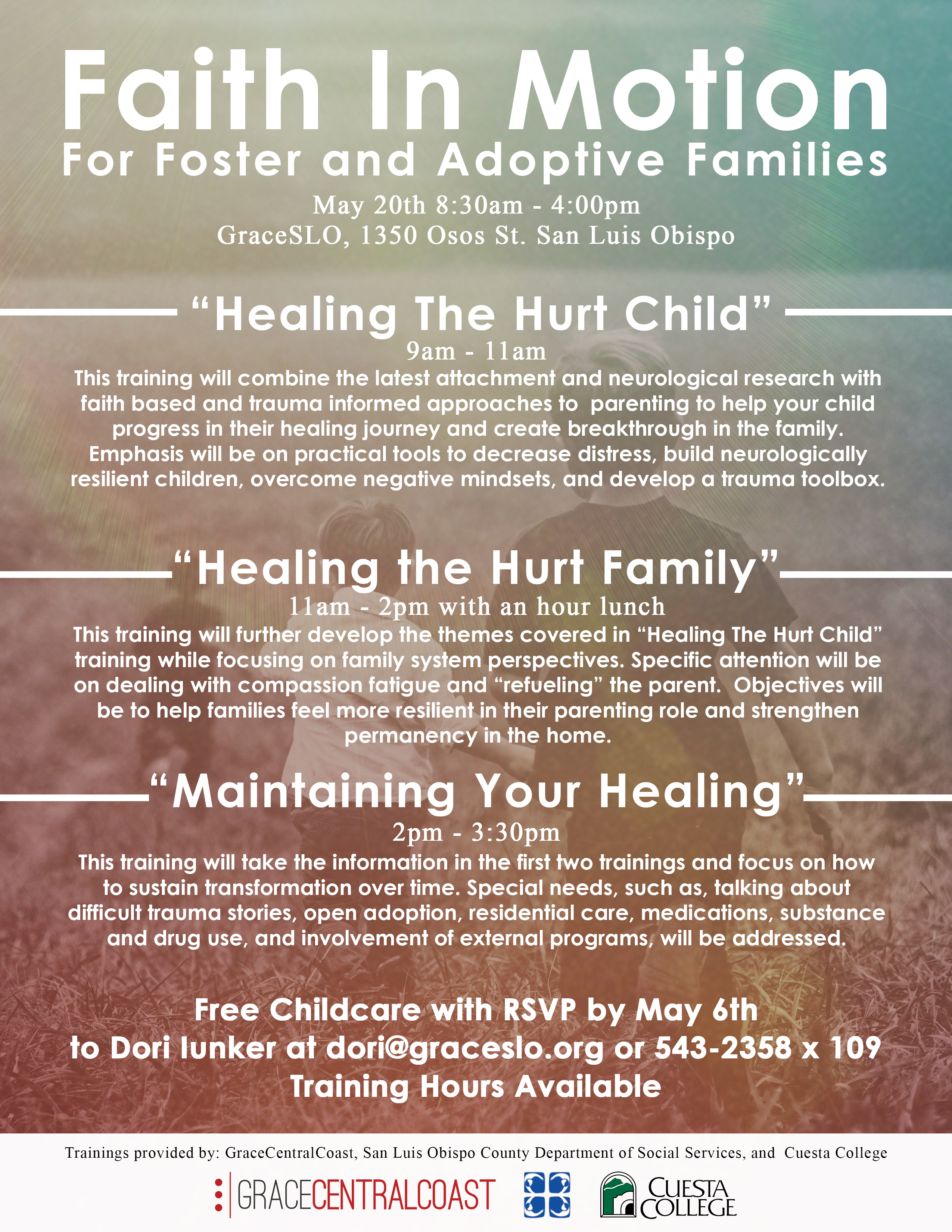
Faith-In-Motion Training Series: “Healing The Hurt Child” May 20, 2017

Adoptive and foster care children that have suffered trauma have lost their “first love”. This loss creates pain in their hearts that make it difficult to love new people, in particular new mom’s and dad’s. Every time they open up to love or be loved the pain comes up as well. This can create some very interesting reactions in the child, often seen in reactive attachment disordered children (RAD) like lying, stealing, hoarding, urinating in their rooms, hurting self and others, destroying property and a host of other emotional and social dysfunctions. The answer to this problem is to remove the pain…

Come to the free training series “Healing The Hurt Child” sponsored by San Luis Obispo Department of Social Services’ Faith-In-Motion Program, Cuesta College and Grace Slo Church. This is a full day training from 9 am to 4 pm on May 20th. Lunch is on your own but child care is provided and the training is free. Parents and professionals who work with traumatized children are welcome to attend. See the training flyer below for registration details:

FaithInMotion_TrainingDay2