The Poison Within: Understanding and Releasing Bitterness and Anger

We’ve all experienced that corrosive feeling that settles in after being hurt, betrayed, or mistreated. It starts as a sharp pain and then becomes more persistent: bitterness. Like a slow-acting poison, bitterness seeps through our emotional system, fundamentally altering how we see ourselves and the world around us.

The Bitter Cycle

Bitterness rarely exists in isolation. It’s typically accompanied by its volatile cousin, anger. While anger can be a healthy, natural response to injustice, bitterness occurs when that anger isn’t processed or released. Instead, it calcifies, becoming a lens through which we view our experiences.

Dr. Maya Thompson, a clinical psychologist specializing in emotional regulation, explains: “Bitterness is essentially anger turned inward and preserved. While immediate anger can be protective and motivating, chronic bitterness becomes self-destructive, affecting everything from our physical health to our capacity for joy.”

Research supports this view. Studies have shown correlations between unresolved anger and increased risks for cardiovascular problems, weakened immune function, and disrupted sleep patterns. Our bodies weren’t designed to carry this emotional weight indefinitely.

Recognizing the Signs

How do you know if bitterness has taken root in your life? Here are some common indicators:

  • You find yourself repeatedly revisiting old hurts, mentally rehearsing what happened and what you should have said or done
  • Cynicism has become your default perspective
  • You experience satisfaction when those who hurt you face difficulties
  • Trusting others feels increasingly impossible
  • You find yourself withdrawing from relationships to avoid potential hurt
  • Physical symptoms like tension headaches, jaw clenching, or digestive issues become frequent companions

The irony of bitterness is that while it begins as a response to being hurt by others, it ultimately hurts us more than anyone else. As the ancient proverb suggests, harboring bitterness is like drinking poison and expecting the other person to die.

The Path to Release

Breaking free from bitterness doesn’t happen overnight, but it is possible. Here are some approaches that can help:

1. Acknowledge the hurt

Bitterness often thrives in denial. By honestly acknowledging what happened and how it affected you, you begin to loosen its grip. This doesn’t mean dwelling on the hurt but giving yourself permission to feel it fully, perhaps for the first time.

2. Practice self-compassion

Beating yourself up for feeling bitter only compounds the problem. Instead, try relating to yourself with kindness. “We often judge ourselves harshly for not being able to ‘just get over it,'” notes therapist James Rivera. “But healing isn’t linear, and self-compassion creates the emotional safety needed for real change.”

3. Reframe your narrative

The stories we tell ourselves about what happened and why can either entrench bitterness or help dissolve it. Consider whether there might be alternative interpretations of events. This doesn’t mean excusing harmful behavior but freeing yourself from a narrative that keeps you stuck.

4. Set boundaries

Sometimes, bitterness persists because we remain in situations that continually reopen wounds. Setting clear boundaries—including limiting contact with certain people—can create the space needed for healing.

5. Practice forgiveness (on your own terms)

Forgiveness is often misunderstood. It doesn’t mean what happened was okay or the relationship must be restored. Instead, it’s a decision to stop allowing the hurt to control your life. As author and researcher Brené Brown puts it, “Forgiveness is not forgetting or walking away from accountability or condoning a hurtful act; it’s the process of taking back and healing our lives so we can truly live.”

6. Seek professional support

Sometimes, professional guidance becomes essential, mainly when the hurt is deep or complex. Therapies like Cognitive Behavioral Therapy (CBT), Acceptance and Commitment Therapy (ACT), and EMDR have proven effective in addressing persistent negative emotions tied to past experiences.

Finding Freedom

A 42-year-old teacher, Maria Chen, describes her journey: “After my divorce, I was consumed by bitterness. It affected my health, my work, and even how I parented. The turning point came when I realized my ex-husband had moved on completely while I was still carrying this massive emotional burden. I decided then that I deserved to be free, too.”

For Maria, healing involved therapy, journaling, and eventually, a deliberate choice to focus on rebuilding her life rather than ruminating on its collapse. “I still have moments,” she admits, “but they’re just moments now, not my entire existence.”

The Gift on the Other Side

Perhaps the most compelling reason to address bitterness is what awaits on the other side: the return of possibility. When we no longer view life through the distorted lens of past hurts, we can engage more fully with the present. Relationships become sources of joy rather than potential threats. Creativity flows more freely. We become more compassionate—both with ourselves and others.

Releasing bitterness doesn’t mean forgetting the lessons learned through difficult experiences. In fact, many find that working through bitterness eventually yields wisdom that wouldn’t have been accessible otherwise. The hurt becomes part of your story without defining it.

As you consider your own relationship with bitterness and anger, remember that seeking help isn’t a sign of weakness but of courage. In reaching for healing, you’re reclaiming your emotional well-being and your right to a future unconstrained by the past.


Leaping into 2025: Embracing Change with an Open Heart and Letting Go!

As we stand at the threshold of 2025, many of us feel like skydivers perched at the airplane door – hearts racing, minds swirling with “what-ifs.” In her profound work, Melody Beattie captures this universal fear perfectly: “Sometimes we’re so scared, all we can think to do is hang on.”

Whether entering this new year carrying hopes for career advancement, relationship healing, or personal growth, the journey ahead requires us to embrace the art of letting go. The coming year represents our metaphorical airplane door. Some of us approach it willingly, armed with resolutions and dreams. Others may be pushed toward change by circumstances beyond our control – a company restructuring, health challenges, or shifting relationships.

Fear often manifests as an intense grip on the familiar. We cling to outdated habits, toxic relationships, or unfulfilling jobs because we feel safer than the unknown. But Beattie notes that holding on is often a “silly illusion.” Like a skydiver must release the aircraft to experience the exhilarating freedom of flight, we must loosen our grip on what no longer serves us.

The Art of Letting Go: A 2025 Action Plan

Recognize Your Airplane Door

    • Identify what you need to release
    • Acknowledge if changes are voluntary or forced
    • Practice Beattie’s physical exercise: literally, drop objects while noting your resistance

    Practice Ground Training
    “Training their bodies and themselves to do it right” – Beattie

      • Start with releasing minor irritations – traffic delays, minor setbacks
      • Journal about your letting-go journey
      • Build resilience through small daily acts of surrender

      Manage the Freefall

        Use Beattie’s anxiety management techniques:

        • Deep breathing exercises
        • Positive self-talk
        • Finding humor in uncertainty
        • Accept that fear is normal during change
        • Trust the process of release

        Deploy Your Safety Measures
        “Cut away major malfunctions” – Beattie

          • Identify toxic situations requiring immediate release
          • Build a support network
          • Create contingency plans for significant life changes
          • Know when to walk away from situations that aren’t working

          Navigate the Landing

            • Actively engage with change rather than passive acceptance
            • Assess when to “push against the wind” (stand firm)
            • Celebrate small victories in letting go
            • Practice grace and resilience in facing challenges

            Remember, letting go isn’t passive surrender. Like a skydiver reading wind patterns and adjusting accordingly, we must actively engage with life’s currents. “The process of letting go,” Beattie emphasizes, “requires as much skill and attention as holding on.”

            Sometimes, life presents us with malfunctioning parachutes – situations that aren’t working despite our best efforts. The new year might require us to deploy our reserve chute by walking away from draining relationships, leaving unfulfilling careers, or abandoning strategies that no longer work. While scary, these decisions often lead to softer landings than forcing a damaged situation to work.

            As we step into 2025, let’s trust that even in freefall, we possess the strength to navigate our descent and land gracefully in new possibilities. Every skydiver was once a beginner. Start small, trust the process, and let 2025 be your conscious release and renewal year.

            The countdown to the new year has begun. What will you choose to release as you leap into 2025?

            Faith is a Guiding Light Through Dark Seasons

            How Individual and Couples Can Find Strength Through Shared Faith

            Life’s journey is often marked by unexpected twists and turns, presenting us with challenges that can test our resilience and inner strength. In the face of adversity, many individuals and couples turn to faith as a source of solace, guidance, and empowerment. Experts across various fields have recognized the profound impact that faith can have on our ability to navigate life’s difficulties with grace and fortitude.

            “Faith is the bird that feels the light when the dawn is still dark,” said Rabindranath Tagore, the renowned poet and philosopher. This sentiment resonates deeply, as faith can provide a glimmer of hope and clarity even in the darkest of times, illuminating the path forward.

            Dr. Kendra Cherry, a renowned psychologist, emphasizes the role of faith in fostering resilience: “Faith can serve as a powerful coping mechanism, offering individuals a sense of purpose and meaning, even in the midst of adversity. It can provide a framework for understanding and accepting life’s challenges, enabling them to persevere with greater strength and determination.”

            For couples facing shared struggles, faith can be a unifying force, strengthening their bond and enabling them to support one another through difficult times. “Faith has the power to bring couples together, fostering a deeper emotional connection and shared understanding,” explains Dr. John Gottman, a renowned relationship expert. “It can provide a common language and set of values to navigate challenges as a team, reinforcing their commitment to one another.”

            Faith can also play a crucial role in promoting mental and emotional well-being. “Spiritual practices, such as prayer, meditation, or contemplation, can have a calming effect on the mind and body,” says Dr. Lisa Miller, a professor of psychology and education at Columbia University. “These practices can help individuals and couples find inner peace, reduce stress and anxiety, and cultivate a sense of gratitude and acceptance, even in the face of adversity.”

            Moreover, faith-based communities often provide a supportive network, offering practical assistance, emotional support, and a sense of belonging. “Being part of a faith community can be a powerful source of strength,” notes Dr. Harold Koenig, a leading researcher in the field of spirituality and health. “It can provide a safe space for individuals and couples to share their experiences, receive encouragement, and access resources to help them navigate life’s challenges.”

            While faith can manifest in various forms and traditions, its essence lies in the belief in something greater than oneself, a guiding force that transcends the physical realm. As Dr. Brené Brown, a renowned researcher and author, eloquently states, “Faith is a place of mystery, where we find the courage to believe in what we cannot see and the strength to let go of our fear of uncertainty.”

            In the tapestry of life, faith can serve as a powerful thread, weaving together hope, resilience, and inner strength. Whether facing personal struggles, relationship challenges, or shared adversities, embracing faith can provide individuals and couples with a profound sense of purpose, guidance, and the fortitude to navigate life’s complexities with grace and courage.

            Here is an exercise to help couples discuss and share their faith with each other:

            Faith Sharing Exercise

            The goal of this exercise is to create a safe, open space for you and your partner to share your personal faith journeys, beliefs, and spiritual practices with one another. It is an opportunity to deepen your understanding of each other’s spiritual selves and find ways to honor and support one another’s faith within your relationship.

            Materials Needed:

            • A quiet, comfortable space free from distractions
            • A small object or item that holds spiritual significance for each partner (e.g., a religious symbol, a meaningful photograph, a cherished book, etc.)

            Instructions:

            1. Begin by setting an intention for the exercise. You may choose to light a candle, say a prayer, or engage in a brief meditation to create a sense of reverence and openness.
            2. Take turns sharing your spiritual item with your partner. Explain what the item represents and why it holds significance for you in your faith journey.
            3. After sharing the item, take turns responding to the following prompts:
            • Describe your earliest memory or experience related to faith or spirituality.
            • What role did faith play in your upbringing and family life?
            • How has your faith evolved or changed over time?
            • What aspects of your faith or spiritual beliefs bring you the most comfort or strength?
            • Are there any specific practices, rituals, or traditions that are particularly meaningful to you?
            • How do you envision faith playing a role in our relationship and family life?
            1. As your partner shares, practice active listening without judgment or interruption. Seek to understand their perspective and experiences with an open heart and mind.
            2. After each partner has had the opportunity to share, engage in an open dialogue. Discuss any similarities or differences in your faith journeys, beliefs, or practices. Explore ways you can support and honor each other’s spiritual needs within your relationship.
            3. Conclude the exercise by expressing gratitude for the opportunity to share and learn more about each other’s spiritual selves. You may choose to hold hands, embrace, or engage in a closing ritual or prayer that feels meaningful to both of you.

            Remember, this exercise is not about convincing or converting one another but rather about fostering a deeper understanding, respect, and appreciation for each other’s spiritual paths. Approach the exercise with an open mind, a compassionate heart, and a willingness to listen and learn from one another.

            Stop Second-Guessing Yourself: Build Confidence and Make Better Decisions

            Second-guessing oneself is a common experience that can lead to indecision, anxiety, and a lack of confidence. For many people, the constant cycle of doubting their choices and actions can be a significant challenge. However, there are ways to overcome this habit and build the confidence needed to make decisions with conviction.

            Step 1: Recognize the Pattern:

            The first step in overcoming second-guessing is to recognize the pattern. Pay attention to when and why you tend to doubt yourself. Is it in social situations, at work, or when making personal decisions? Understanding the triggers for your second-guessing can help you address the issue more effectively.

            Step 2: Challenge Negative Thoughts:

            Once you identify the pattern, work on challenging the negative thoughts that lead to second-guessing. Instead of assuming the worst or doubting your abilities, consciously replace negative thoughts with more positive and realistic ones. For example, if you catch yourself thinking “I can’t do this,” reframe it to “I have the skills and knowledge to tackle this.”

            Step 3: Practice Self-Compassion:

            It’s important to be kind to yourself when facing the challenges of second-guessing. Practice self-compassion by acknowledging that it’s okay to make mistakes and that everyone experiences moments of doubt. Treat yourself with the same understanding and encouragement that you would offer to a friend in a similar situation.

            Step 4: Seek Support and Feedback:

            Don’t be afraid to seek support and feedback from trusted friends, family members, or colleagues. Sharing your thoughts and concerns with others can provide a different perspective and help you gain clarity. Constructive feedback can also reinforce your confidence in making decisions.

            Step 5: Take Action and Embrace Mistakes:

            Overcoming second-guessing often involves taking action despite the uncertainty. Embrace the possibility of making mistakes and recognize that they are valuable learning opportunities. By taking decisive action, you can build confidence in your ability to handle challenges and make informed choices.

            Step 6: Celebrate Achievements and Progress:

            As you work on overcoming second-guessing, celebrate your achievements and progress along the way. Recognize and acknowledge the times when you make decisions without hesitation or doubt. By acknowledging your growth, you reinforce positive behaviors and build confidence in your decision-making abilities.

            Overcoming the habit of second-guessing oneself is a gradual process that requires self-confidence, and a willingness to take action. By recognizing the pattern, challenging negative thoughts, seeking support, and embracing mistakes, individuals can gradually build the confidence needed to make decisions with conviction. Through consistent practice and perseverance, it is possible to break free from the cycle of second-guessing and approach life’s challenges with greater confidence and clarity.

            Using PsychoEducation with Moral Scrupulosity and OCD: Breaking Free from the Chains of Doubt

            Living with moral scrupulosity and obsessive-compulsive disorder (OCD) can be an overwhelming experience. The constant need to prove one’s value to a higher power can be mentally and emotionally exhausting. However, with the right knowledge and therapeutic interventions, it is possible to break free from the chains of doubt and find peace within oneself. In this article, we will explore the concept of moral scrupulosity and OCD, and discuss one of the fundamental interventions that can help individuals regain control over their lives: psychoeducation.

            “The goal in treating Religious OCD is not in taking away the religion. It’s to give it back.”

            Dr. Jed Siev

            Understanding Moral Scrupulosity and OCD:

            Moral scrupulosity is a subtype of OCD characterized by an intense preoccupation with morality, religious or spiritual beliefs, and a constant fear of committing moral transgressions. Individuals with moral scrupulosity often feel an overwhelming responsibility to demonstrate their worthiness to a higher power. This can lead to the development of intrusive thoughts, doubts, and the need to engage in compulsive behaviors or rituals to alleviate the anxiety associated with these thoughts.

            According to studies, moral obsessions, which include excessive guilt, fear of committing immoral acts, and an overemphasis on religious or moral rules, are present in approximately 25% to 50% of individuals with OCD. However, it is important to note that not all individuals with moral obsessions meet the diagnostic criteria for moral scrupulosity.

            It’s worth mentioning that OCD as a whole affects about 2% to 3% of the general population, making it a prevalent mental health condition. While specific data on moral scrupulosity may be limited, these numbers indicate that a significant number of individuals with OCD experience moral obsessions and may benefit from targeted treatment approaches.

            The Power of Psychoeducation:

            Psychoeducation plays a crucial role in the treatment of moral scrupulosity and OCD. It involves providing individuals with information and understanding about their condition, which can be empowering and liberating. By gaining knowledge about the nature of their thoughts and behaviors, individuals can begin to challenge the distorted beliefs that contribute to their suffering.

            Breaking Down the Beliefs:

            A key aspect of psychoeducation is helping individuals identify and challenge their distorted beliefs associated with moral scrupulosity. Together with a therapist, individuals can examine the evidence supporting their beliefs and explore alternative, more balanced perspectives. This process involves recognizing that OCD thoughts are not reflective of one’s true moral character, but rather a product of the disorder itself.

            Here are a few common distorted beliefs seen in moral scrupulosity:

            1. Black-and-White Thinking: Moral scrupulosity often involves rigid thinking patterns, where individuals perceive actions and thoughts as either entirely good or completely evil, with no room for gray areas. This all-or-nothing mindset can lead to excessive guilt and anxiety. For example, a person may believe that any impure thought or minor transgression makes them inherently evil or unworthy.
            1. Exaggerated Responsibility: Those with moral scrupulosity tend to excessively assume responsibility for their thoughts, actions, and even the thoughts and actions of others. They may believe that they are solely accountable for preventing harm or ensuring perfection. For instance, someone might feel personally responsible for the moral choices of their loved ones, believing that their actions could lead to dire consequences.
            1. Hyperfocus on Intentions: Moral scrupulosity can involve an intense fixation on the purity of intentions behind actions. Individuals may believe that unless their intentions are entirely virtuous and selfless, their actions are morally flawed. This can lead to constant doubt and second-guessing of their motives. For example, a person might question whether their act of charity was driven by a genuine desire to help or if it was simply for personal recognition.
            1. Overemphasis on Rituals: Moral scrupulosity often involves a heightened focus on performing religious or moral rituals perfectly. Individuals may believe that the slightest deviation or omission from prescribed rituals can result in divine punishment or moral failure. For instance, someone may feel compelled to repeat prayers multiple times or perform rituals with excessive precision to ensure correctness.

            By challenging these distorted beliefs and exploring alternative perspectives, individuals with moral scrupulosity can gradually develop a more balanced understanding of their thoughts and actions. They can begin to separate themselves from the grip of OCD and embrace a more compassionate and accepting relationship with themselves and their moral beliefs. Remember, this process takes time and patience, and professional guidance can provide invaluable support along the way.

            Recognizing the Patterns:

            Through psychoeducation, individuals can gain insight into the patterns of their thoughts and behaviors. They can learn to identify the triggers that lead to their obsessions and compulsions, as well as understand the temporary relief that comes from engaging in these behaviors. By recognizing these patterns, individuals can begin to disrupt the cycle and develop healthier coping strategies.

            Recording or listing the patterns of thoughts and behaviors associated with moral scrupulosity can be a helpful practice in gaining awareness and identifying triggers. Here are some ways to record or list these patterns:

            1. Thought Journal: Keep a journal specifically dedicated to recording obsessive thoughts related to moral scrupulosity. Whenever a distressing thought arises, write it down along with any associated triggers, emotions, and the compulsive behaviors that follow.
            2. Behavior Log: Maintain a log to track the compulsive behaviors you engage in. Note the specific actions, the context or situation in which they occur, and any immediate relief or anxiety reduction experienced as a result.
            3. Trigger Diary: Create a diary to record triggers that prompt obsessive thoughts or anxiety related to moral scrupulosity. Note the circumstances, events, or situations that initiate distress and contribute to the onset of obsessions and compulsions.
            4. Digital Apps: Utilize mobile applications designed for tracking thoughts, emotions, and behaviors associated with OCD. These apps often include features for recording patterns, triggers, and monitoring progress over time. Examples include nOCD and MindShift.
            5. Checklists or Worksheets: Use checklists or worksheets specifically designed for tracking patterns in OCD and moral scrupulosity. These resources often provide prompts and categories to help individuals identify triggers, thoughts, emotions, and behaviors associated with their condition.
            6. Visual Representation: Some individuals find it helpful to create diagrams or visual representations of their thought patterns and behavioral cycles. This can be done through flowcharts, mind maps, or diagrams that connect triggers, thoughts, emotions, and compulsions.

            Developing Coping Mechanisms:

            Psychoeducation also involves equipping individuals with practical coping mechanisms to manage their moral scrupulosity and OCD symptoms. This may include learning relaxation techniques, mindfulness exercises, and strategies to challenge and reframe negative thoughts. Mindfulness techniques can help individuals observe their thoughts without judgment, cultivating a greater sense of acceptance and reducing the urge to engage in compulsions.

            A relaxation technique that can be helpful for coping with moral OCD is Progressive Muscle Relaxation (PMR). PMR is a method that involves systematically tensing and relaxing different muscle groups in the body to induce a deep state of relaxation. By practicing PMR regularly, individuals can experience a sense of calm and reduce overall anxiety levels. Here’s a step-by-step guide to practicing PMR:

            1. Find a Quiet and Comfortable Space: Begin by finding a quiet and comfortable space where you can sit or lie down without distractions.
            2. Deep Breathing: Take a few deep breaths, inhaling slowly through your nose, holding the breath for a few seconds, and exhaling gently through your mouth. Focus on allowing the breath to fill your lungs fully and releasing any tension with each exhalation.
            3. Systematic Muscle Tensing: Start with your feet and work your way up through different muscle groups in your body. Tense each muscle group for 5 to 10 seconds and then release the tension. Focus your attention on the sensation of tension and relaxation in each muscle group. Here’s a suggested sequence: a. Start with your toes and feet: Curl your toes tightly and then relax.
              b. Move to your calves: Flex your calf muscles by pulling your toes towards your knees, then release the tension.
              c. Progress to your thighs: Tighten your thigh muscles by pressing your thighs together, then release.
              d. Proceed to your abdomen: Tighten your abdominal muscles by pulling your belly button towards your spine, then release.
              e. Move to your hands and forearms: Clench your fists and tense your forearms, then release the tension.
              f. Proceed to your upper arms and shoulders: Raise your shoulders towards your ears and tense your upper arm muscles, then release.
              g. Move to your facial muscles: Scrunch your face tightly, including your forehead, eyes, and jaw muscles, then release.
            4. Focus on Relaxation: After tensing and releasing each muscle group, focus on the sensation of relaxation and the contrast between tension and relaxation. Notice any sensations of warmth, heaviness, or comfort as you let go of tension.
            5. Repeat the Process: Repeat the process of tensing and relaxing each muscle group, gradually moving up through your body, until you have gone through all major muscle groups.
            6. Full Body Relaxation: Once you have completed the muscle groups, take a few moments to enjoy the overall relaxation in your entire body. Allow yourself to fully experience the deep state of relaxation.
            7. Practice Regularly: To experience the full benefits of PMR, make it a regular practice. Set aside dedicated time each day to practice PMR, especially during times of heightened anxiety or distress.

            Building a Support System:

            In addition to providing information, psychoeducation emphasizes the importance of building a support system. Connecting with others who understand the challenges of moral scrupulosity and OCD can provide validation, encouragement, and a sense of community. Support groups or therapy sessions can be invaluable resources, offering a safe space to share experiences, gain insights, and receive support.

            Here are some ways to establish and nurture those connections:

            1. Seek Professional Help: Reach out to mental health professionals who specialize in OCD or anxiety disorders. They can provide guidance, therapy, and support tailored to your specific needs.
            2. Join Support Groups: Look for local or online support groups specifically focused on OCD or moral scrupulosity. These groups provide a safe space to share experiences, gain insights, and receive support from others who understand your struggles.
            3. Involve Loved Ones: Share your experiences with trusted family members or friends. Let them know about your condition and how it impacts your life. Their understanding and support can be invaluable in your journey towards recovery.
            4. Engage in Online Communities: Connect with online communities or forums dedicated to OCD or moral scrupulosity. Platforms such as Reddit, OCDforums.org, or the IOCDF website provide spaces to connect with others facing similar challenges, ask questions, and receive support.
            5. Explore Religious Communities: Engage with religious communities or organizations that promote understanding and support for individuals dealing with moral concerns. Seek out spiritual leaders or mentors who can offer guidance and a compassionate perspective on your struggles.
            6. Utilize Helplines and Hotlines: Many mental health organizations and helplines offer confidential support and guidance. Consider reaching out to helplines dedicated to OCD or general mental health support in your country or region.
            7. Attend Workshops and Events: Look for workshops, conferences, or events focused on OCD or mental health. These gatherings provide opportunities to learn from experts, hear personal stories, and connect with others on a similar journey.
            8. Online Therapy: Explore the option of online therapy platforms that connect you with licensed therapists through video sessions. This allows you to receive support from the comfort of your own home.

            Remember, establishing and nurturing support systems may require time and effort, but the benefits of connecting with others who understand your experiences and can provide support and encouragement are invaluable. Reach out, seek connections, and don’t hesitate to lean on your support system when you need it.

            Books on OCD and Moral Scrupulosity:

            Here are some popular books that address moral OCD or OCD in general, which can provide valuable insights and support for individuals dealing with moral scrupulosity:

            1. “The Imp of the Mind: Exploring the Silent Epidemic of Obsessive Bad Thoughts” by Lee Baer, Ph.D.
            • This book delves into the nature of intrusive thoughts, including moral obsessions, and provides practical strategies for managing and overcoming them.
            1. “Freedom from Obsessive-Compulsive Disorder: A Personalized Recovery Program for Living with Uncertainty” by Jonathan Grayson, Ph.D.
            • Dr. Grayson, a renowned expert on OCD, offers a comprehensive guide to understanding and treating OCD, including moral scrupulosity, through Cognitive Behavioral Therapy (CBT) and Exposure and Response Prevention (ERP).
            1. “Overcoming Obsessive Thoughts: How to Gain Control of Your OCD” by David A. Clark and Christine Purdon
            • This book provides evidence-based strategies and practical exercises for managing obsessive thoughts and breaking free from OCD patterns, including moral obsessions.
            1. “The OCD Workbook: Your Guide to Breaking Free from Obsessive-Compulsive Disorder” by Bruce M. Hyman, Ph.D., and Cherry Pedrick, R.N.
            • A widely recognized resource, this workbook offers step-by-step guidance, including specific chapters on moral scrupulosity, to help individuals understand OCD, challenge distorted beliefs, and implement effective coping techniques.
            1. “Brain Lock: Free Yourself from Obsessive-Compulsive Behavior” by Jeffrey M. Schwartz, M.D.
            • Dr. Schwartz presents his Four-Step Self-Treatment Method to help individuals with OCD rewire their brains, regain control, and reduce the impact of intrusive thoughts and compulsive behaviors.

            It’s important to note that while these books provide valuable information and strategies, they are not a substitute for professional help. For a comprehensive understanding of moral scrupulosity and personalized guidance, it is recommended to consult with a mental health professional specializing in OCD or anxiety disorders.

            Online Resources:

            Here are some online sites and resources that provide information and support specifically focused on moral OCD (moral scrupulosity) and OCD in general:

            1. International OCD Foundation (IOCDF) – The official website of the IOCDF offers extensive information on OCD, including moral scrupulosity. It provides educational resources, articles, personal stories, support forums, and a directory to find specialized therapists: https://iocdf.org/
            2. OCD Action – OCD Action is a UK-based charity that provides information, support, and advocacy for individuals affected by OCD, including moral scrupulosity. Their website offers resources, a helpline, online support groups, and a forum: https://www.ocdaction.org.uk/
            3. OCD-UK – OCD-UK is another UK-based charity dedicated to supporting individuals with OCD. Their website provides information, resources, personal stories, and a forum to connect with others: https://www.ocduk.org/
            4. Reddit OCD Community – The subreddit r/OCD offers an online community where individuals can connect, share experiences, ask questions, and provide support to one another: https://www.reddit.com/r/OCD/
            5. NOCD – NOCD is an online platform that specializes in OCD treatment, including moral scrupulosity. They offer teletherapy services, self-help tools, and a community forum: https://www.treatmyocd.com/
            6. IntrusiveThoughts.org – Intrusive Thoughts is a website that provides information, resources, and support for individuals dealing with intrusive thoughts, including moral scrupulosity. It includes articles, personal stories, and a community forum: https://www.intrusivethoughts.org/
            7. Beyond OCD – Beyond OCD is a nonprofit organization that offers education, resources, and support for individuals with OCD. Their website provides information, self-help tools, articles, and personal stories: https://beyondocd.org/

            Remember, while these online sites can be valuable sources of information and support, they should not replace professional help. If you’re struggling with moral OCD or any mental health condition, it’s essential to consult with a qualified mental health professional for proper diagnosis, guidance, and treatment.
            A Dialogue on Mental Health, Faith, and Trauma

            I had the honor of talking with John Sparrow, pastor of Equippers Church – Central Coast, on how to manage our mental health during the pandemic. John shares some of his personal journey, dealing with the stressors of life. I respond to his concerns about dealing with uncertainty, how faith helps us through the struggles of life, and some practical tools to heal from trauma. I hope you enjoy it!

            Click the image to watch the full video on Facebook.

            Trauma + Faith = Resilience

            According to the National Opinion Research Center’s General, Social Survey over 90% of Americans believes in God or a higher power. Sixty percent belong to a local religious group. Another 60% think that religious matter is important or very important in how they conduct their lives, and 80% are interested in “growing spiritually”.

            Even when people do not belong to a specific religious group or identity with a particular spiritual orientation, 30% of adults state they pray daily and 80% pray when faced with a serious problem or crisis.

            Trauma is defined as any event, small or large, that overwhelms the mind and bodies ability to cope. Some people appear more resilient or able to “bounce back” in the face of trauma. Studies proof that faith is one-way children and adults can cope with traumatic events and suffering.

            The question remains “how does faith make us more resilient?” It may be that faith reduces the negative, victimized thinking that results from trauma. For example, victimized people understandable “feel” as if they are damaged, dirty, worthless, stupid, vulnerable, ashamed, or unlovable. The type of trauma might be small or large but this is a common emotional reaction to the hurt someone suffers.

            This reaction results in a lower ability to mentally plan and adaptively cope with situations create more possibility that fear, hurt, and worthlessness will result. You can see the vicious cycle that trauma can create…

            Our minds are meaning-seeking devices. We like to find things to validate our thoughts and experiences so we can better navigate future circumstances. The upside of this is that we can be more efficient problem-solvers and survive. The downside is we can unrealistic or simply untrue beliefs.

            Faith counters this downward cycle of believing, acting, and reacting by shifting the story from the negative plot lines to the bigger themes that “I am loved, valued, and cared for…even when things are bad!” Faith can override negative views of oneself with the belief that you are loved just as you are, normalize the internal spiritual struggles, encourage opening up and being vulnerable again, renewing a sense of control or mastery in life, and fostering social connections.

            Being part of a larger group of people contributes to our collective connectedness that detours isolation and loneliness and encourages greater personal healing. Research demonstrates that socially connected people are more likely to meet the demands of everyday loss and stress.

            Spirituality and religious affiliation can also benefit traumatized people from the toxic memories of the trauma event. This occurs with the individual feels they can share their grief with a greater community. Traumatic memories cannot be forgotten but they can be contained and/or unburdened when shared with fellow sufferers and with God or your higher power. This is a move toward memory instead of moving beyond memory. As one author described it: “One must have the courage of memory, because through it, one can seek God.”

            Finally, religious groups have the best inspirational self-help scripts available in the form of the Bible, Torah, Koran, other holy scriptures, liturgy, and worship. They offers a framework for dealing with trauma and copes with stress.

            Rabbi Harold Kushner, in his popular book on “When Bad Things Happen to Good People” writes:

            “In the final analysis, the question of why bad things happen to good people translates itself into some very different questions, no longer asking why something happened, but asking how we will respond, what we intend to do now that it has happened.” (p. 147) .

            Faith provides us with the HOW of living resiliently!

            REFERENCES:

            Meichenbaum, D. (2016) TRAUMA, SPIRITUALITY AND RECOVERY: TOWARD A SPIRITUALLY-INTEGRATED PSYCHOTHERAPY :

            Click to access SPIRITUALITY_PSYCHOTHERAPY.pdf

            SAMHA Website on Faith-based Communities : http://www.samhsa.gov/fbci/fbci_pubs.aspx

            Pargament, K. I., Kennell, J. et al. (1988). Religion and the problem-solving process: Three styles of coping. Journal of the Scientific Study of Religion, 29, 90-104.

            Microsoft Word – MeichSPIRITUALITY INTEGRATED PSYCHOTHERAPY1 final edits.doc

            Jay, J. (1994). Walls of wailing. Common Boundary, May/June, 30-35.

            Harold S. Kushner’s “When Bad Things Happen To Good People” New York: Schocken Books, 1981.

            Spiritual Surround: How to shift the negative atmosphere of your home.

            Join me for the third seminar in the “Healing the Traumatized Child” series November 26, 2018, from 9 am to 12 noon. The seminar will be held at GraceSlo Church on 1350 Osos St., San Luis Obispo, California.

            Healing strategies for traumatized children involve helping children help within the spiritual atmosphere of the home. Let’s explore spiritual strategies that create compassion and loving kindness in our children and ourselves. Transform negative atmospheres into hope-filled realities with this practical training by Ron Huxley, LMFT.

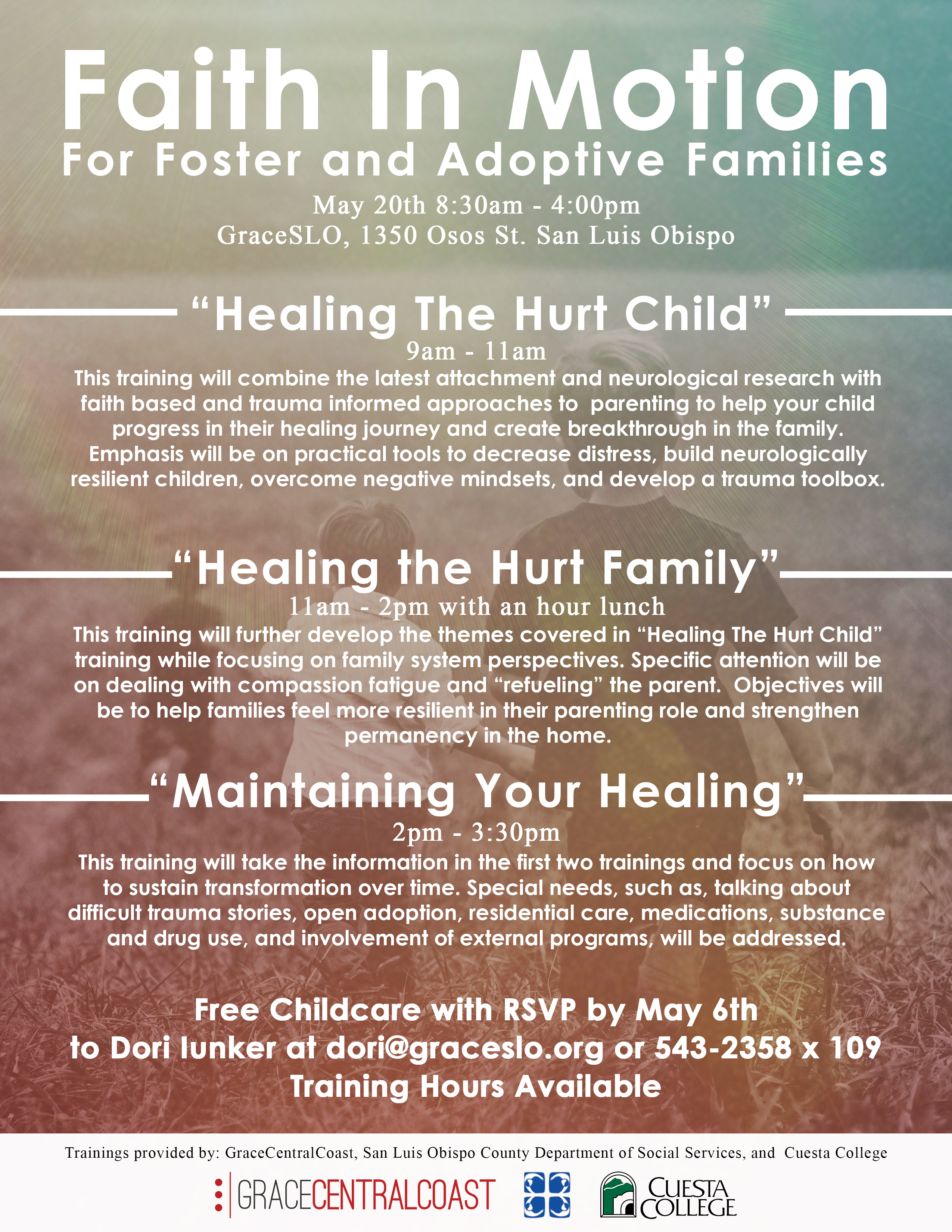
            Faith-In-Motion Training Series: “Healing The Hurt Child” May 20, 2017

            Adoptive and foster care children that have suffered trauma have lost their “first love”. This loss creates pain in their hearts that make it difficult to love new people, in particular new mom’s and dad’s. Every time they open up to love or be loved the pain comes up as well. This can create some very interesting reactions in the child, often seen in reactive attachment disordered children (RAD) like lying, stealing, hoarding, urinating in their rooms, hurting self and others, destroying property and a host of other emotional and social dysfunctions. The answer to this problem is to remove the pain…

            Come to the free training series “Healing The Hurt Child” sponsored by San Luis Obispo Department of Social Services’ Faith-In-Motion Program, Cuesta College and Grace Slo Church. This is a full day training from 9 am to 4 pm on May 20th. Lunch is on your own but child care is provided and the training is free. Parents and professionals who work with traumatized children are welcome to attend. See the training flyer below for registration details:

            FaithInMotion_TrainingDay2

            Better Beliefs Bring Better Relationships

            By Ron Huxley, LMFT

            You don’t have to keep praying for better relationships. You can just start having them. Let them start with you today. Don’t expect others to start because you did but once you start they will feel the ripple effects of it and will try to have better relationships with you as well. 

            The thing that drains you in your relationships isn’t the other person. It is the beliefs you have about that relationship that drains you. Negative emotions make you tired. 

            Change what you believe about your family. A hopeful thought will bubble up life and love that you didn’t know was still inside. Stop trying to do what you are doing better and do it with better beliefs about what is possible. Don’t wait for better days to come. Start having better attitudes and better days will come. 

            So much effort goes into changing other family members instead of changing the culture of the family. Shifting the atmosphere of the home and paying attention to examples of hope, love, kindness, celebration, patience, cooperation, respect, power, optimism, fun, playfulness, honesty, sharing, peach and more, will make those values increase. Ignoring what you dislike about your family relationships will strangle those things and they will wither away. 

            Don’t act on feelings. Feelings deceive you. They come and then they go. Let them. Practice what you believe and act on your hope of what will be and not what is going on in your relationships. Feelings are signals to the temperature level in the home. They are not the thermostat. Your beliefs are set the temperature. 

            Hurting families protect and hold back parts of themselves to avoid further hurt. Risk involves giving more of ones self to build trust and get more of the other in return and better, safer relationships develop through these small acts of faith.

            Breakthrough in the strongholds of fear will change the atmosphere of the home bringing balance in mood and reactivity. Underestimating your influence will disempower your ability to change. Stop thinking about yourself and powerless and start thinking about yourself as powerful. You have 100% power over your own life, reactions, attitude and beliefs. Your outer reality doesn’t determine your inner reality. Your inner reality will transform your outer reality. 

            It is time for unreasonable optimism about your present and future relationships. This is more than strategies to change things. It is a personal revival to change yourself. The family changes when you change.