Page 3 of 3

5 Steps to Managing Big Emotions
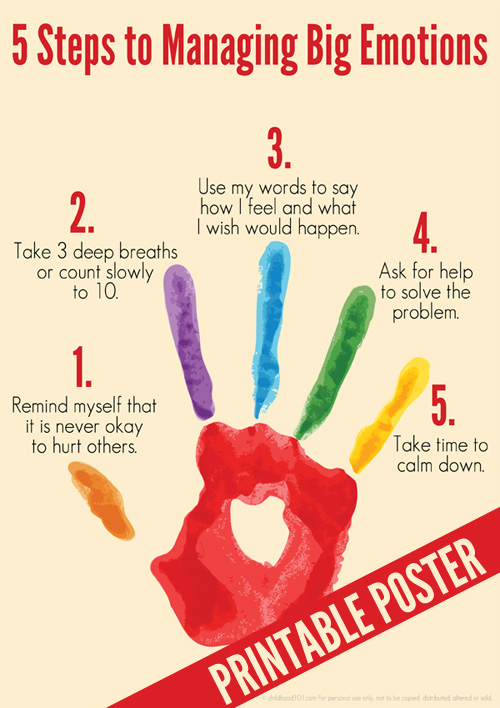
5 Steps to Managing Big Emotions
Source: http://childhood101.com/2015/03/helping-children-manage-big-emotions/
How to Engage Men in Emotional Dialogue
You would like your Boomer husband or boyfriend to open up more and talk about his emotions. He’s probably aware of his feelings; he just hasn’t said them out loud very often. He may be fearful about getting into this emotional dialogue arena with you because he knows you’re far more skilled. He needs to feel absolute trust with you before he attempts what he probably considers a death-defying act. Opening his heart with you may be a first for him in a relationship. His feeling safe is important. You already knew that an authentic relationship requires emotional dialogue, so your patience while he tries to speak from his heart is critical towards achieving this goal.
He’s likely going to have to overcome lifelong, negative feelings that trace back to his boyhood. His lesson was simple; acting like a man meant never showing or talking about physical or emotional pain. Need proof regarding how difficult talking about feelings is for men? Ask any ten men how they feel about something, and nine will respond by telling you what they think, instead. Getting him to engage in this conversation with you is a high bar for him to hurdle. His senses of safety and trust are tantamount for his success.
The point you want to share is that he can only get what he wants or needs from you if he knows how to ask for it, based on his feelings. If you and your partner follow these simple guidelines, you can deepen the intimacy in your relationship, and move it to the next level. While helping him in this endeavor isn’t your responsibility, your relationship will benefit exponentially, so consider helping him as an act of love instead of a thankless task.
1. Explain to your partner that you’re willing to abide by specific conditions if he’s willing to share what’s in his heart. Assure him in no uncertain terms that he won’t receive any judgment, opinions, or criticism from you when he’s finished, because you recognize that his feelings, like yours, are his absolute truth. Everything spoken from his heart is his truth, and as such, is not open for debate. Alternatively, his thoughts are simply his opinions, and are always open for debate. It may take a while before he’s able to separate the two and handle each as different entities.
2. Suggest that he take a few moments before speaking to connect with how he’s feeling, in his body. Is he anxious or nervous? Let him know that you’ll wait while those feelings dissipate before he shares, and that pausing might help him to more easily convey the appropriate emotions. It’s important that you wait until he’s completely finished sharing his feelings with you before responding. He may stumble a bit and need your patience while he tries to make his point. Feeling that he has control of his end of the emotional dialogue will afford him a sense of autonomy.
3. Remember, the point of asking him to share his feelings with you wasn’t to please you, but rather, to have him speak from his heart to you, without fear. You wanted to discover how he feels about you and your relationship, and now he’s told you. Whatever follows, he’s learned a critical relationship communication skill, and you’ve gotten a better sense of what direction your relationship is headed. That’s invaluable information towards building a better working relationship. He’s your equal partner now in an arena few men dare enter with a woman. Thanking him for what was probably a Herculean effort, will encourage additional emotional dialogue in the future. This is a win/win, by anyone’s standards.
Ron Huxley’s Reply: This isn’t the typical parenting post for the Parenting Toolbox blog but perhaps it should be…So many women complain over the lack of emotional sharing from dad. They assume this is due to “complacency” or lack of “compliance” (i.e., stubbornness). Often, the real reason is due to “competence” or lack of experience/education. It could also be due to low “capacity.” This last area is usually a result of early life trauma that many men suffer but society refuses to acknowledge.
Next time you are frustrated with your husband, try to be patient and take the time to retrain them. Nagging only backfires!
Teen Conflict Spillover
Parents of teens probably know this all too well. A conflict at home can mean sending your teen out the door in a funk, which can spur negative interactions outside of the home. Conversely, teens can come in the door having had a conflict with a friend and that means anyone in his or her path is in for it, too. This dynamic is what a recent study in the journal Child Development studied.
Chung and colleagues set out to examine whether or not there was spillover between conflict with parents/family and conflict with peers. As one may guess, the researchers found that when teens had a conflict with a parent or other family member they were more likely to report having a conflict with a peer, and vice versa. They referred to this phenomenon as “spillover”.
The authors discuss spillover in the context of a “transmission of negative emotions” and an extreme and negative quality that can color the adolescent emotional experience. Teens simply experience emotions with an intensity that is specific to being a teenager. With all of the changes that teens go through (remember puberty?), it would make sense that they would experience some fierce emotions.
The authors collected daily diary entries for two weeks from over 500 ninth-grade males and females from diverse backgrounds. Study participants reported on family and peer conflict, as well as emotional distress. Because the entries were subjective, the results certainly need to be interpreted within the framework of perception. That is, the diaries were the information that the teens reported to be their experiences. Asking someone else could have potentially offered different information.
In each situation of conflict, same predicted same at the highest rates. In other words, peer conflict predicted peer conflict more than family conflict predicted it. Conversely, family conflict predicted family conflict at a higher rate than peer conflict predicted it.
Although the effects were smaller, family conflict still significantly predicted same-day and next-day peer conflict. Interestingly, it also significantly predicted peer conflict two days later. Now that’s some spillover! Peer conflict significantly predicted same-day and next-day family conflict. Effects were stronger for girls than for boys and girls reported the experience of arguing with family members as being more stressful than arguing with peers.
Nobody suggests that parenting a teen is a walk in the park. On the contrary, it is a challenging time for both parent and teen and brings with it a host of trying situations unique to this phase of life. While parents can’t be there to keep peer conflict from happening, they do have some control over parent-teen conflict. And improving parent-teen conflict, according to this study, may have the added bonus of improving teen conflict with peers.
So what can parents of teens do to bring down the conflict at home? Oftentimes, learning how to talk about tough (or even not so tough) topics in a different way can make an amazing difference. I know, I know. Teens are especially clever at knowing exactly which buttons to push to make your face turn purple and your voice raise an octave or two. If you’d like to, in turn, be clever by learning some new ways to defuse these situations and make them productive rather than meet them with conflict, I definitely recommend Faber and Mazlish’s book “How to Talk So Teens Will Listen & Listen So Teens Will Talk”. It’s chock full of different techniques and strategies that both parents and teens can use to increase respect and decrease conflict while helping teens become more responsible individuals. Enjoy! -Anita
Source: Chung GH, Flook L, & Fuligni AJ (2011). Reciprocal Associations Between Family and Peer Conflict in Adolescents’ Daily Lives. Child development PMID: 2179382

Does your interactions with your teen at home affect their interactions with peers? According to this review of the research it does. Your teen will never let you know you have such an influence on them other than blame you for all the problems that exist in their lives but you do have an emotional impact, called a “spillover.”
 Ron Huxley LMFT