New evidence shows that certain types of praise can actually backfire, making kids less successful and giving them low self-esteem.
One recent report explains the results of two experiments that compare the results of “person praise” (praise for personal qualities) and “process praise” (praise for behavior). Overall, person praise (“You are so smart!”) predisposed children to feel ashamed following failure, since they attributed the failure to their own self – some intrinsic quality. Process praise (“You worked really hard!”), on the other hand, did not have this effect, as children attributed failure to a factor that they can control – some extrinsic quality.
A similar study reveals the results of three experiments that tested the effects of inflated praise. Overall, inflated praise sent the message that kids need to continue to meet unreasonably high standards. Inflated praise decreased challenge-seeking behavior in children with low self-esteem, causing them to miss out on learning experiences. However, in children with high self-esteem, inflated praise had the opposite effect. It inspired these kids to continue to set high expectations for themselves. Generic person-centered praise implies that a child has a specific quality, such as intelligence, aptitude, or other talent, that is responsible for his or her achievements. Non-generic process-centered praise implies that a child’s achievements are performance-based. Person praise has been found to increase the attention that kids pay to errors – their own and others. Such attention is caused by the belief that an error threatens the possession of a positive trait. Further, after an error or failure, children who received person praise displayed less task persistence, less task enjoyment, and worse task performance.
In general, inflated and/or person-centered praise undermines motivation in children with low self-esteem. However, when sincere process-centered praise is heaped upon children, it encourages performance that is attributed to controllable causes, promotes autonomy, and establishes attainable standards and expectations.
We all think our children are great, and so we should. But, as parents we must also be mindful of setting our kids up for failure with inappropriate praise. Praising hard work seems to be a much better motivator than praising intrinsic qualities that the child has no control over. Achievement is the result of performance and behavior, not always inherent traits, and children should be motivated to love learning, engage in new experiences, and even risk failure to achieve goals. Praise should help children flourish, instead of becoming an obstacle to success.
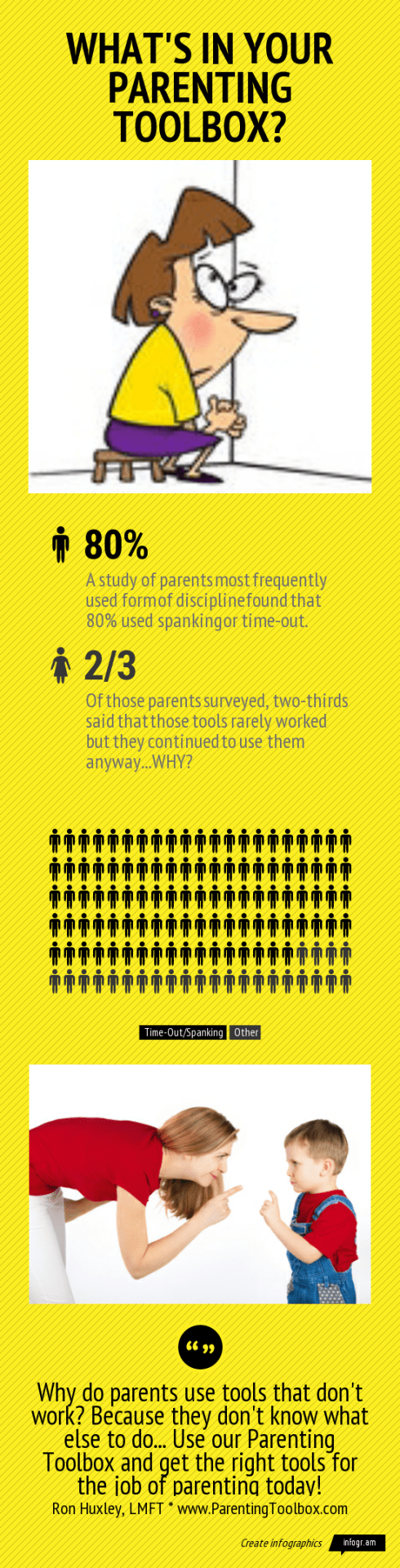
What is in your Parenting Toolbox? A study on the most widely used parenting tool revealed that most parents use time-out or spanking to discipline their children. When asked how effective their primary tool was only 1/3 stated that it worked consistently for them. That left 66.9% that felt it didn’t work. Why use a tool that doesn’t work? Because parents don’t know what else to do…
This is the mission and goal of the Ron Huxley’s Parenting Toolbox: To give parents the right tools to do the job of parenting.
Putting away laundry is often a long, lonely and profoundly boring activity that takes up so much time.
Babies generate a huge amount of laundry and cloth nappies. Toddlers and preschoolers with their rough and tumble, exploratory play.
We eventually work out a routine but countless hours are devoted to it each week. Piles loom and perhaps get moved from room to room or chair to basket.
Children love the side by side play while we are working. As I sweep he’s sweeping too. As I cook, he’s stirring too. They love to imitate and we can teach them in small steps how to do the larger things with the piece of apple technique.
Piece of apple technique
Let me tell you a quick story about the piece of apple technique. My boys love apples. If I quickly cut the apple into two huge slices either side of the core. Cut those two pieces into three, then cut the two pieces off the odd-shaped original apple, we quickly have eight pieces of apple.
Those apples when left on a plate disappear almost before the plate hits the table. Also when there’s one person eating the apple they are quick to eat it all. However, when I suggest they eat the apple by just biting it, perish the thought now, the apple isn’t often finished.
It somehow becomes too much to eat by itself
We eat in that classic pattern and leave big chunks at the top and bottom
It’s not a satisfactory outcome for me the apple buyer and them the apple eater.
They need to eat one piece then the next piece and so on to complete. It won’t always be like that but right now this system works for us both; the piece of apple technique.
So what does this story have to do with laundry?
We need to give our children a piece of the apple by teaching them and training them in the laundry process; piece by piece. Eventually they will be able to eat the whole apple and not blink an eye.
Ron Huxley Eats: I love simple parenting techniques and this is as basic as it comes…thankfully. Teach children to do tasks one step at a time but remember to teach them. Don’t yell or threaten to get compliance. Parents have to look at the job of parenting when in a challenging moment with a child.
Ron Huxley’s Remarks: Ever wonder why your child behaves at school but not at home? In this very informative article, parents.com lists 13 ways your child’s teacher uses to gain control:
Do you ever swat your child on the behind? Let’s hope not. Over the past few
decades, numerous studies have concluded that spanking isn’t the best or most
effective way to discipline a child successfully. But when your kids
misbehave, don’t replace spanking with yelling. New research shows that
screaming loudly at children may also harm them. So what can parents do when
their kids become unruly, especially with the summer vacation months upon us
and children spending more time at home?
Remember what attracted you to your mate when you first got married? Are those characteristics that originally attracted you to your partner the very things drive you crazy now? The old saying “opposites attract” may have a lot of truth when it comes to creating a balanced parenting relationship but it is also true that those styles of parenting can rips homes apart and be a source of constant parenting struggle. It is natural for people to want to fill in the gaps of their personality or find a compliment to their own skills and abilities. These different styles unconsciously “round out” their parenting roles. This is why one partner may be more aggressive, more organized, more emotional, or more controlled than the other partner and why together the two personalities seem, at least at first glance, to be a good “team.”
Just as values are largely unconscious and tucked out of parents awareness, certain styles of parenting that were attractive early on in the parenting relationship are also largely unconscious. Parents may have fallen in love, not just with the other person, but with their ability to make firm decisions or feel passionate about something. Parents may have even fallen in love with characteristics they lacked or felt they never could adequately provide for a child. The ability of one parent to follow a budget or use common sense may impress another parent whose checkbook is always unbalanced or feels their finances and life are out of control. The other person creates a sense of balance in their life that translates to a feeling of balance of love and limits during child rearing. After a while, though, these attractive attributes can become annoying. The parenting partner, who provided a sense of stability early on in the relationship and could offer common sense when the baby cried all night long, is seen as boring, emotionally detached, and too rigid later on in the relationship.
PARENTING PERSPECTIVES
Parenting changes how people perceive themselves. Setting limits on one’s checkbook is different than setting limits on a child. And nurturing oneself is very different from nurturing a totally depended, often demanding infant. This evolution from “partners in love” to “partners in parenting” creates a feeling of imbalance. Having a child forces the partners to merge two sets of cultures, parenting values, and beliefs. It also brings up positive and negative memories of a parent’s own childhood. Parents, who had abusive parents or whose partner had abusive parents, may fear their own children being abused. Parents who idealized their parents may feel incompetent when comparing their own parenting skills to their parental figures. Now, as parents, the positive attributes that attracted one parenting partner to another, reminds partners of negative traits in their own parents. The organizational skills they admired in their partner and in their own parents also remind them of the compulsive, rigid behavior of their parent. The spontaneity and attention given by one’s partner also reminds them of their parents smothering overprotection.
DECISION, DECISIONS
Having children also force partners to make decisions they never had to be make before. It requires them to act cooperatively with one another on such things as who stays home with the child when he or she is sick; how to deal with a bad grade on a report card; or how to handle a child who has an emotional or behavioral disorder, all of which can result in parental disagreements, arguments, and resentments. Even the value that parenting partners must be, act, or react in the same manner can be disastrous to a balance of love and limits. Fortunately, these differences can become the groundwork for a fuller relationship if partners are willing to learn from one another rather than continue the vicious cycle of anger and resentment. This is possible only where both parents make an honest attempt at communication and cooperation. In addition, partners can learn from one another’s differences and incorporate the others strengths into their own parenting style.
LEARNING FROM DIFFERENCES
The first step to learning from the other parenting figure is to accept that differences are acceptable, even necessary, in the parenting relationship. If one parent is to develop certain parenting characteristics they never received from their own parental figures, they must accept and allow the other person to demonstrates these qualities. Believing that the other parent has something valuable to offer the parenting relationship will create cooperation in the difficult task of raising a child rather than resentment.
The second step is to learn new ways to parent from the example of the other parent. Getting out of the way and letting them “do their thing” will not produce growth in one’s own parenting skills. Letting the other person have their way is not synonymous with learning. This can become learned helplessness, which results in negative feelings toward oneself and the other partner. While one parent may never be quite as good at setting firm rules at bedtime, they can learn to do it more frequent and more consistently than they have in the past, simply by learning from the example of the other parent.
The third step is to agree to disagree. Not every parenting decision will be made in total agreement. Nor should one person, regardless of how confident or aggressive they are in making decisions make every decision. Parenting partners can take turns on how to take care of night-time fears, with one parent singing and holding the child one week and the other parent scaring away the bedtime monsters with a flashlight, the next. Or they can compromise by finding a third, equally agreeable solution to getting their child to stay in bed. If an equally agreeable solution does not present itself, partners can always “agree to disagree” by waiting until a third solution does becomes possible. “Agreeing to disagree” is helpful when a discussion becomes “heated” and partners need to wait until both parties are feeling “cooler” and better able to see the other person’s viewpoint. This behavior is a powerful model to children. It demonstrates that parents can be different and disagree without engaging in a physical or verbal battle. It communicates to the children that “we are working it out.” And relationships can continue to be satisfying (or balanced) even when an issue is not yet settled.
The fourth step is to recognize that the negative or uncooperative behavior seen in the other parent may be a reflection of a characteristic of their own personality of their past and not the other parenting partner after all. It may be a habit learned from parental figures in one’s own childhood about how to deal with a frustrating situation or cope with a problem. Take time to reflect on your own past and talk with the other partner about childhood experiences. Insight, not ignorance, will lead to intimacy.
And the fifth step is to have a discussion on balancing parenting styles free of name-calling, blaming, or shaming one another. Don’t make the other parent feel bad by labeling them “stubborn,” talking about them in front of friends, or constantly pointing out their flaws. If this is too difficult to master, parenting partners will need to find help to deal with these destructive communication styles. While it is true that “opposites attract” it is also true that “If you can’t say anything nice, don’t say anything at all.”





 Ron Huxley LMFT