∞The Welcoming Children Home Conference 2015 is HERE!
This Saturday, November 7th from 8:30-4:00 is your chance to learn more about how you can help foster children, foster families, and your family if you have adopted. That’s right, we have workshops and speakers for every season of life whether you are college age, retired, parenting, young married, you can come and learn how to get involved and where you can help a child in crisis.
Register here http://www.welcomingchildrenhome.com/ to hear more about how to help a foster child, CASA, SAFE families, Tree of Life Crisis Pregnancy, becoming a Foster or Adoptive Parent, how to work with kids who have experienced trauma, and much more! Contact me if you have questions. Hope to see you there.
Page 4 of 6

In Defense of “Broken Families”
By Ron Huxley, LMFT
I have been noticing this term “broken families” pop up a lot recently in various professional writings and parent blogs. Each time I read it, I shudder. The underlying connotation is that a family that has undergone a divorce, death, adoption, abuse, etc. is somehow broken and unrepairable. It is a fatal diagnosis that leaves families without hope. I know, I know, it’s just language but words do have power. They percolate in the brain and become belief systems and self identifying references. The more we hear the word, the more we start to belive them and then we start to give up.
When someone witnesses a teenager with substance abuse issues, for example, people will comment: “You know they come from a broken family”. Everyone who goes through foster care, adoption, or experiences a divorce is going to have mental issues, right? Wrong. Many families deal with teenage substance abuse, not just nontraditional families. While it is possible that children of divorce may act out in antisocial ways, this doesn’t mean that all children of divorce will have issues in life that impair them. The same is true for adopted children or someone in a foster home or raised by a grandparent.
I am not denying that families do suffer from going through experiences like divorce or death or adoption. Loss is central to each of these things but that should not be a life-sentence resulting in mental and relational problems. Life is full of suffering. The focus here needs to be on how to help others cope. How can we learn from those who survive and thrive and teach it to everyone. I take affront at these comments and attitudes because they assume a dark, gloomy fate just because they have undergone a loss. That is just one path.
A recent national study on foster care and adoption in the child welfare system listed that 48% of children, in the system, have significant behavior problems. At first glance, that feels devastating but what about the other 52% that don’t? Who studies them? What makes them more of a survivor, better able to cope, more reselient? Let’s see those studies. Perhaps we could learn some useful tools to help us build strong families.
My challenge is too guard our language. This means we have to closely guard the thoughts that produce them too. We have to start looking at loss for what it is, a painful experience and not as destiny. To counter these negative connotations, try identifying the strengths of families and individuals in them. What have they done well that we can build upon? What new words can we use to describe them and assume their inevitable success in life?
National Center on Adoption and Permanency form Relationship with American Institute for Research
The National Center on Adoption and Permanency – which I am very proud to lead – has formed a partnership with the American Institutes for Research, one of the world’s largest behavioral and social science research and evaluation organizations. I am proud to be a team member of NCAP and it efforts to improve the lives of foster and adoptive children in the US. Get more info now at http://www.nationalcenteronadoptionandpermanency.net/press-releases
Grieving and the Nontraditional Family
While grief is fresh, every attempt to divert only irritates. You must wait till it be digested, and then amusement will dissipate it.
– Samuel Johnson
It has been said that the nontraditional family of yesterday is the traditional family of today! These means that the nontraditional family is fast becoming the norm in today’s society. But that also means that society is not prepared to help nontraditional parents and children cope with that reality. In particular, society has few, if any, means to help nontraditonal families cope with grief and loss, out of which they are born.
Nontraditional families include single, divorced, step or blended, adoptive, foster parents, and grandparents raising grandchildren. They are quickly becoming the majority in today’s society. Whether society/people consider them defective or less than “ideal” they are a reality and need special information and support. Most of the parenting programs available to nontraditional parents forget this reality. Consequently, the parenting programs apply only to traditional, two-parent, biologically based parents. Part of the problem is that nontraditional families have unique needs not usually experienced by traditional parents. One example of this is grief.
Grief is the state that individuals experience when a significant loss occurs in their life. The loss might occur as a result of death, divorce, and/or abandonement by a familiy member. It might be said that nontraditional families are born out of grief as they are formed as a result of a loss. This is not to say the traditional families do not experience grief but that nontraditional families have this experience, to one degree or another, in common.
Grief has predictable stages of development. This is beneficial to the nontraditional parent as they attempt to make sense of their grief experience. Most importantly they know that it will not last forever, at least not in the same intensity as when it started. Perhaps the best know framework for grief and loss are the stages listed in the work of Elisabeth Kubler-Ross who wrote the book On Death and Dying (1969). Her stages of grief include:
Denial
Anger
Bargaining
Depression
Acceptance
A useful metaphor for understanding grief are the waves of an ocean. When you are way out in the ocean, the waves are large and frightening. They pull you under and twist you about, creating a sense of hopelessness or fear of your future. This is similar to the stage of Denial or shock at the reality of the loss. When the waves pass and the ocean feels momentarily calm, this is called the stage of anger or bargaining. The shore represents the stage of acceptance. As nontraditional parents and children swim for the stage of acceptance, waves continue to crash over them, sometimes threatening to pull them under in denial and shock and at other times settling down and letting anger and bargaining propel them forward to the shore. The closer you come to the shore the less intense the waves. But even small waves, when standing on the edge of the ocean can unsettle and cause you to lose your balance.
Nontraditional parents can use this metaphor to help them balance love and limits with their children. Because they are in the ocean and not on the shore they cannot compare themselves to traditional parents. Rather than live up to society’s expectation of what an ideal family should look like, nontraditional parents need to concentrate their energy on swimming for the shore.

Kids put in institutions have different brain compositions than kids in foster care
In new research published in the journal JAMA Pediatrics, researchers looked at brain differences between Romanian children who were either abandoned and institutionalized, sent to institutions and then to foster families, or were raised in biological families.
Kids who were not raised in a family setting had noticeable alterations in the white matter of their brains later on, while the white matter in the brains of the children who were placed with a foster family looked pretty similar to the brains of the children who were raised with their biological families.
Researchers were interested in white matter, which is largely made up of nerves, because it plays an important role in connecting brain regions and maintaining networks critical for cognition. Prior research has shown that children raised in institutional environments have limited access to language and cognitive stimulation, which could hinder development.
These findings suggest that even if a child were at a risk for poor development due to their living circumstances at an early age, placing them in a new caregiving environment with more support could prevent white matter changes or perhaps even heal them.
More studies are needed, but the researchers believe their findings could help public health efforts aimed at children experiencing severe neglect, as well as efforts to build childhood resiliency.
Source:
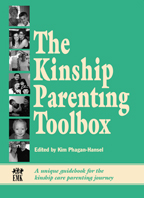
It’s Almost Here! It was an honor to be able to contribute to this publication on helping grandparents raising grandchildren or aunts and uncles raising nieces and nephews or older siblings raising younger brothers and sisters or any kinship care situation. Reserve your copy today!
The Kinship Parenting Toolbox
A unique guidebook for the kinship care parenting journey
Edited by Kim Phagan Hansel
With 7.1 million grandchildren living with their grandparents and 4.7 million children living with “other relatives,” according to the 2010 census, almost 12 million children in America today are being raised in kinship care. Of course, this group of kinship providers comes with unique needs and challenges that they face. And the outcome for millions of children depend on the resources and support these families can access. This book helps build resources for these families, in the hopes that children’s lives will be profoundly, positively impacted.
Containing articles from more than 70 contributors touched in a variety of ways by kinship care – grandparents raising grandchildren, children raised by relatives, social workers, therapists, kinship support organizations and others, this book will be a much need resource for those working with and parenting relative’s children.
Chapters include:
The Unexpected Role
Getting Organized
Your Legal Toolbox
Your Financial Toolbox
Our Changing Family
Guilt, Shame, & Love
Perspective of the Child
Finding Support
Parenting Children from Tough Starts
Understanding Attachment
Behavior and Discipline
Working with Schools
The Teen Years
Tying Up Loose Ends
Resources
Get more info: http://www.emkpress.com/kinshiptoolbox.html
A New Organization and a New Focus: Enabling Children and Families to Succeed
by Adam Pertman
Source: http://www.huffingtonpost.com/adam-pertman/a-new-organization-and-a-new-focus_b_6543152.html
Finding safe, permanent homes for children in foster care – usually through adoption when they cannot return to their families of origin – has become a federal mandate and a national priority during the past few decades. That’s obviously a very good thing, but there’s a too-little-discussed downside to this positive trend: Far too little attention is being paid to serving children after placement to ensure that they can grow up successfully in their new families and so that their parents can successfully raise them to adulthood.
Notice the use of the word “successfully” twice in the last paragraph. It’s the key. It’s also the founding principle of a new organization I’m proud to lead, the National Center on Adoption and Permanency (NCAP). Our mission is to move policy and practice in the U.S. beyond their current concentration on child placement to a model in which enabling families of all kinds to succeed – through education, training and support services – becomes the bottom-line objective.
Along with fellow NCAP team members, I’ll be writing more about our organization and its goals in subsequent commentaries. For now, please check out our website and know we are already at work around the country. Furthermore, I’m delighted to announce that we’re entering into an exciting new partnership designed to significantly enhance our efforts; it is with the American Institutes for Research, one of the world’s largest behavioral and social science research and evaluation organizations. In addition, we are partnering with the Chronicle for Social Change, which like NCAP is dedicated to improving the lives of children, youth and families.
Because of the traumatic experiences most children in foster care have endured, a substantial proportion of them have ongoing adjustment issues, some of which can intensify as they age. And many if not most girls and boys being adopted from institutions in other countries today have had comparable experiences that pose risks for their healthy development.
Preparing and supporting adoptive and guardianship families before and after placement not only helps to preserve and stabilize at-risk situations, but also offers children and families the best opportunity for success. Furthermore, such adoptions not only benefit children, but also result in reduced financial and social costs to child welfare systems, governments and communities.
A continuum of Adoption Support and Preservation (ASAP) services is needed to address the informational, therapeutic and other needs of these children and their families. The overall body of adoption-related research is clear on this count: Those who receive such services show more positive results, and those with unmet service needs are linked with poorer outcomes.
(Next June, the first national conference in over a decade to focus on ASAP – which many in the child welfare community believe is the most important issue facing their field – will take place in Nashville, TN. NCAP is among the many sponsors; learn more about the event here.)
Our nation has made a concerted effort to move children into adoption and other forms of permanency because, from research and experience, we understand their value for girls and boys who cannot remain in their original homes, a value rooted in the belief that all of them – of every age – need and deserve nurturing families to promote optimal development and emotional security throughout their lives. Indeed, while child welfare systems in many states are still experiencing a variety of problems, it’s also the case that a combination of federal funding and other resources has made a significant difference – that is, they have contributed to a huge increase in the number of children moving from insecurity into permanency over the last few decades, from about 211,000 in FY 1988-1997 (an average of 21,000 annually) to 524,496 in the 10-year period ending in FY2012 (over 52,000 annually).
Furthermore, an analysis conducted by the Donaldson Adoption Institute indicates that, as a nation, we have made some progress in developing ASAP services, particularly in 17 states rated as having “substantial” programs. At least 13 states, however, have almost no specialized ASAP programs, and even the most developed of them often serve only a segment of children with significant needs. For example, many of the specialized therapeutic services have limits in duration or frequency or serve only children with special needs adopted from foster care in their own states, and some serve only those at imminent risk of placement outside their homes.
To enable families to succeed, ASAP services must become an integral, essential part of adoption. Just as the complex process of treating an ongoing health issue requires continuing care, as well as specialists who understand the complications that can arise and how to best address them, the adoption of a child with complex special needs requires specific services and trained professionals to address the challenges that arise over time.
When families struggle to address the consequences of children’s early adversity, they should be able to receive – as a matter of course integral to the adoption process, and not as an “add-on” that can be subtracted – services that meet their needs and sustain them. Adoptive families, professionals, state and federal governments, and we as a society share an obligation to provide the necessary supports to truly achieve permanency, safety and well-being for the girls and boys whom we remove from their original homes.
Given the profound changes that have taken place in the field today, especially the reality that most adoptions in the U.S. are of children from foster care with some level of special needs, permanency for them should focus on more than just sustaining their original families when possible or finding new ones when necessary. We must also provide the resources and supports that will allow them to – here’s that word again – succeed.
Get more information at http://www.nationalcenteronadoptionandpermanency.net
National Center on Adoption and Permanency: One-Stop National Org on Adoption, Foster Care and Child Welfare
The Myriad group announced a new team of experts and trainers to provide agencies, government entities, conference organizers, family and advocacy groups, and professionals with a “one-stop” shop on expert services and consulting, information and other assistance.
Ron Huxley, founder of the Parenting Toolbox is now one of these leading mental health experts and trainers for the NCAP. Together with founders Adam Pertman (author of “The Adoption Nation” and write for the Huffington Post) and Carol Biddle, former Executive Director of the Kinship Center for Children in California they are working to deliver a new model for child welfare that is based on family success.
Read more about NCAP and the team of national experts at http://www.nationalcenteronadoptionandpermanency.net
What It Really Takes to Raise Emotionally Healthy Kids
Interview with Dr. Jonice Webb, author of Running on Empty: Overcome Your Childhood Emotional Neglect
(Source: https://www.youtube.com/)
 Ron Huxley LMFT