Manage Compassion Fatique with Self-Care Strategies
Watch more trauma-informed videos now at http://TraumaToolbox.com
Watch more trauma-informed videos now at http://TraumaToolbox.com
I am pleased to announce my Spring 2018 Seminars for Faith-In-Motion are underway…My second of four seminars will take place February 26th, from 9 am to 12 pm. See the flyer below for more details.

Grounding exercises are short, simple techniques that focus attention and distract from intense emotions.
They often involve focusing on environmental stimuli or pleasant, calming topics or objects.
They can usually be done with minimal equipment, such as a pen and paper, or nothing at all except one’s thoughts and imaginations.
Therefore they are versatile exercises that can be performed anywhere.
Grounding exercises quiet down extreme emotions and help survivors of trauma shift to a more rational form of thinking.
People with trauma will, from time to time, experience high stress or emotional overload.
This is true for people with acute trauma, complex trauma, even traumatic grief.
The goal is not to eradicate feelings of intense anxiety, sadness, or anger. Instead, learning how to respond to those emotions, in the moment, is key to our healing.
In the video above you will learn 5 powerful Grounding Exercises:
Item Listing
The 54321 Game
Task Visualization
The Method of Loci
The 5 Senses Technique
It’s always best to have multiple grounding techniques in your toolbox.
What works best for one stressful situation (a trauma flashback, for example) might not work best in another (such as prior to a job interview).
A technique that you use frequently may become less effective over time. It is best to use a variety of techniques to avoid becoming acclimated to them.
Some grounding exercises may not be a good fit for your temperament.
For example, some people find the Ice Cream Technique frustrating because they get stuck and can’t remember any additional flavor examples.
Other people find the 54321 Game unhelpful because it can draw attention toward unpleasant feelings or sights in their environment.
For each technique, there are modifications to help expand their usefulness. But some techniques might just not be for you.
Get more tools for your Trauma Toolbox at http://www.TraumaToolbox.com/
Looking for a speaker on Trauma-Informed care for your next workshop, conference, or event? Contact Ron Huxley for more information at rehuxley@gmail.com
Join me as I kick off 2018 with a new series of Faith-In-Motion Seminars. Sponsored by the San Luis Obispo County Department of Social Services, Grace Central Coast, and Cuesta College, this seminar scheduled on January 22, from 9 am to 12 noon, will be on “Healing the Family Constellation.”
I will be talking about the healing power of the family from a faith-based, trauma-informed approach. In addition, we will have a panel that represents the adoption constellation. They will share their diverse stories and answer some practical, real-life questions.
In this month’s seminar, we will discover the pro’s and con’s of open adoption, the various levels of relationship between adoptive parents, children, bio family members, extended family, and professionals. You will collect powerful trauma tools to heal the damaging effects of toxic stress and trauma. And, of course, there will be a time for questions and answers.
There is NO FEE to attend this seminar. Training hours are available. I hope to see you there.
Anxiety vs. Fear
A lot of people confuse anxiety with fear. We use the words interchangeably without much thought about the difference. Understanding the definitions will help us find the anxiety balance between acceptance and change.
Imagine you are on a rollercoaster and as you start up the hill you are starting to get tense and gripping the rail in front of you in anticipation of the drop that will come on the other side. This is anxiety. As you make the sudden plunge downward you are screaming in joyful terror and feel out of control. This is fear.
Anxiety can be described as the “fear of the fear.” The experience of fear resides in your imagination about an event in the future. It could be a real event or it could be false. Fear is the experience of terror in the present as events are actually occurring. This is important because, in anxiety, the future has not happened yet. We are anticipating a stressful event and creating our own physiological symptoms, sweating, tension, heart palpitations, in our minds. The actual events, however, justified they appear to be, have not taken place. Knowing this would suggest that we can control what we think and imagine to manage anxiety.
This presents us with a key strategy used by Marsha Linehan, Ph.D. in her program called Dialectical Behavior Therapy. Dialectical simply means “tension” between two equally valid concepts such as acceptance and change.
Acceptance & Change
While it appears that acceptance and change are opposing forces, they are actually compliments of one another in the process of managing our emotional states. Applying them together facilitates a greater sense of mastery in our lives.
For example, if we are scheduled to give a public presentation and feeling anxious about it, we simply accept that we have these feelings while also recognizing that we only have to speak for a few minutes and then it will be over. You also know there are supportive people in the audience who would never humiliate you and in fact, you are very well prepared.
You might worry about your health and while you accept that you may find out bad news and get a poor diagnosis, you also know that modern medicine has a lot of treatments, medications, and know that you trust.
This paradox creates space for skill building. If presentations are part of your work and can’t avoid doing them, you can build skills like getting a coach, go to Toastmasters, read books or watch Youtube videos to increase your confidence and abilities. If the idea of asking someone out on a date terrifies you, you can just hang out with your peers, go on group dates, find a matchmaker to help you find your true love. If you are worried about your health, because your family has bad genes, you can get a trainer, talk to doctors, develop a new eating routine, and so on. The more you build skills, the less anxious you feel about some bad event occurring in your future.
Get more information on this topic and how to build mind-full-ness into your life to balance anxiety by taking the complete “Freedom From Anxiety” program >> Click here!
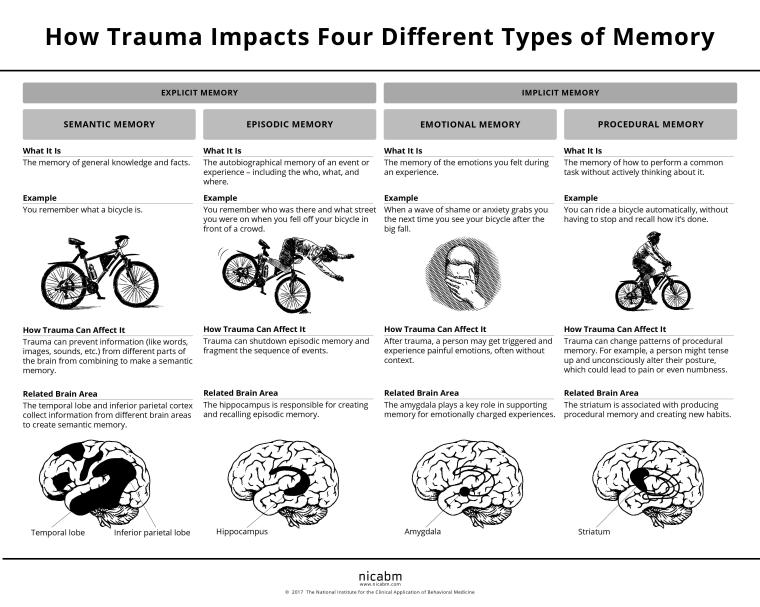
Download this infographic here!
Source: http://www.nicabm.com/trauma-how-trauma-can-impact-4-types-of-memory-infographic/

It’s been reported that one out of every four children attending school has been exposed to a traumatic event that can affect their learning and/or behavior. Educators need the right information, with the right tools, to be prepared at the right time.
When children have experienced chronic and pervasive trauma, their thinking skills are literally hijacked by their emotional brain, shutting down their ability to focus, initiate tasks, follow directions, organize work, and control impulses. Everything a child needs to be successful in school.
The Emotionally Regulated Classroom:

Educators can model emotional self-regulation for their students.
They can demonstrate how to notice, name, and respond to intense feelings instead of reacting to them. Doing so, will build resilience within and beyond the classroom.
Educators can use classroom design to prepare a space that promotes self-regulation. Classrooms should, generally, be well organized, clean, well-labeled, and provide resources for overwhelmed students.
Many of the principles and techniques used to interact with students with trauma are broadly applicable to conversations with all students.
Clear, assertive, comfortable communication can establish trust and provide structure.
However, it is important for educators to realize that the emotional and social needs of students with trauma are different.
Students should be made aware, in a clear, specific fashion, what their teachers and staff expect of them.
School discipline policies should be communicated at the beginning of the year to all students, faculty, and staff, and should be consistently described.
Allowing students an opportunity to inquire about, and even challenge, rules, will increase their sense of procedural justice.
If students perceive the procedures as basically transparent and fair, they are more likely to go along with an individual decision or policy they do not agree with.
Regulation Strategies for the Classroom:

One strategy to regulated the classroom is called “Two Before Me.”
In a group discussion, a student may initially speak up whenever they have the opportunity & are called on.
However, after speaking, a student must wait for at least two other people to speak before they can raise their hand or contribute again.
This prevents conversations from being dominated by a limited few people and can reduce conflict/arguments.
Another strategy is the “Suggestion Box.”
Students with trauma often find it scary to communicate their needs or express displeasure.
Students who have been neglected may not be used to identifying or sharing needs at all.
To encourage these students to express their needs, supply them with a suggestion box or cubby hole in a circumspect place in your classroom.
Set aside a weekly or monthly time where the contents of the box are discussed or provide written answers to students concerns on a bulletin board.
You can name this box something other than a suggestion box. Perhaps call it a comment box or question box or come up with a name the class decides together. Remind students that it is OK to write feelings they are uncomfortable to say out loud as long as the feeling is not directed at a specific person, or intended to cause harm.
In the “Ouch/Oops” strategy, the classroom learns how to manage hurt feelings and resolve conflicts.
If your class adopts this rule, anyone is free to say “Ouch” if something a peer or teacher says rubs them the wrong way.
For example, if someone said something hurtful, accusatory, or generally offensive, the person who caused the “Ouch” is required to say “Oops”. It is then up to the person who said “Ouch” to determine how the conflict should be resolved, like having a private discussion or a mediation with the teacher or other peers.
Educators will need to watch for misuses of this strategy, such as a student using “Ouch” frequently to derail a conversation or target a disliked peer. Also, students may “Ouch” something benign a teacher says that they don’t like, such as assignment due date. And students may refuse to respond with an “Oops” if there are no firm rules on it.
If necessary, educators may want to restrict this strategy to personal discussions to prevent misuse. Generally speaking, older students are somewhat more likely to use “Ouch/Oops” strategy correctly but with some practice, it can be a useful regulation tool for all ages.
References:

It is my honor to present at the 41st Annual State-Wide Foster Parent Conference in Garden Grove, CA. on October 12th, 2017. The conference is entitled: “Riding the Wave of Change Together.
I will be teaching a 4-hour seminar on The Trauma Toolbox – NeuroResilience: How to Trauma Proof Your Nervous System and Healing Strategies for the Hurt Family.
Descriptions of the seminar are as follows:
|
You have a beautifully designed brain and nervous system, but what happens when it is exposed to toxic stress and trauma? Learn the basic components of NeuroResilience to calm the brain and body with easy-to-use nervous system hacks. |
|
How do power-full families live in close relationships with one another? Learn how to decrease power struggles and teach children to be responsible and fun to be around. Use practical, power-full parenting tools with interactive activities to help your family heal. |
This seminar will be fun, informal, and always functional. Hope to see you there!
Conference Presentation Slides: Click here!

A generational pattern refers to behaviors or attitudes that are passed from one generation to another. This usually occurs through “learned behavior.” Take bad parenting, for example, …if you grew up in a home with abuse or neglect you might have vowed that you would never do to your own children what your parents did to you…but what happens to many families who make this vow? They end up saying and acting in a similar manner. You know the moment I am referring to when you yell at your children and realize that sounds just your mother or father? Not a good moment, right? But we learn how to act or react, right or wrong, from the previous generation
Take a moment and think something GOOD that you learned from your family of origin. Maybe it was how to cook or build things or a love to read poetry.
It would be nice if all we learned was the good stuff and we never learn anything bad from our parents but unfortunately, we do get both. Some of this is genetic. We can have temperaments, chemical makeups, and other inherited traits that come from our parents. We could grow up in a poor family and adopt some ideas about the need to “count pennies” even when we are not poor in our current family. We can also inherit depression and anxiety just like we can inherit medical issues, like certain genetic disorders or diseases.
Being able to accept the good with the bad is part of a healthy mind. This ability to understand the limitations of one’s parents and not be influenced by them is what clinicians called having a “coherent narrative.” This essentially means your story with all the good, bad, and the ugly is part of who you are but it doesn’t have to continue to define you. Your identity and your ability to have healthy, secure relationship are under your control.
Get the pdf of the slides for this seminar here:
https://www.dropbox.com/s/7g20sqv5f9g9uzn/Generational%20Patterns%20of%20Parenting%202.pdf?dl=0
If you would like to have Ron come speak on the Generational Patterns of Parenting to your organization or conference, contact him at rehuxley@gmail.com or call 805-709-2023.
Register for the upcoming workshop here: https://ronhuxley.wordpress.com/2017/08/26/understanding-generational-patterns-of-parenting/
|
|
|



 Ron Huxley LMFT