Page 5 of 12

Helping Children Focus in School After Trauma…

When children experience trauma, it can be difficult to focus and stay engaged in the classroom. Fortunately, many social-emotional learning activities can help children develop the skills they need to stay focused and engaged in the classroom. Here are 10 ways children can use social-emotional learning activities to help them focus in the classroom after experiencing trauma.

1. Positive Self-Talk: Positive self-talk can be a powerful tool for helping children to stay focused and engaged in the classroom. Encourage your child to practice positive self-talk by repeating mantras and affirmations to themselves throughout the day. This will help them to stay positive and motivated, even when facing challenging tasks.

2. Mindfulness: Mindfulness activities can help children to stay in the present moment and pay attention to what is happening in the classroom. Encourage your child to practice mindfulness activities like deep breathing and body scans to help them stay focused and engaged.

3. Visualization: Visualization activities can help children to create positive images in their minds, which can help them stay focused and engaged in the classroom. Encourage your child to practice visualization activities, such as imagining a peaceful place or positive future, to help them stay on task.

4. Social Skills: Social skills can help children stay engaged in the classroom and positively interact with their peers. Encourage your child to practice social skills, such as active listening, problem-solving, and conflict resolution.

5. Emotional Regulation: Emotional regulation activities can help children to manage their emotions and stay focused in the classroom. Encourage your child to practice emotional regulation activities like deep breathing, progressive muscle relaxation, and positive self-talk.

6. Self-Awareness: Self-awareness activities can help children to understand their emotions, thoughts, and behaviors. Encourage your child to practice self-awareness activities such as journaling, reflecting on their experiences, and talking to a trusted adult.

7. Goal Setting: Goal-setting activities can help children to stay focused and motivated in the classroom. Encourage your child to set short-term goals that are achievable and to create a plan for how to reach those goals.

8. Problem-Solving: Problem-solving activities can help children to think flexibly and stay focused in the classroom. Encourage your child to practice problem-solving activities, such as brainstorming, making lists, and breaking down tasks into smaller steps.

9. Self-Care: Self-care activities can help children to stay focused and engaged in the classroom. Encourage your child to practice self-care activities such as getting enough sleep, eating healthy meals, and engaging in physical activity.

10. Connecting With Others: Connecting with others can help children to stay focused and engaged in the classroom. Encourage your child to connect with peers by talking to them, listening to their stories, and engaging in conversations.

Ron Huxley can help your and your child focus and learn after dealing with stress and trauma. Ron Huxley is a licensed therapist specializing in anxiety and trauma. Contact him today!
Why are the 6 Key Principles of SAMHSA important to your Organization?

The Substance Abuse and Mental Health Services Administration (SAMHSA) has identified six fundamental principles of trauma-informed care (TIC) to incorporate into treating individuals with trauma-related problems. These principles recognize the importance of understanding the impact of trauma on an individual’s life and how to provide care best that meets their needs.

The six principles of trauma-informed care and the questions traumatized individuals ask are:

  1. Safety: The first priority in any trauma-informed care setting is to ensure the safety of everyone involved. This means creating a safe emotional and psychological environment while addressing potential safety risks that could lead to additional re-traumatization.
    “Am I safe here?”
  2. Trustworthiness and Transparency: It is essential that any trauma-informed care setting be transparent and trustworthy. This means that all information is shared openly and honestly and that individuals are free to ask questions and express concerns.
    “Can I trust you?”
  3. Peer Support: Peer support is an essential part of the healing process for individuals who have experienced trauma. This means that individuals should be encouraged to reach out to others who have had similar experiences to build a support network.
    “Who shares my experiences?”
  4. Collaboration and Mutuality: Individuals in trauma-informed care settings must work together to create an atmosphere of collaboration and mutuality. All individuals involved should feel respected and valued, and their experiences and perspectives from past trauma should be considered in any activity or treatment plan.
    “Do I have a choice?”
  5. Empowerment: Individuals in trauma-informed care settings should be empowered to make their own decisions and take control of their healing process. This means that individuals should be encouraged to take an active role in their care and to make decisions that are in their best interests.
    “Do I have a voice that will be heard?”
  6. Cultural, Historical, and Gender Issues: It is essential that any trauma-informed care setting consider the cultural, historical, and gender issues that may impact an individual’s experience and recovery. This means that individuals should be encouraged to discuss their experiences without fear of judgment or criticism.
    “Is my cultural, gender, or history valued?”

These six principles of trauma-informed care, outlined by SAMHSA, are essential to providing effective, individualized, and compassionate care to individuals who have experienced trauma. By ensuring that these principles are incorporated into all aspects of care, we can create a safe and supportive environment for individuals to heal and move forward.

At its core, trauma-informed care is about understanding and responding to the needs of individuals and eliminating practices that lead to re-traumatization. It is about creating a safe and supportive environment where individuals can explore their experiences and work toward recovery. By incorporating SAMHSA’s six key principles of trauma-informed care, we can ensure that individuals receive the care and support they need to heal and move forward.

5 Misconceptions of Trauma-Informed Care

When it comes to trauma-informed care, there are a lot of misconceptions that can prevent people from getting the help they need. Trauma-informed care is a way of providing care that recognizes trauma’s impact and helps reduce the trauma’s effects. Unfortunately, some common misconceptions can result in people getting the needed help.

Misconception #1: Trauma-Informed Care Is Only for People with Severe Mental Illness

One of the most common misconceptions about trauma-informed care is that it is only for people with severe mental illness. This is not true. Trauma-informed care is for anyone who has experienced trauma, regardless of the severity of their mental illness. We all go through trauma; call it a Big T trauma or a Little T trauma. Trauma affects every group of people in society. Call it a silent wound that goes unspoken due to shame or fear if you want. It is still a growing reality in our world, even if undetected.

Misconception #2: Trauma-Informed Care Is Too Expensive

Another misconception about trauma-informed care is that it is too expensive. While there can be a cost, there is no substitute for the price you can pay for not understanding trauma-sensitive principles. Trauma-informed care can enhance client outcomes, prevent relapses, open cooperation and communication, and create more health and happiness for traumatized individuals.

Misconception #3: Trauma-Informed Care Is Only for Survivors of Abuse

Another misconception about trauma-informed care is that it is only for abuse survivors. While trauma-informed care can be beneficial for survivors of abuse, it can also be helpful for anyone who has experienced trauma, regardless of the source. Trauma-informed care can help reduce the effects of trauma, including natural disasters, accidents, and other life-altering events.

Misconception #4: Trauma-Informed Care Is Only for Adults

A fourth misconception about trauma-informed care is that it is only for adults. While trauma-informed care can be especially beneficial for adults, it can also be helpful for children. Trauma-informed care can help children process and cope with the trauma they have experienced, which can help them lead healthier and more fulfilling lives.

Misconception #5: Trauma-Informed Care Is Only for Those Who Are “Professionals”

Finally, there is the misconception that trauma-informed care is only for “Professionals.” You don’t have to be a clinician, doctor, social worker, or lawyer to benefit from Trauma-informed care. Everyone needs to understand the principles and practices of trauma because trauma happens in every area of life. There might be some areas of trauma that individuals don’t need to know in great detail, but recognizing the signs, responding compassionately, and avoiding retraumatizing others are crucial for anyone who lives with or works with a traumatized child or adult.

Ron Huxley can provide you with trauma-informed therapy or training. Let Ron work with your entire organization to get everyone on the same page and create Trauma-Informed Champions at every level of your school, nonprofit, church, or business. Contact Ron today at rehuxley@gmail.com.

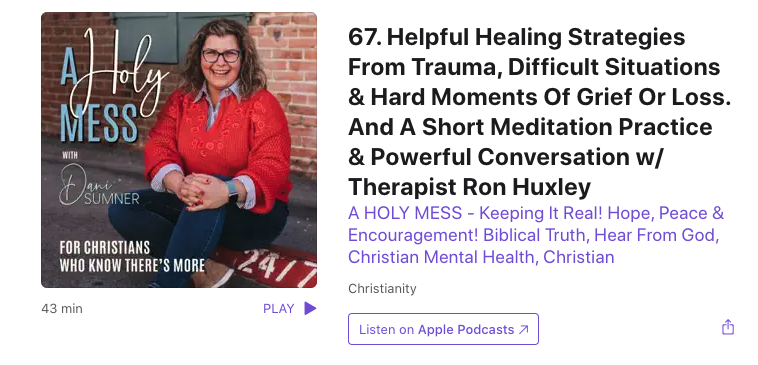
Helpful Healing Strategies from Trauma, Difficult Situations & Hard Moments of Grief or Loss (a Holy Mess Podcast)

I am so excited to guess again on the Holy Mess Podcast (see the link below). The show creator, Dani Sumner, has the #1 Christian Mental Health podcast on Spotify. This episode talks about healing from a body, mind, and spirit perspective. At the end of the podcast, I will lead you through a short meditation on how to “resource” safety from each perspective. You don’t want to mess with this podcast: Click here now!

6 Steps Adoptive Parents Need to Learn

When you adopt a child, it’s not uncommon to find yourself parenting a child who has been traumatized. The emotional regulation skills that all children learn in their early years were probably not developed as well as they could have been in the child’s pre-adoption life, and now you’re facing the task of helping your child learn how to manage their emotions.

It’s not always easy, but some strategies can help make this process easier. Here are some tips for dealing with emotionally dysregulated children who were adopted:

1.) Learn about trauma and its effects on developing minds and bodies.

2.) Learn about emotional regulation and how it develops in children.

3.) Identify what emotional regulation looks like for your child—what do they do when they get upset? How do they express anger? Frustration? Sadness? Joy? What helps them calm down when they get upset? What makes them get upset or escalate into inappropriate behaviors? And most importantly: what doesn’t work when they feel overwhelmed by intense emotions?

4.) Since every child is unique, there is no one-size-fits-all approach. Learn brain-based parenting skills and methods.

5) Identity the attachment styles for each family member and discover techniques that create greater security.

6) Take care of yourself. Self-care is not a luxury. It is necessary to be more patient and resilient with your dysregulated child.

Take a free course on Trauma-Informed Care in the home, school, and community at TraumaToolbox.com.

If you need specialized help, contact Ron Huxley today by clicking here and scheduling an appointment.

School Behaviors: What’s behind it?

Use a trauma-informed lens when dealing with school behaviors / Ron Huxley, LMFT

The school is back in full swing, and parents and teachers may be trying to manage misbehaviors. Don’t be too quick to assume that it is all about MOTIVATION and MANIPULATION. I call this the M and M misunderstanding. Take some time to look behind the behavior and answer the problem under the problem for greater school success.

Consult with Ron Huxley today for additional help…

Have a Power-FULL Morning!

Did you wake up in a mood today? We often wake up thinking about the problems we have to face today. We rehearse the past memories and circumstances that create a hyper state of arousal, using the natural cortisol levels of the morning to increase anxiety, fear, irritability, and anger.

Before your feet hit the floor, use gratitudes to change how you think and feel. Use the natural energy of cortisol to direct your thoughts and behaviors in the morning. Engage in meditation and focus for the day and be more productive and creative with using that cortisol. Make today better than yesterday. Make your inspiration greater than your suffering!

Use your cortisol to have a power-full morning!

Let Ron Huxley help you find more power in your life by scheduling a session today or using the power-full tools at FamilyHealer.tv

6 Tips To Make Fear Your Friend

What makes you afraid? Is it losing someone you love? Or is it having to see your dentist? Maybe you fear thunderstorms or heights or elevators.

Whatever it is, fear is normal. It’s how our body warns us of dangerous situations and that we should be careful.

Yet, sometimes, our fears can become so great that they hold us back from living up to our full potential. They fill us with dread and uncertainty that we soon become constantly stressed and anxious over the smallest things.

Although surprisingly, fear, in its positive form, can actually be good for us. It can inspire innovative ideas and motivate us to reach new heights.

So, we’re here today to help you make fear your friend. Follow the six tips below, and you’ll know how to turn what was once your foe into an ally.

Let’s get started.

  1. Identify the Source

This is probably the hardest step, but it’s absolutely worth it. But first, you need to come to terms with the source of your fear in order to overcome it.

Being aware of the root cause will be difficult in the beginning, but it’ll make you stronger. You’ll no longer live in the shadow of that big, insurmountable fear.

  1. Embrace It

You’ve come face-to-face with your fear. Now, it’s time to embrace it.

But before you do that, you have to actually admit that such-and-such scares you. There are several ways to do this. First, you can either say it aloud, preferably to someone else in a natural setting.

You can also write it down in a journal or diary. The point is to get it out of your head and into real life. That’s when your fear loses its control over you.

It also feels better to get it off your chest and share it with the world. You’ll be surprised to know just how many people are just as afraid as you are.

  1. Think Rationally

Fear makes us panic, and panic makes us do stupid things. In fact, studies show that when we panic, our prefrontal cortex shuts down. This is the region of our brain responsible for rational thinking.

So, case in point, learn how to think rationally despite your worries and panic. Make fear your friend, and you’ll be able to go a lot farther in life.

  1. Take Stock

People deal with fear, stress, and anxiety in different ways. Some people like to be challenged and are great under pressure. Others find it better to work at their own pace without any tight deadlines looming overhead.

Whichever way you prefer, the important thing is not to let fear get the better of you. For example, say you’re afraid to speak in public. But then a colleague suddenly got sick and asked you to take over the presentation you’ve been preparing for weeks.

In this scenario, you have to pick whether you’ll let your fear overpower you or whether you’ll rise to the challenge.

The latter won’t be easy, but it’ll definitely be worth it in the long run. Be objective and tell yourself that others have held presentations before and have lived to tell about it. So, what’s the big deal?

Remember, your mind tends to blow things out of proportion. So, find a way to deal with the stress and take stock. It’s the only way you’ll be able to harness your fear and get the job done.

  1. Find Support

No one ever failed by having a strong support system. Surround yourself with people who encourage you to do better. These are the people who listen to you when you’re venting about your fears and anxiety, and they still choose to love you unconditionally.

A lot of research has been carried out on the benefits of having a support system. It empowers you with good coping skills while boosting your self-esteem and overall well-being.

Moreover, a sound support system can lower stress, anxiety, and depression rates. 

  1. Be Positive

Whenever you’re afraid, you’ll tend to focus on negative thoughts and emotions. But then, they fester in your mind and transform into this big, ugly thing that you can no longer control.

Why not try some positivity for a change? Remember, the mind is quite powerful; it just needs a small push in the right direction.

By thinking positively, you can overcome your fears and actually live to tell the tale! All you have to do is believe it, and everything else will fall into place.

Start Each Day with Positive Intentions

If you struggle in the mornings, there is one thing you can add to your daily routine that will help, and that’s positive intention. Helping to set the tone for your day, starting with positive intentions can deliver a lot of great benefits.

Below, we’ll look at the benefits positive intentions provide. You will also learn exactly how to create and use positive intentions to your advantage.

What Positive Intentions Are

A positive intention is much like a map. It tells your mind where you want to go in life and what you want to achieve. When you are adding a positive intention into your day, you are basically telling your mind what it is you want to accomplish in the next 24 hours. 

We all set intentions at the start of our day, whether we realize it or not. Even bad habits can stem from positive intentions. For example, your intention may subconsciously be to feel good, so you indulge in your favorite junk foods. By taking control consciously of your positive intentions, it can deliver a lot of great benefits.

Benefits Positive Intentions Provide

Positive intentions provide a lot of awesome benefits. Some of the biggest advantages include:

  • They help you to get out of your head
  • They improve your focus
  • They can help you to develop a more positive mindset
  • You will be more likely to achieve your goals

Positive intentions give the mind a clear focus. They help you to become more present in the moment and focus on what it is you need to do today to achieve your goals. Helping you to get out of your head and provide a clear path to where you want to be, you will notice you are much more productive, less stressed, and happier overall.

The thing is the mind is going to set its own intentions for the day if you don’t intervene. Unfortunately, the mind finds it easier to focus on the negative. With positive intentions, it can help you to train the mind to be more positive.

How to Start With Daily Positive Intentions

Now you know some of the benefits of starting each day with a positive intention, what types of intentions can you set? Knowing where to start can be tough, but it’s much easier than you might think. Some examples of positive intentions include:

  • “Today my intention is to accept love and joy into my life”
  • “Today, I will remain silent for 15 minutes and listen to my inner guide”
  • “Today, I will remain focused on my to-do list and not give in to distractions”

These are just some basic examples you can follow. Think of what it is you want to achieve or feel by the end of the day. Then, set that as your intention and remember to keep it positive.

When you start each day with a positive intention, it can add real meaning into your life. You may just be surprised by how beneficial this simple act can make you more successful. 

To create a powerful day, create a daily routine. Follow your routine to structure your life more efficiently and receive many powerful benefits.

1. Develop good habits.

One of the best reasons to create a daily routine is that it can help you to combat bad habits. By replacing bad habits with good ones, you can gradually improve all aspects of your life. It can be tough to overcome bad habits, but a routine can help massively.

2. Boost your efficiency.

Do you ever wish you could get more done and make the most of your time? With a daily routine you can. Adding structure into your life, a good daily routine will make you much more efficient. You won’t waste as much time as you once did, helping you to achieve much more during your day.

3. Improve your health. 

One of the most powerful reasons to create a daily routine is that it can help you improve your health. Whether you need to improve your physical or your mental health, a good routine can prove invaluable. By using it to introduce healthier habits, you’ll start to notice fast changes in your mood and general wellbeing.

4. Sleep better.

Did you know when you have a routine you sleep better? If you go to bed at the same time each night, and awake at the same time each morning, you’ll feel much more refreshed. You can also implement things into your routine that help you sleep better, such as switching off technology an hour before bed. When you sleep better, you feel better and it improves every aspect of your life.

5. Incorporate more structure.

To achieve your goals, you need willpower and motivation. A daily routine can incorporate both. Exercise is a good example of this. When you add it into your daily routine, it quickly starts to become an automatic habit. You won’t need to force yourself through willpower or motivate yourself with a reward, once it becomes a habit.

6. Reduce and relieve stress. 

A daily routine can help reduce and relieve stress. As you know what your day mostly consists of, and you use it to introduce healthier habits, your stress levels will naturally decrease. You can also schedule in time for relaxation each day to help.

So, there you have it, 6 reasons you should create daily routines. While developing an effective routine can take time, once you have it in place you won’t regret taking the time to create it. To become successful, happy, and healthy, we all need structure and routine in our lives.

Had any assumptions shattered lately?

The last two years have been one of daily uncertainty and fear, but a crisis is also a great revealer of the myths and idols we hold. It “knocks us off our thrones” and breaks our “assumptive worlds.” Our assumptions are the beliefs we hold about who we are and the world we live in…at times, like these, they don’t hold up. In fact, they can shatter into thousands of meaningless thoughts.

In social psychology, shattered assumptions theory proposes that traumatic events can change how victims and survivors view themselves and the world. We all have three inherent assumptions including “overall benevolence, the meaningfulness of the world, and self-worth.” They are the bedrock of our conceptual system, and as such, they are the ones we are least aware of and least likely to challenge. We become confident in our beliefs and use them to plan and act in daily living. If nothing challenges them they allow our lives to move along smoothly.

Sadly, traumatic life events shatter core assumptions, and coping with them requires a new effort to construct more realistic and viable assumptions. We have to rebuild our belief systems to fit the new world we live in.

Core Beliefs:

The world is benevolent

The world is meaningful

The self is worthy

This can be painful for people of faith who end up questioning their faith. When our assumptive worlds shatter, it causes believers to questions the goodness of God. They might “assume” that God is silent or uncaring. The promises they believed must be wrong since things didn’t work out the way they “believed.” Trying to reconcile a good God to their adverse life situations may turn some to question themselves, wondering if they ever heard God speak into their lives or if some sin or trauma from the past has made them unworthy of mercy.

I mean, if God never changes, then the problem must be ourselves, right? Christians believe that when they become followers they are “new creations.” New creations have to have renewed minds to find new beliefs about God’s goodness and nature in their lives. Renewal is exactly what we need when our assumptions become shattered. Neurologists called this neuroplasticity.

Neuroplasticity is the brain’s ability to restructure itself through training and practice, thereby creating new neuropathways in the human nervous system. Neuroplasticity, renewed minds, and rebuilt belief systems are about personal growth that is sometimes only possible after trauma.

The reason that believers feel peace after giving their lives to follow the Christian faith is that new neuropathways are being created. Transformation or growth is occurring. From a more secular viewpoint, life has a way of creating maturity in our thinking. The trick is how to not become bitter and negative afterwords.

There is a favorite verse of mine that goes: “Do not worry about anything, but in everything by prayer and supplication with thanksgiving let your requests be made known to God. And the peace of God, which surpasses all understanding, will guard your hearts and your minds in Christ Jesus.  –Philippians 4:6-7 (NRSV)” Prayer and meditation increase brain neuroplasticity and makes renewal possible. Allowing our minds to let go of distractions and slow down helps us focus on what we control and let go of what we cannot. In Alcoholics Anonymous, this is the path to serenity.

After a shattering event, people are able to discover strength they didn’t know that had in them. They also find new purposes and seek out deeper connections than before. Faith also grows in people after difficulty. They start to see deeper meaning and value in their life. This is called Post-Traumatic Growth in contrast to Post-Traumatic Stress Disorder.

Would you like assistance recovering from a shattering event or trauma? Need new tools for your organization or group? Contact Ron Huxley today!