Page 4 of 7

Healing from Trauma: Understanding the Stages and Supporting Your Child Through the Journey

Healing from trauma is a complex and challenging, but recovering and moving forward with life is possible. As a trauma therapist, I have worked with many people who have experienced trauma and have seen firsthand how healing can transform lives. In this article, I will discuss the stages of recovery from trauma and what parents can do to support their children.

Stage 1: Safety and Stabilization
The first stage of healing from trauma is focused on safety and stabilization. This stage is about establishing a sense of safety and security, both physically and emotionally. Many people who have experienced trauma may feel like the world is dangerous and unpredictable, so finding ways to feel safe and grounded in the present moment is essential. This may involve developing a safety plan, finding a safe and supportive community, and practicing self-care.

As a parent, you can support your child during this stage by creating a safe and predictable environment. This may involve establishing routines, setting boundaries, and providing emotional support. Listening to your child’s needs and concerns and validating their feelings is also important.

Stage 2: Processing and Understanding
The second healing stage focuses on processing and understanding the traumatic experience. This stage is about exploring thoughts and feelings related to the trauma, making sense of the incident, and working through any confusion or self-blame. It’s important to note that this stage can be complicated and involve intense emotions, so having a supportive therapist or other mental health professionals guide you through the process is essential.

As a parent, you can support your child during this stage by providing a safe and supportive environment for them to express their feelings. It’s important to listen without judgment and validate their experiences. You can also help your child to understand that their reactions to the trauma are normal and that they are not alone.

Stage 3: Integration and Meaning-Making
The third healing stage focuses on integrating the experience into one’s sense of self and life story. This stage involves finding ways to incorporate the trauma into one’s identity and a sense of purpose and developing a greater understanding of meaning and purpose due to the experience. This stage is about finding a way to move forward with life, even in the face of adversity.

As a parent, you can support your child during this stage by helping them find meaning and purpose in their life. This may involve helping them to explore their interests and passions and keeping them pursuing their goals. It’s also important to remind your child that they are strong and resilient and can overcome the challenges they face.

Stage 4: Re-connection and Empowerment
The final stage of healing is about reconnecting with oneself, others, and the world in a safe and empowering way. This stage is about finding ways to engage in meaningful activities and pursuits and to feel a sense of agency and control in one’s life. This stage concerns reclaiming power and moving forward with a renewed sense of purpose.

As a parent, you can support your child during this stage by encouraging them to engage in activities that bring them joy and fulfillment. This may involve helping them to connect with others who share their interests and supporting them in pursuing their passions. It’s also important to remind your child that they can create the life they want and are not defined by past experiences.

In conclusion, healing from trauma is a complex and individualized process. Still, it is possible to recover and move forward with life. As a parent, you can support your child through the healing process by creating a safe and supportive environment, listening without judgment, and encouraging them to find meaning and purpose in their life.

If you or your child have experienced trauma and are struggling to heal, know that you are not alone. Seeking support from a therapist can be an important step in the healing process. Ron Huxley, LMFT, can help you and your child find freedom from the burden of trauma. Schedule a session today!
Helping Children Focus in School After Trauma…

When children experience trauma, it can be difficult to focus and stay engaged in the classroom. Fortunately, many social-emotional learning activities can help children develop the skills they need to stay focused and engaged in the classroom. Here are 10 ways children can use social-emotional learning activities to help them focus in the classroom after experiencing trauma.

1. Positive Self-Talk: Positive self-talk can be a powerful tool for helping children to stay focused and engaged in the classroom. Encourage your child to practice positive self-talk by repeating mantras and affirmations to themselves throughout the day. This will help them to stay positive and motivated, even when facing challenging tasks.

2. Mindfulness: Mindfulness activities can help children to stay in the present moment and pay attention to what is happening in the classroom. Encourage your child to practice mindfulness activities like deep breathing and body scans to help them stay focused and engaged.

3. Visualization: Visualization activities can help children to create positive images in their minds, which can help them stay focused and engaged in the classroom. Encourage your child to practice visualization activities, such as imagining a peaceful place or positive future, to help them stay on task.

4. Social Skills: Social skills can help children stay engaged in the classroom and positively interact with their peers. Encourage your child to practice social skills, such as active listening, problem-solving, and conflict resolution.

5. Emotional Regulation: Emotional regulation activities can help children to manage their emotions and stay focused in the classroom. Encourage your child to practice emotional regulation activities like deep breathing, progressive muscle relaxation, and positive self-talk.

6. Self-Awareness: Self-awareness activities can help children to understand their emotions, thoughts, and behaviors. Encourage your child to practice self-awareness activities such as journaling, reflecting on their experiences, and talking to a trusted adult.

7. Goal Setting: Goal-setting activities can help children to stay focused and motivated in the classroom. Encourage your child to set short-term goals that are achievable and to create a plan for how to reach those goals.

8. Problem-Solving: Problem-solving activities can help children to think flexibly and stay focused in the classroom. Encourage your child to practice problem-solving activities, such as brainstorming, making lists, and breaking down tasks into smaller steps.

9. Self-Care: Self-care activities can help children to stay focused and engaged in the classroom. Encourage your child to practice self-care activities such as getting enough sleep, eating healthy meals, and engaging in physical activity.

10. Connecting With Others: Connecting with others can help children to stay focused and engaged in the classroom. Encourage your child to connect with peers by talking to them, listening to their stories, and engaging in conversations.

Ron Huxley can help your and your child focus and learn after dealing with stress and trauma. Ron Huxley is a licensed therapist specializing in anxiety and trauma. Contact him today!

Why are the 6 Key Principles of SAMHSA important to your Organization?

The Substance Abuse and Mental Health Services Administration (SAMHSA) has identified six fundamental principles of trauma-informed care (TIC) to incorporate into treating individuals with trauma-related problems. These principles recognize the importance of understanding the impact of trauma on an individual’s life and how to provide care best that meets their needs.

The six principles of trauma-informed care and the questions traumatized individuals ask are:

  1. Safety: The first priority in any trauma-informed care setting is to ensure the safety of everyone involved. This means creating a safe emotional and psychological environment while addressing potential safety risks that could lead to additional re-traumatization.
    “Am I safe here?”
  2. Trustworthiness and Transparency: It is essential that any trauma-informed care setting be transparent and trustworthy. This means that all information is shared openly and honestly and that individuals are free to ask questions and express concerns.
    “Can I trust you?”
  3. Peer Support: Peer support is an essential part of the healing process for individuals who have experienced trauma. This means that individuals should be encouraged to reach out to others who have had similar experiences to build a support network.
    “Who shares my experiences?”
  4. Collaboration and Mutuality: Individuals in trauma-informed care settings must work together to create an atmosphere of collaboration and mutuality. All individuals involved should feel respected and valued, and their experiences and perspectives from past trauma should be considered in any activity or treatment plan.
    “Do I have a choice?”
  5. Empowerment: Individuals in trauma-informed care settings should be empowered to make their own decisions and take control of their healing process. This means that individuals should be encouraged to take an active role in their care and to make decisions that are in their best interests.
    “Do I have a voice that will be heard?”
  6. Cultural, Historical, and Gender Issues: It is essential that any trauma-informed care setting consider the cultural, historical, and gender issues that may impact an individual’s experience and recovery. This means that individuals should be encouraged to discuss their experiences without fear of judgment or criticism.
    “Is my cultural, gender, or history valued?”

These six principles of trauma-informed care, outlined by SAMHSA, are essential to providing effective, individualized, and compassionate care to individuals who have experienced trauma. By ensuring that these principles are incorporated into all aspects of care, we can create a safe and supportive environment for individuals to heal and move forward.

At its core, trauma-informed care is about understanding and responding to the needs of individuals and eliminating practices that lead to re-traumatization. It is about creating a safe and supportive environment where individuals can explore their experiences and work toward recovery. By incorporating SAMHSA’s six key principles of trauma-informed care, we can ensure that individuals receive the care and support they need to heal and move forward.

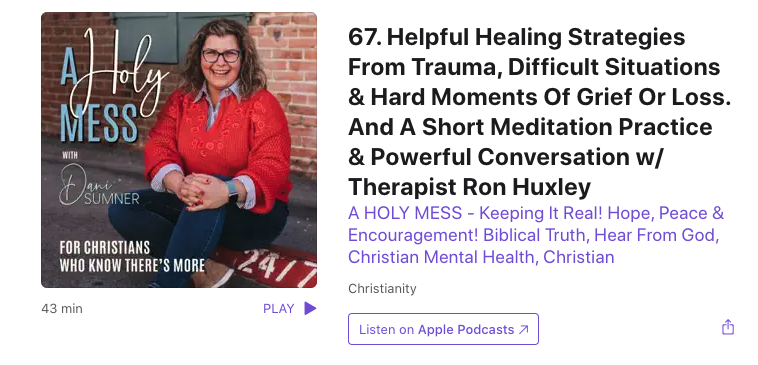
Helpful Healing Strategies from Trauma, Difficult Situations & Hard Moments of Grief or Loss (a Holy Mess Podcast)

I am so excited to guess again on the Holy Mess Podcast (see the link below). The show creator, Dani Sumner, has the #1 Christian Mental Health podcast on Spotify. This episode talks about healing from a body, mind, and spirit perspective. At the end of the podcast, I will lead you through a short meditation on how to “resource” safety from each perspective. You don’t want to mess with this podcast: Click here now!

The Healing Power of Music

Music has a powerful ability to evoke strong emotions, which can be both positive and negative. It can help us to process and express our feelings, allowing us to make sense of them and move on. Music can also be a form of self-care, helping us relax and take a break from our worries.

Music can also help to reduce stress and anxiety. Studies have shown that listening to music can have a calming effect on the body, reducing heart rate and blood pressure. It can also help reduce cortisol levels, hormones released in response to stress. 

Research has also found that music can help to relieve pain. By providing a distraction from pain, music can help to reduce the perception of pain. It can also help to reduce the need for pain medication in some cases. 

Music can also be used to help people heal from trauma. Music therapy is effective in helping people cope with traumatic experiences. It can help to provide a safe space for people to process their emotions and find ways to move forward. 

Music can also be used to boost mood. Listening to uplifting music can help to reduce levels of depression and increase feelings of joy and happiness. It can also help reduce fatigue levels, helping people feel more energized. 

The healing power of music is undeniable. It can help to reduce stress, anxiety, and pain. It can also provide a safe space for people to process their emotions and heal from trauma. Finally, it can help boost mood and increase joy and happiness. 

If you’re looking for a way to relax and take a break from your worries, or if you’re struggling with pain or trauma, music may be just the thing to help you heal. So, turn up the volume and let the healing power of music work!

Breaking out of Negative Thoughts and Rumination

Do you ever feel like your mind is racing or your thoughts are stuck in a loop? You might be experiencing what’s called negative thinking or rumination. People who engage in this tend to overthink things, strive for perfection, look at the downside of events and miss the good stuff that happened to them.

Coping with negative thoughts and rumination can be a challenge. But it’s not impossible to overcome, and it’s not something you have to live with forever.

The good news is that you can learn ways to cope with negative thinking and rumination without using medications. Here are some things that might help:

1) Practice mindfulness meditation. This involves focusing on the present moment without judgment, especially when you have negative or repetitive thoughts. You can try this by focusing on your breath, listening to music or nature sounds (like rain or waves), or simply sitting quietly in silence and noticing what’s happening around you (or inside yourself).

2) If you are spiritual, pray! Prayer is a powerful weapon against depression and anxiety. It can be hard to pray when you are overwhelmed by negative thoughts, but if you commit yourself to prayer as a daily routine, it will help keep your mind focused on what matters most.

3) Get some exercise. Exercise releases endorphins into the brain, making us feel better about ourselves and more optimistic about our lives. So if you’ve been feeling down lately, try getting out for a run instead of staying cooped up inside all day!

4) Eat healthy foods! Eating well helps regulate hormones in our bodies that are responsible for mood swings (like serotonin). So if you’re feeling down, try eating something like strawberries or almonds—they contain nutrients that promote happiness and contentment. Ever heard the expression: “Your mental health is at the end of your fork”? It’s true.

5) Try writing down your feelings instead of keeping them bottled up inside where no one else can see them except for yourself (and even then, only if you want to share them with others. Grammer and punctuation aren’t necessary. The point is to let that negative go.

6) Identify the areas where you were hurt or traumatized. Destructive thought patterns can result from betrayal, abandonment, unfair actions, and traumatic events. We can internalize external actions and believe we are the problem or too broken, leaving us in a vicious loop of negative thoughts and feelings.

7) Work with a professional therapist specializing in trauma-informed practices and Cognitive Behavior Therapy. Together, you can get to the unhealthy core beliefs causing so much pain and suffering and find alternative perspectives on your life.

Negative thinking and rumination are exhausting. It ruins your sleep, and it interferes with your day. If you want help finding a way out of this destructive pattern, contact Ron Huxley and set up an appointment to start feeling good immediately! Click here now…

6 Steps Adoptive Parents Need to Learn

When you adopt a child, it’s not uncommon to find yourself parenting a child who has been traumatized. The emotional regulation skills that all children learn in their early years were probably not developed as well as they could have been in the child’s pre-adoption life, and now you’re facing the task of helping your child learn how to manage their emotions.

It’s not always easy, but some strategies can help make this process easier. Here are some tips for dealing with emotionally dysregulated children who were adopted:

1.) Learn about trauma and its effects on developing minds and bodies.

2.) Learn about emotional regulation and how it develops in children.

3.) Identify what emotional regulation looks like for your child—what do they do when they get upset? How do they express anger? Frustration? Sadness? Joy? What helps them calm down when they get upset? What makes them get upset or escalate into inappropriate behaviors? And most importantly: what doesn’t work when they feel overwhelmed by intense emotions?

4.) Since every child is unique, there is no one-size-fits-all approach. Learn brain-based parenting skills and methods.

5) Identity the attachment styles for each family member and discover techniques that create greater security.

6) Take care of yourself. Self-care is not a luxury. It is necessary to be more patient and resilient with your dysregulated child.

Take a free course on Trauma-Informed Care in the home, school, and community at TraumaToolbox.com.

If you need specialized help, contact Ron Huxley today by clicking here and scheduling an appointment.

Restart Your Life (Free Course)

Learn how to reboot and restart your life with a new course from Ron Huxley, LMFT, and FamilyHealer.tv. Here’s what you will learn:

6 ways to deal with upheaval at work

Worry only 30 minutes a day

Be more supportive of your friends

Don’t let disagreements ruin your relationships

Defeat perfectionism!

How avoidance actually creates more stress

5 ways to get out of your own way

Create a plan for your family life

>> Click here now to take this course for free <<

The Self-Care, Self Assessment

Self-care is no longer a luxury for our busy, stressful lives. It is a necessity! Use this self-care self-assessment on how well you are taking care of yourself. The examples here can be used as ideas, but you are not limited to this list…work to be consistent with your self-care plan and/or add new ideas to keep things fresh.

Taking care of yourself better is not only important to you but also to everyone around you. When you aren’t practicing self-care daily, you are probably not as healthy as you could be. This means you aren’t at your best, and you aren’t able to help others much.

To help you optimize and/or increase your self-care, fill in each section of this self-care assessment sheet to give you an idea of what you need to work on to feel better yourself, and to be there for others. 

For each of the following, rate how well you rate each item. Use the number system with 1 being poor and 5 being the best. Write your score in the line by the item. Then total up the numbers in each section and put it on the total score line by the section title.

Physical Self-Care – Total Score ________

___ I exercise 3-5 times a week.

___ I eat 3 healthy meals daily.

___ I eat healthy snacks.

___ I follow a healthy sleep routine.

___ I avoid eating at fast food restaurants.

___ I visit my family doctor regularly.

___ I visit my dentist regularly.

___ I drink water for better hydration.

___ I incorporate weights in my exercises.

___ I take medications as prescribed.

I want/need to build/enhance these qualities:

Mental Self-Care – Total Score ________

___ I write in a journal regularly.

___ I keep up with current news & events.

___ I play cognitive games that challenge me.

___ I engage in at least one hobby a week.

___ I listen to relaxing music.

___ I call or write to keep in touch with people I care for.

___ I volunteer regularly.

___ I visit places that I enjoy at least twice a week.

___ I learn to do something new each week.

___ I practice self-compassion and acceptance.

I want/need to build/enhance these qualities:

Emotional Self-Care – Total Score ________

___ I journal about things that bother/worry me.

___ I talk about troubling thoughts with a trusted friend.

___ I make it a point to be kind to others.

___ I don’t take hurtful things to heart.

___ I listen to upbeat or sad music as needed.

___ I watch inspiring or funny movies/shows to cheer up.

___ I don’t allow my anger or frustration to affect others.

___ I read the news or books to keep my thoughts in perspective.

___ I tell people what I really think, in appropriate ways.

___ I effectively limit the time I spend with toxic people.

I want/need to build/enhance these qualities:

Social Self-Care – Total Score ________

___ I schedule one-on-one time each person in my immediate family. 

___ I participate in community events regularly.

___ I am part of several community groups.

___ I encourage my family and friends to try new things.

___ I check on my friends/family regularly.

___ I tell my friends and family why I appreciate them.

___ I effectively balance the time I need for myself and with others.

___ I ask for help when needed.

___ I offer help when I see another’s unfulfilled need.

___ I make new people feel welcome and valued.

I want/need to build/enhance these qualities:

Business Self-Care

___ I arrive/begin work on time.

___ I work with a peer-support group.

___ I work with others a team-player.

___ I compliment others on their work.

___ I follow the rules/instructions set for my job.

___ I read industry-related information regularly.

___ I regularly build and enhance my job skills. 

___ I keep my desk/office clean and organized.

___ I take time off only when needed.

___ I take 15-minute breaks as needed.

I want/need to build/enhance these qualities:

Have a Power-FULL Morning!

Did you wake up in a mood today? We often wake up thinking about the problems we have to face today. We rehearse the past memories and circumstances that create a hyper state of arousal, using the natural cortisol levels of the morning to increase anxiety, fear, irritability, and anger.

Before your feet hit the floor, use gratitudes to change how you think and feel. Use the natural energy of cortisol to direct your thoughts and behaviors in the morning. Engage in meditation and focus for the day and be more productive and creative with using that cortisol. Make today better than yesterday. Make your inspiration greater than your suffering!

Use your cortisol to have a power-full morning!

Let Ron Huxley help you find more power in your life by scheduling a session today or using the power-full tools at FamilyHealer.tv