Page 2 of 2

Breathwork is the body’s “calm down” switch

When life throws us challenges, we experience trauma or a stressful event; our natural response is to go into fight-or-flight mode. This is a normal, automatic response to a perceived danger. But when the threat has passed, it’s essential to learn how to calm your nervous system and release the tension and anxiety that can linger in the aftermath.

One of the most powerful tools for calming the nervous system is breathing. Breathwork has been used in various forms for centuries to help people manage stress, anxiety, and trauma. It’s an effective and natural way to reset your body and mind.

We take shallow, rapid breaths when our bodies are in fight-or-flight mode. This type of breathing is known as sympathetic breathing, and it’s the body’s way of preparing us to fight or run away. But when the danger has passed, this type of breathing can increase anxiety and make it more difficult to relax.

On the other hand, deep, slow breaths can help to activate the body’s parasympathetic nervous system. This system is responsible for calming the body and restoring balance. Deep, slow breaths can help to trigger the body’s relaxation response, which is the opposite of the fight-or-flight response.

The key to using breathing to calm the nervous system is to focus on the breath. Focusing on our breath brings us into the present moment and helps us become aware of our body and mind. This awareness helps us relax, as it allows us to recognize what is happening and let go of any tension or fear we may be holding onto.

Breathing can also help to release the emotions that may be stored in our body from the traumatic event. When we take a few deep, slow breaths, we can help to release the tension and stress that may have built up in our bodies. This type of breathing can also help release emotions associated with the trauma, allowing us to move through the experience more quickly.

Breathing can also help to regulate the body’s cortisol levels. Cortisol is a hormone that is released in response to stress. When we take deep, slow breaths, we can help to lower our cortisol levels and restore balance in the body. This can help to reduce anxiety and improve mood.

Try this simple breathing exercise:
Make your exhales longer than your inhales. For example, if you breathe in for 4 seconds, breathe out for a count of 8 seconds. Longer exhales than inhales will turn on the “rest and relaxation” functions in the parasympathetic system. Conversely, longer inhales than exhales energize the system. This is an exercise used by Navy Seals to prepare for or calm down from a battle. Take 3 or 4 long exhales. You should feel your body relax immediately, with shoulders dropping and tension releasing. You might even yawn, which is a good sign too.

Breathing is a powerful tool for calming the nervous system and helping manage trauma’s effects. It can help to reduce stress, release emotions, and regulate cortisol levels. When we focus on our breath and take a few slow, deep breaths, we can help to activate the body’s relaxation response and restore balance.

If you want help calming the body and brain due to worry, fear, stress, or panic, contact Ron Huxley today. Click here to schedule an appointment!
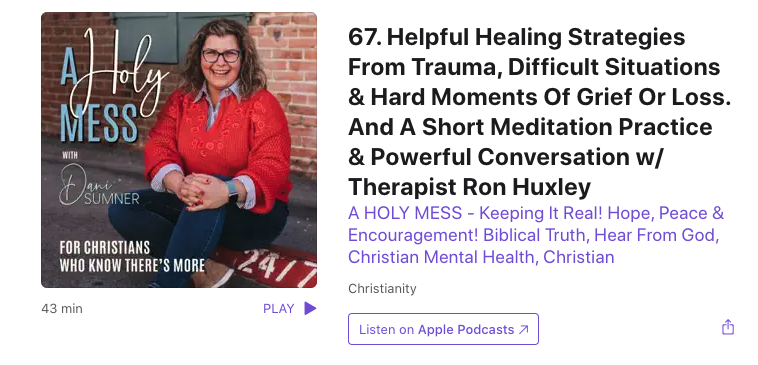
Helpful Healing Strategies from Trauma, Difficult Situations & Hard Moments of Grief or Loss (a Holy Mess Podcast)

I am so excited to guess again on the Holy Mess Podcast (see the link below). The show creator, Dani Sumner, has the #1 Christian Mental Health podcast on Spotify. This episode talks about healing from a body, mind, and spirit perspective. At the end of the podcast, I will lead you through a short meditation on how to “resource” safety from each perspective. You don’t want to mess with this podcast: Click here now!

10 Ways to Manage Your Panic Attacks

“In my experience, the words “now just calm down” almost inevitably have the opposite effect on the person you are speaking to.” – Elyn Saks

A panic attack is a sudden and intense feeling of fear or anxiety that can be overwhelming and debilitating. It is often accompanied by physical symptoms such as rapid heartbeat, difficulty breathing, dizziness, sweating, trembling, and a feeling of impending doom. Some people may also experience chest pain, nausea, and a fear of losing control or going crazy.

During a panic attack, the body’s fight or flight response is activated, even though there is no real danger. This response causes the physical symptoms of a panic attack and a heightened state of alertness and arousal.

Many things trigger panic attacks, social events, public speaking, conflict with family or coworkers, and situations reminiscent of past traumas. Sometimes, an accumulation of stress builds up over time and then pops up unexpectedly in a panic. 

Most people believe they have a heart attack when experiencing a panic attack. They often go to the emergency room or their doctor for a checkup. When the doctor cannot find anything physically wrong with them, they suggest that the individual might have had a panic attack and recommend talking to a mental health professional. 

Family and friends feel helpless around individuals who struggle with panic attacks. They can suggest useless advice or tell them to “calm down,” which never works. 

Mental health professionals might offer several strategies to cope with a panic attack:

  1. Focus on your breathing: Take slow, deep breaths through your nose and out through your mouth. This can help to calm your body and mind.
  2. Use positive self-talk: Remind yourself that you are safe and that the panic attack will pass.
  3. Find a peaceful place to relax: Find a quiet place where you can sit or lie down and relax.
  4. Use relaxation techniques: Try progressive muscle relaxation, visualization, or mindfulness meditation to help you relax.
  5. Find a focus object: Redirect your attention to something in clear sight and consciously notice all the details about that object, engaging all of your senses if possible.
  6. Picture a safe place, face, or space: Visualizing a place or location that holds a positive memory can be helpful to calm the nervous system. Additionally, you can picture someone safe or an activity that gives you joy. 
  7. Engage in light exercise: Taking a walk, stretching, or playing an outdoor game with someone can alleviate the stressful energy in your body.
  8. Use a mantra or affirmation: A positive statement, verse, song, or quote can redirect fear or worry about your condition and reset negative thoughts. 
  9. Change your life situation: If panic results from stress, consider distancing yourself from people, changing jobs, setting boundaries, or reorganizing living situations for your future health.
  10. Reach out to someone: Talk to a friend or loved one, or consider seeking support from a mental health professional.

The best time to deal with a panic attack is before you have a panic attack. Trying to deal with one in the middle is highly challenging to control. A daily practice of calming, affirming prayer and meditation, healthier living, and new perspectives can strengthen the body’s defenses, so the panic never comes up again. 

Panic attacks can be very distressing and may interfere with daily activities. It is essential to seek help from a mental health professional if you are experiencing panic attacks, as they can be treated effectively with therapy and medication. Consult Ron Huxley today if you are struggling with panic attacks and want help. 

20 Ways to Forgive – Infographic

How to invite forgiveness to bless your life…

Forgiveness is both a decision and a process. Choose one of the ways listed in this infographic to implement in your life for one week. Assess how it has blessed you and then try a new way until you feel the weight of hurt and bitterness lessen.

Have a Power-FULL Morning!

Did you wake up in a mood today? We often wake up thinking about the problems we have to face today. We rehearse the past memories and circumstances that create a hyper state of arousal, using the natural cortisol levels of the morning to increase anxiety, fear, irritability, and anger.

Before your feet hit the floor, use gratitudes to change how you think and feel. Use the natural energy of cortisol to direct your thoughts and behaviors in the morning. Engage in meditation and focus for the day and be more productive and creative with using that cortisol. Make today better than yesterday. Make your inspiration greater than your suffering!

Use your cortisol to have a power-full morning!

Let Ron Huxley help you find more power in your life by scheduling a session today or using the power-full tools at FamilyHealer.tv

Top Tips for Resolving Conflicts in Your Relationships

No matter how much you like the other person, at some point, conflict is likely to happen. While most conflicts are fairly small (like trying to decide where to go out for dinner), left untended a conflict can fester and grow. That’s why it’s so important to resolve conflicts in your relationships before they have a chance to take on a life of their own.

How do you go about doing that?

1. Start by listening. But don’t just listen to the spoken words, but the feelings behind them. It’s the emotions that drive the conversation after all! By listening actively, meaning pausing to ask questions, clarify, and to reiterate what you think the other person is saying, you tell the other person that what they have to say matters. But more importantly, you’re letting them know that they’re being heard.

2. Look for the resolution over being right. Giving up the notion that you have to ‘win’ is where you start seeing the solutions. Conflict is not a competition.

3. Stay in the moment. Instead of focusing on what happened that brought you into this conflict, pay attention to what’s going on right now. Now isn’t the time for blame. Rather look for solutions.

4. Decide what’s important right now. That is called ‘picking your battles’ and is important in determining whether a thing is worth fighting over. Ask yourself if this is just an issue over a minor annoyance that will be easily forgotten, or if you have something deeper going on that maybe needs to be addressed.

5. Know how and when to disengage. That means being able to do what it takes to walk away. It might be forgiveness is in order. It might be that you’re just going to need to agree to disagree. Worst case scenario? It might be time just to let the matter go entirely. Whatever the case, there’s nothing to be gained by staying in the conflict. 

Resolving conflicts isn’t a hard skill to learn. By following these tips, you will discover how better to deal with conflict in every kind of relationship – whether business or personal. So take heart – a misunderstanding doesn’t have to mean the end of the world. Instead look at your conflict as a step toward better understanding that will, in turn, lead to better relationships in the long run.

Let Ron Huxley help you resolve conflict in your life by scheduling a session today or take a free course at FamilyHealer.tv

Start Each Day with Positive Intentions

If you struggle in the mornings, there is one thing you can add to your daily routine that will help, and that’s positive intention. Helping to set the tone for your day, starting with positive intentions can deliver a lot of great benefits.

Below, we’ll look at the benefits positive intentions provide. You will also learn exactly how to create and use positive intentions to your advantage.

What Positive Intentions Are

A positive intention is much like a map. It tells your mind where you want to go in life and what you want to achieve. When you are adding a positive intention into your day, you are basically telling your mind what it is you want to accomplish in the next 24 hours. 

We all set intentions at the start of our day, whether we realize it or not. Even bad habits can stem from positive intentions. For example, your intention may subconsciously be to feel good, so you indulge in your favorite junk foods. By taking control consciously of your positive intentions, it can deliver a lot of great benefits.

Benefits Positive Intentions Provide

Positive intentions provide a lot of awesome benefits. Some of the biggest advantages include:

  • They help you to get out of your head
  • They improve your focus
  • They can help you to develop a more positive mindset
  • You will be more likely to achieve your goals

Positive intentions give the mind a clear focus. They help you to become more present in the moment and focus on what it is you need to do today to achieve your goals. Helping you to get out of your head and provide a clear path to where you want to be, you will notice you are much more productive, less stressed, and happier overall.

The thing is the mind is going to set its own intentions for the day if you don’t intervene. Unfortunately, the mind finds it easier to focus on the negative. With positive intentions, it can help you to train the mind to be more positive.

How to Start With Daily Positive Intentions

Now you know some of the benefits of starting each day with a positive intention, what types of intentions can you set? Knowing where to start can be tough, but it’s much easier than you might think. Some examples of positive intentions include:

  • “Today my intention is to accept love and joy into my life”
  • “Today, I will remain silent for 15 minutes and listen to my inner guide”
  • “Today, I will remain focused on my to-do list and not give in to distractions”

These are just some basic examples you can follow. Think of what it is you want to achieve or feel by the end of the day. Then, set that as your intention and remember to keep it positive.

When you start each day with a positive intention, it can add real meaning into your life. You may just be surprised by how beneficial this simple act can make you more successful. 

To create a powerful day, create a daily routine. Follow your routine to structure your life more efficiently and receive many powerful benefits.

1. Develop good habits.

One of the best reasons to create a daily routine is that it can help you to combat bad habits. By replacing bad habits with good ones, you can gradually improve all aspects of your life. It can be tough to overcome bad habits, but a routine can help massively.

2. Boost your efficiency.

Do you ever wish you could get more done and make the most of your time? With a daily routine you can. Adding structure into your life, a good daily routine will make you much more efficient. You won’t waste as much time as you once did, helping you to achieve much more during your day.

3. Improve your health. 

One of the most powerful reasons to create a daily routine is that it can help you improve your health. Whether you need to improve your physical or your mental health, a good routine can prove invaluable. By using it to introduce healthier habits, you’ll start to notice fast changes in your mood and general wellbeing.

4. Sleep better.

Did you know when you have a routine you sleep better? If you go to bed at the same time each night, and awake at the same time each morning, you’ll feel much more refreshed. You can also implement things into your routine that help you sleep better, such as switching off technology an hour before bed. When you sleep better, you feel better and it improves every aspect of your life.

5. Incorporate more structure.

To achieve your goals, you need willpower and motivation. A daily routine can incorporate both. Exercise is a good example of this. When you add it into your daily routine, it quickly starts to become an automatic habit. You won’t need to force yourself through willpower or motivate yourself with a reward, once it becomes a habit.

6. Reduce and relieve stress. 

A daily routine can help reduce and relieve stress. As you know what your day mostly consists of, and you use it to introduce healthier habits, your stress levels will naturally decrease. You can also schedule in time for relaxation each day to help.

So, there you have it, 6 reasons you should create daily routines. While developing an effective routine can take time, once you have it in place you won’t regret taking the time to create it. To become successful, happy, and healthy, we all need structure and routine in our lives.

Reprogram Your Nervous System

  1. Focus on a safe, comforting image or memory of attachment. It could be your partner, child, or interaction with God. 
  2. Close your eyes, focus on this image or memory, and breathe slowly and deeply.
  3. Let your breath be long, holding it for a second or two at the top of the inhale and bottom of the exhale. 
  4. Allow whatever emotion to come up without judgment or interpretation. 
  5. Open your eyes and do a “body scan” from the top of your head to your feet. Notice what is going on in your body. Place a hand in that area, adjust your position and repeat the steps above. 
  6. Do this as many times as you need or want to…the more you practice this, the stronger your nervous system becomes. I call this NeuroResilience. 

Schedule an appointment today with Ron Huxley and learn this an other important life skills today!

4 Ways to Get Clear on Why You Care So Much 

Caring is an important quality in one’s life. What would the world be like if we didn’t have caring people? Too much caring can create problems, however. Overcaring can cause fatigue, burnout, or secondary trauma, enabling addictive behaviors, preventing healthy child independence, rejection and estrangement from loved ones, and so much more. Finding a healthy balance is essential to living a healthier, happier life. The first step in this process is learning WHY you care so much so that you can find that balance.

Here are four ways to help you get clear on why you care so much that you can use:

Reading

Sounds too simple, right? The truth is that it is that simple…mostly! There are a lot of books and devotionals for people who care too much. Melodie Beattie is one of my favorite authors. She wrote the books Codepency No More, The Language of Letting Go, and Codepence Guilt to the 12 steps. Another classic is Boundaries by Cloud and Townsend. I regularly recommend this book to families. Of course, there are other great reads, such as Women Who Do Too Much, Raising Empowered Children, Keeping Your Love On, Caregivers Survival Guide, The Heart of the Caregiver, and so many more.

In addition to books, there are YouTube videos and online courses that you can take to learn healthier caregiving lifestyles. Try one now at FamilyHealer.tv

Journaling 

You can use your computer, buy a specialized journal, or you can simply use a notebook you have created to journal. It’s up to you what type of system you use and whether it’s modern or analog. 

The important part is that you try to use your journal to express your thoughts, emotions, and stream of consciousness about a problem you’re trying to solve or a feeling you’re trying to explore without judgment or censoring. 

Write in your journal every day when you’re trying to understand why you care so much. You may end up discovering your life purpose or a new reason for getting up each day that you had not realized before. 

Become a Patron Sponsor of FamilyHealer.tv and get free journals and many more tools for living a happier life at FamilyHealer.tv

Meditation 

Before you use your journal, it can help to clear your mind using meditation. Meditation practice is all about not thinking and not judging your thoughts or feelings even as they still happen during the meditation. 

Each time you meditate, you can have a purpose of self-discovery or have a goal to clear your mind and relax. To practice this type of meditation, you’ll want to find a quiet, comfortable place to sit or lay down. Then concentrate on your goals for the meditation, close your eyes, and start focusing on your breathing. 

Think about the situation you’re trying to understand for a moment, then clear your mind. If any intrusive thoughts come in, brush them aside by refocusing on your breathing. You mustn’t allow any outside information or sensation to distract you during this time. 

Try using an app, like Headspace, Calm, 10% Happier, Stop Breath Think, or Abide.

Therapy 

These days you’re so fortunate because you can get psychological therapy from the comfort of your home using your computer or smartphone. Numerous companies offer this service and varying price points, but you can expect to pay $60 or more per hour to get therapy. In addition, many insurance companies include several sessions as part of your benefits.

If you seek therapy, make sure you find someone experienced working with you on overcoming people-pleasing and putting yourself last in life. Remember, your wants and needs matter too. Most therapists can guide you through the self-discovery process to finally know what you want and feel good about it regardless of the reactions from other people. 

Any or all three of these methods help you become crystal clear regarding your motivations to seek approval from others and even help you stop doing it. Remember, what you want from life is important too, and following someone else’s dreams will never get you what you want and need to feel successful and, more importantly, satisfied and content in your life. 

Let Ron Huxley help you today by scheduling a therapy session online. Just click here to start!

Had any assumptions shattered lately?

The last two years have been one of daily uncertainty and fear, but a crisis is also a great revealer of the myths and idols we hold. It “knocks us off our thrones” and breaks our “assumptive worlds.” Our assumptions are the beliefs we hold about who we are and the world we live in…at times, like these, they don’t hold up. In fact, they can shatter into thousands of meaningless thoughts.

In social psychology, shattered assumptions theory proposes that traumatic events can change how victims and survivors view themselves and the world. We all have three inherent assumptions including “overall benevolence, the meaningfulness of the world, and self-worth.” They are the bedrock of our conceptual system, and as such, they are the ones we are least aware of and least likely to challenge. We become confident in our beliefs and use them to plan and act in daily living. If nothing challenges them they allow our lives to move along smoothly.

Sadly, traumatic life events shatter core assumptions, and coping with them requires a new effort to construct more realistic and viable assumptions. We have to rebuild our belief systems to fit the new world we live in.

Core Beliefs:

The world is benevolent

The world is meaningful

The self is worthy

This can be painful for people of faith who end up questioning their faith. When our assumptive worlds shatter, it causes believers to questions the goodness of God. They might “assume” that God is silent or uncaring. The promises they believed must be wrong since things didn’t work out the way they “believed.” Trying to reconcile a good God to their adverse life situations may turn some to question themselves, wondering if they ever heard God speak into their lives or if some sin or trauma from the past has made them unworthy of mercy.

I mean, if God never changes, then the problem must be ourselves, right? Christians believe that when they become followers they are “new creations.” New creations have to have renewed minds to find new beliefs about God’s goodness and nature in their lives. Renewal is exactly what we need when our assumptions become shattered. Neurologists called this neuroplasticity.

Neuroplasticity is the brain’s ability to restructure itself through training and practice, thereby creating new neuropathways in the human nervous system. Neuroplasticity, renewed minds, and rebuilt belief systems are about personal growth that is sometimes only possible after trauma.

The reason that believers feel peace after giving their lives to follow the Christian faith is that new neuropathways are being created. Transformation or growth is occurring. From a more secular viewpoint, life has a way of creating maturity in our thinking. The trick is how to not become bitter and negative afterwords.

There is a favorite verse of mine that goes: “Do not worry about anything, but in everything by prayer and supplication with thanksgiving let your requests be made known to God. And the peace of God, which surpasses all understanding, will guard your hearts and your minds in Christ Jesus.  –Philippians 4:6-7 (NRSV)” Prayer and meditation increase brain neuroplasticity and makes renewal possible. Allowing our minds to let go of distractions and slow down helps us focus on what we control and let go of what we cannot. In Alcoholics Anonymous, this is the path to serenity.

After a shattering event, people are able to discover strength they didn’t know that had in them. They also find new purposes and seek out deeper connections than before. Faith also grows in people after difficulty. They start to see deeper meaning and value in their life. This is called Post-Traumatic Growth in contrast to Post-Traumatic Stress Disorder.

Would you like assistance recovering from a shattering event or trauma? Need new tools for your organization or group? Contact Ron Huxley today!