Page 72 of 101

There are a lot of very good parenting techniques available to parents in the form of parenting books, videos and classes. I have written and taught them myself. What you don’t often hear about is how to “do" parenting when the rubber hits the road. How do you get through the daily grind of life and keep a cheerful face and engage your child (or for some us multiple children)? My best parenting advice is this: Be silly. I know, parenting should be serious, shouldn’t it? The truth is that it is serious way too often.

Silliness is a useful way to lighten up the mood in the home and to engage bored or irritable children. Over the years I have used variations on the silly theme with mostly good effect. Here’s a few to try on and see how they fit for you:

Change the game rules Parents can get exhausted playing the same old game of “Go Fish" or “Sorry.“ Anything done hundreds of times can be hum drum. Spice it up by changing the game rules. Use a pirate voice when playing a card game. “Argh, give me your fours!” Narrate the characters in the book you read at bedtime every night. Act it out instead of reading it. This weekend I played my niece, nephews and grandson Ping Pong Poetry. Every time you hit the ball you have to rhyme a word: Ping, sing, ring, thing, king, etc. It resulted in several belly laughs.

Tell a joke This is perhaps the simplest silly strategy. Have a long car ride? Tell a few Knock-Knock jokes. OK, you might have to do a Google search first to come up with a few but it will be worth the research! I have one I told me kids over and over again. They groaned every time I would start to tell it but I could tell by their smiles they loved the “tradition" of it as well. Want to hear it? “How do you make a hanky (handkerchief) dance? Put a little boogie in it.“ Made you laugh? I know it is a little irreverent but isn’t that the point here?

Make up a song Need to get your kids to focus and march in a file through a store without touching everything? Come up with a marching song and sing it (quietly) as you go down the aisles. Preschool teachers do this all the time to get kids to clean up their mess and move to a new classroom activity. Use it at home too.

Food can be fun Got a picky eater? Dinner time always turns into a fight? Use the food to create some fun. Put coloring food into the milk. Make a game out of how slowly you can eat. Wiggle your nose at others around the table and see who can catch who doing it. Eat in courses, switch seats for each one or use your opposite eating hand to do it. Make faces out of the foot as you place it on the plate. We often use special pancake forms on the griddle to make dinosaur shapes. A lot of food is package in shapes of animals or other character. I enjoy biting their heads off. Sorry, but I do. Have a crunching contest – keeps kids focused and eating mom!

Wear funny slippers My sister-in-law came over for the weekend and wore fluffy pink slippers most of the weekend. She was comfortable and the kids loved making fun of her. Keep a full house of people energized and in good humor. Alternate this strategy by wearing bright clothing, mix patterns or act cool in your shades. I am sure you have a few silly tricks up your sleeve.

Share them with us by leaving a comment or Facebook post or Tweet us! Let’s pool our silliness ideas together and use it to increase cooperation, enjoy each other more, and decrease stress levels.

Reposted from Parenting Toolbox April 2011.

Adoption Parties’ Help Form New Families:

According to the British Association for Adoption and Fostering (BAAF), at one recent activity day event in Kent 34 out of 54 children found possible links to new foster parents.

The events are designed for people who are already well advanced in the adoption process.

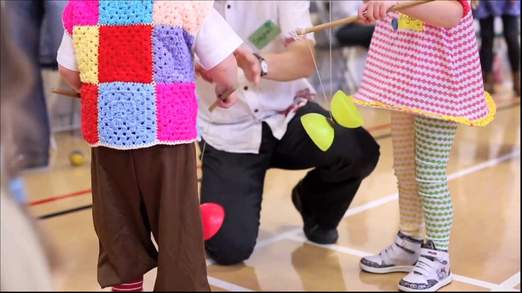
They get to meet children at play while the youngsters enjoy face, painting, climbing and other activities.

The children’s foster parents or social workers attend the event to support them.

It is part of a scheme to help speed up the process and find adoptive parents for those children who may be more difficult to place.

More than 6,000 children are going through the adoption process with only 1,800 prospective parents approved and waiting for a child.

Parenting Games: 3 Ways to Build More Cooperation

Sometimes parenting just seems like a game…that you can never win.

The other team has more energy, more time, and more players. To help parents improve the odds, we’ve come up with some new “game plans" that might even the score. 

Follow the Leader is a parenting tool that can be used in two ways:

 As a game; and as a “redirection" tool. When using this tool as a game, parents can invite their children to play “follow the leader.“ This game is fun on family trips or vacations. Families with more than one child can have each child take turns leading the family hike or singing a song. The leader has the power to choose which forest path to take or which song to sing. Each child (and parent) gets the opportunity to be the leader, thereby encouraging equality and fairness. When used as a “redirection” tool controlling children can be direct their need to take charge of a particular task, such as getting the family together for dinner or organizing a wood gathering party for the campfire. This is a great game to replace power-struggling.

Freeze Play is a parenting tool variation of the old stand-by: Time-Out

Time-out is usually conducted by isolating or excluding a child from the rest of the family or classroom. In this traditional form children are sent to their room, a chair in the kitchen, outside the classroom door, or left facing a wall. Time-Out has a number of disadvantages, the primary one being that it involves the use of punishment that may seem harsh to some parents and children. Some children may become out-of-control or physically destructive when put in isolation or exclusion time-out. Fortunately, parents can use a different form of time-out, that behaviorists call “nonexclusionary time-out.“

Nonexclusionary time-out, like isolation and exclusionary time-out, eliminates reinforces (interaction with others). It accomplishes this by freezing the moment of interaction with the child for a very brief, but poignant amount of time. For example, if a child starts whining when told they must wait for dinner to eat, the parent can firmly but evenly, say, “freeze!” The parent then avoids eye contact (i.e., attention during the discipline) for a few seconds and the child is prohibited from communicating during this time. Afterwards the parent can nonchalantly carry on the task at hand or use Time-In or educational parenting tool. Be careful not to place too much emphasis on talking about the misbehavior afterwards as it might inadvertently reinforce the child to misbehave again for the attention it gains.

It might be necessary for the parent to tell the child what is going to happen during “freeze play" and the expectation that there will be no communication/eye contact during that time, so that the child knows why the parent is “acting this way.“ In addition, the old rule of thumb for time-out, one minute for every year of life, can be used in Freeze Play by substituting seconds for minutes (e.g., one frozen second for every year of life.) 

Huddling is a parenting tool shorten version of a family meeting without all the fuss or preparation time.

Huddling is a quick, informal, type of family meeting that any number of family members can have together and can occur at any time or place. Football players do this before every play to make sure the team knows what the plan is and to make clear everyone’s job. Family members can stop whatever they are doing to have a quick, little meeting about a specific problem or task. Parents can play the captain by telling the family to “huddle together.” Put arms around one another for support or just gather together in a circle, face in. Talk about the problem or task and assign jobs or ask for quick input. Decide on a plan of action and say “let’ go!“ Parents can use this tool at the zoo to decide what they are going to go see first, at the restaurant to decide what everyone wants to eat, and at home to decide what toys need to be gathered up before going to the park. While these “game plans” don’t guarantee a winning season, they can coach parents on new ways to improve their performance and their satisfaction in parenting.

OK, let’s play!


Share your thoughts on these three power parenting tools by leaving a comment here or on our Facebook page at http://www.facebook.com/parentingtoolbox


You can get more quick tips to change your family dynamics and have the family you dreamed about by contacting Ron now! Click here for more information.

The 101 on Fidgets:

I think of a fidget as any small item or toy that helps keep one’s hands busy and helps them focus while completing an activity. Almost anything can be a sensory fidget. Even basic household items or small party favor toys can make great fidgets. You can make your own fidgets, or buy them from catalogs, online or even in local stores such as Target, a party store, a craft store, or the dollar store.

A Toy or a Tool?
I have found fidgets to be a very helpful tool for me for many years. When I was much younger, I was taught that fidgets were to be used as a tool, and not like a toy. A tool is something that can help one focus, while a toy can distract both the individual playing with the fidget and others around them. This can be a hard thing for an individual to understand as some of the best fidgets that I have found are indeed toys, but they make great tools.

Let Ron Huxley help your child succeed at home and school. Click the Get Parenting Answers in the nav bar.

Dream Parenting: The Natural Ally

At times parenting can be met with rejection by family members. Some of this can be developmental as a child has drives for independence. Some of it can be a self-protection from intimacy. If I don’t get close to you, then I don’t get hurt. Attempts to parent differently and achieve the family of your dreams requires significant risk in these situations.

You biggest ally is already inherent in you and your family members. It is a biologically-based need for attachment. We are social beings and as such, want to connect with one another even it doesn’t appear on the surface to be true. 

If there has been problems in your closest relationships it may mean that patterns of rejection and defenses of self-sufficiency have been created. These are tough walls to knock down. Start off by believing that you have a primal need to connect as you ally in this new strategy. Find ways to make eye contact and smile without using any words. Look for chances to connect with no words of judgement, correction, or instruction. Just make a connection no matter how small or brief. Make it a personal challenge to increase these moments everyday until you start to see the walls starting to crumble. 

Remember that your family wants this naturally. It was how they are designed. If they don’t get it from you, they will seek it elsewhere but they will find it, good or bad. Make it good starting right now. 

Incarceration Tips – How do you help a child whose parents are incarcerated. Here’s some parenting tools for Sesame Street:

Tips for Coping with Incarceration

#1

In the morning, let your child know some of the things that will happen throughout the day. For example, “Grandma will pick you up from school. Then you’ll go to the park, and later we’ll all have dinner together.”

#2

Give your child a paper heart to keep in her pocket. You might say, “This is to remind you that I love you and will always be there for you.”

#3

Take time each day to check in with your child and ask, “How are you feeling?” Remember to let your child know that it’s okay to have big feelings no matter what they are.

#4

When explaining where an incarcerated parent is, you can say, “Daddy is in a place called prison (or jail) for a while. Grown-ups sometimes go to prison when they break a rule called a law.”

#5

Phone calls are a great way to reach out. Help your child to think of something she’d like to tell her incarcerated parent, and give her a photo of her parent to hold during the call.

#6

Before you visit your incarcerated loved one, let your child know some of the things she can expect to happen. For instance, “We won’t be able to sit in the same room with Mommy, but we can see her through a window and read a story together.”

#7

Caring for yourself helps you care for your child. At least once a day, do something that you enjoy or find relaxing.

Incarceration Tips – How do you help a child whose parents are incarcerated. Here’s some parenting tools for Sesame Street:

neuromorphogenesis:

Breakthrough study reveals biological basis for sensory processing disorders in kids

Sensory processing disorders (SPD) are more prevalent in children than autism and as common as attention deficit hyperactivity disorder, yet it receives far less attention partly because it’s never been recognized as a distinct disease.

In a groundbreaking new study from UC San Francisco, researchers have found that children affected with SPD have quantifiable differences in brain structure, for the first time showing a biological basis for the disease that sets it apart from other neurodevelopmental disorders.

One of the reasons SPD has been overlooked until now is that it often occurs in children who also have ADHD or autism, and the disorders have not been listed in the Diagnostic and Statistical Manual used by psychiatrists and psychologists.

“Until now, SPD hasn’t had a known biological underpinning,” said senior author Pratik Mukherjee, MD, PhD, a professor of radiology and biomedical imaging and bioengineering at UCSF. “Our findings point the way to establishing a biological basis for the disease that can be easily measured and used as a diagnostic tool,” Mukherjee said.

The work is published in the open access online journal NeuroImage:Clinical.

‘Out of Sync’ Kids

Sensory processing disorders affect 5 to 16 percent of school-aged children.

Children with SPD struggle with how to process stimulation, which can cause a wide range of symptoms including hypersensitivity to sound, sight and touch, poor fine motor skills and easy distractibility. Some SPD children cannot tolerate the sound of a vacuum, while others can’t hold a pencil or struggle with social interaction. Furthermore, a sound that one day is an irritant can the next day be sought out.  The disease can be baffling for parents and has been a source of much controversy for clinicians, according to the researchers.

“Most people don’t know how to support these kids because they don’t fall into a traditional clinical group,” said Elysa Marco, MD, who led the study along with postdoctoral fellow Julia Owen, PhD. Marco is a cognitive and behavioral child neurologist at UCSF Benioff Children’s Hospital, ranked among the nation’s best and one of California’s top-ranked centers for neurology and other specialties, according to the 2013-2014 U.S. News & World Report Best Children’s Hospitals survey.

“Sometimes they are called the ‘out of sync’ kids. Their language is good, but they seem to have trouble with just about everything else, especially emotional regulation and distraction. In the real world, they’re just less able to process information efficiently, and they get left out and bullied,” said Marco, who treats affected children in her cognitive and behavioral neurology clinic.

“If we can better understand these kids who are falling through the cracks, we will not only help a whole lot of families, but we will better understand sensory processing in general. This work is laying the foundation for expanding our research and clinical evaluation of children with a wide range of neurodevelopmental challenges – stretching beyond autism and ADHD,” she said.

Imaging the Brain’s White Matter

In the study, researchers used an advanced form of MRI called diffusion tensor imaging (DTI), which measures the microscopic movement of water molecules within the brain in order to give information about the brain’s white matter tracts. DTI shows the direction of the white matter fibers and the integrity of the white matter. The brain’s white matter is essential for perceiving, thinking and learning.

The study examined 16 boys, between the ages of eight and 11, with SPD but without a diagnosis of autism or prematurity, and compared the results with 24 typically developing boys who were matched for age, gender, right- or left-handedness and IQ. The patients’ and control subjects’ behaviors were first characterized using a parent report measure of sensory behavior called the Sensory Profile. 

The imaging detected abnormal white matter tracts in the SPD subjects, primarily involving areas in the back of the brain, that serve as connections for the auditory, visual and somatosensory (tactile) systems involved in sensory processing, including their connections between the left and right halves of the brain. 

“These are tracts that are emblematic of someone with problems with sensory processing,” said Mukherjee. “More frontal anterior white matter tracts are typically involved in children with only ADHD or autistic spectrum disorders. The abnormalities we found are focused in a different region of the brain, indicating SPD may be neuroanatomically distinct.” 

The researchers found a strong correlation between the micro-structural abnormalities in the white matter of the posterior cerebral tracts focused on sensory processing and the auditory, multisensory and inattention scores reported by parents in the Sensory Profile. The strongest correlation was for auditory processing, with other correlations observed for multi-sensory integration, vision, tactile and inattention.

The abnormal microstructure of sensory white matter tracts shown by DTI in kids with SPD likely alters the timing of sensory transmission so that processing of sensory stimuli and integrating information across multiple senses becomes difficult or impossible.

“We are just at the beginning, because people didn’t believe this existed,” said Marco. “This is absolutely the first structural imaging comparison of kids with research diagnosed sensory processing disorder and typically developing kids. It shows it is a brain-based disorder and gives us a way to evaluate them in clinic.”

Future studies need to be done, she said, to research the many children affected by sensory processing differences who have a known genetic disorder or brain injury related to prematurity.

Image1: These brain images, taken with DTI, show water diffusion within the white matter of children with sensory processing disorders.  Row FA: The blue areas show white matter where water diffusion was less directional than in typical children, indicating impaired white matter microstructure.  Row MD: The red areas show white matter where the overall rate of water diffusion was higher than in typical children, also indicating abnormal white matter.  Row RD: The red areas show white matter where SPD children have higher rates of water diffusion perpendicular to the axonal fibers, indicating a loss of integrity of the fiber bundles comprising the white matter tracts.

regular bedtimes are important for both boys and girls and the earlier these can be implemented, the better for cognitive performance. The suggestion is that irregular sleeping patterns adversely affect development and these may cause permanent damage:

“Sleep is crucial for the maintenance of homeostasis and brain plasticity, including processes to do with embedding new knowledge, memory and skills into developing neural assemblies”

Read more…

Dream Parenting: Winning the Battle

You don’t have to win every battle with your child. You don’t have to be a perfect parent. Some days are going to be sweet one’s, with lots of cuddling, peaceful interactions and other days are going to be more chaotic and bumpy. It is important that parents learn how to ride these ups and downs and now that they are still headed in the right direction. if today was a bad day, than you get to have another day. Make tomorrow different. If tomorrow is bad too, look forward to the day after than and so on…

You were there to write the first chapter of your child’s life and you get to help write the next one until the day they start writing their own chapters. You are never totally powerless and no mistake cannot be forgiven and un-reconciled. It make take a while but time really is on your side and it can heal the most grievous hurts. Use this to your parenting advantage. 

Action Parenting Tool: Don’t focus on today’s problem. Visualize how you want tomorrow to look and start working toward it. Be OK with small adjustments until you achieve the family you dreamed about.